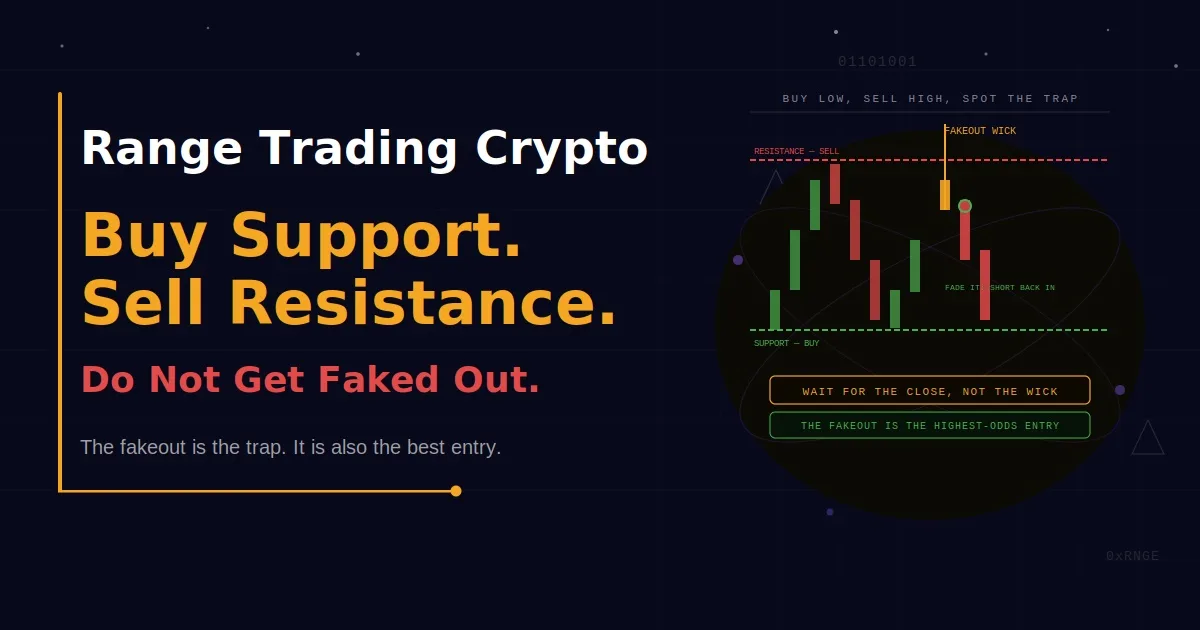
A complete range trading crypto guide. Learn to buy support and sell resistance, avoid the fakeouts and know exactly when a range has ended.

A complete trend following crypto guide. Learn the exact entry methods, exit rules, and filters that keep you in strong trends.
A mean reversion strategy wins often but fails hard in trends. Learn the exact RSI, Bollinger Band, and ADX rules that define when it works.
All information on this site is provided by Mubite for educational purposes only, specifically related to financial market trading. It is not intended as an investment recommendation, business advice, investment opportunity analysis, or any form of general guidance on trading investment instruments. Trading in financial markets involves significant risk, and you should not invest more than you can afford to lose. Mubite does not offer any investment services as defined under the Capital Market Undertakings Act No. 256/2004 Coll. The content on this site is not directed toward residents in any country or jurisdiction where such information or use would violate local laws or regulations. Mubite is not a brokerage and does not accept deposits. All trading accounts provided by Mubite are simulated demo accounts using live market data. No client funds are traded on live markets. Payout figures shown are individual results and are not typical. Past performance does not guarantee future results.
Mubite s.r.o., Školská 660/3, Nové Město, ICO: 23221551 Praha 1, 110 00, Czech Republic | Copyright Ⓒ 2026 Mubite. All Rights Reserved.
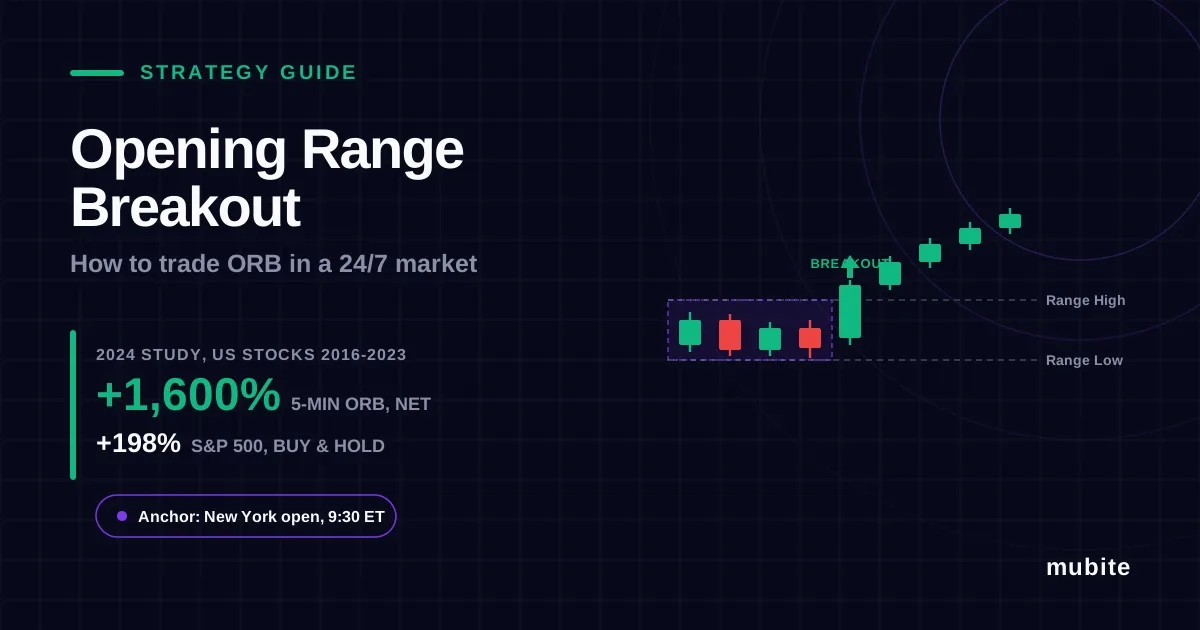
Does opening range breakout work in a market that never closes? How the ORB trading strategy works, what the research shows, and how to set it up for crypto.
The opening range breakout is one of the oldest day trading setups. You mark the high and low of the first minutes after the open, then trade the break. Simple rules, clear risk, and strong published research. The catch for crypto traders: Bitcoin has no opening bell. Here is how the ORB strategy works, what the data shows, and how to adapt it to a 24/7 market.
| What it is | mark the high and low of the first 5, 15, or 30 minutes of a session, then trade the candle close outside that range |
|---|---|
| Does it work | in US stocks, yes. A 2024 study found a 5 minute ORB on high volume stocks returned over 1,600% net from 2016 to 2023, against 198% for the S&P 500 |
| In crypto | there is no official open, so anchor the range to a session with a real volume spike, usually the New York open at 9:30 ET |
| Stop and target | stop at the midpoint, the opposite side of the range, or VWAP. Target 1:1 to 1:2 risk to reward, or the previous day's high or low |
| Fakeout filters: | volume, VWAP, higher timeframe trend, and a one-and-done rule per session |
ORB stands for opening range breakout. The opening range is the price range a market sets in a fixed window after the session opens. Those first minutes absorb overnight news and initial order flow, so a breakout with volume often shows the direction for the rest of the day.
Toby Crabel formalised the concept in his 1990 book on short term price patterns, and it has been a staple for futures and stock traders since. ORB is a specific type of breakout trade. For the broader framework, see our guide to breakout crypto trading rules.
The ORB trading strategy comes down to four steps:
Define the time window. Pick the opening period, most commonly 5, 15, or 30 minutes after the session open.
Mark the key levels. Draw the Range High (highest price in the window) and Range Low (lowest price). The midpoint between them is your third reference level.
Enter on the breakout
Long: when a candle closes above the Range High,
Short: when a candle closes below the Range Low.
Set the stop loss and target
Stop loss: the midpoint of the range, the opposite side of the range, or the VWAP (Volume Weighted Average Price),
Profit target: a multiple of your risk such as 1:1 or 1:2, a Fibonacci extension of the range, or the previous day's high or low.
Two rules complete the system. Close the trade if it has not reached target within a few hours, because ORB momentum fades as the session matures. And cap yourself at one long and one short per session.
3 vs 15 Minute Opening Range
A 5 minute range gives earlier entries and tighter stops, but in crypto it catches more noise. A 15 minute range filters the first burst of volatility and gives a more reliable level, so it is the better starting point for crypto. A 30 minute range suits traders who want fewer signals. Our guide to the best time frame for crypto trading covers the trade offs.
The retest version waits for price to come back to the broken level and hold it. A Range High that turns into support confirms the breakout and gives a better entry with a tighter stop, though you will miss moves that never look back. If price falls back inside the range and stays there, the session may turn into a range day, where a range trading approach fits better.
The strongest evidence comes from A Profitable Day Trading Strategy for the U.S. Equity Market, a 2024 paper by Carlo Zarattini, Andrea Barbon, and Andrew Aziz. They tested a 5 minute opening range breakout on more than 7,000 US stocks between 2016 and 2023.
The strategy only worked well on "Stocks in Play", names with unusually high relative volume that day. Trading the top 20 of those each session, ORB returned over 1,600% net of commissions, with a Sharpe ratio of 2.81 and 36% annualised alpha. Buying and holding the S&P 500 returned 198% over the same period.
Volume is the edge, not the range. The same rules applied to every stock performed far worse.
There is no fixed win rate. Most ORB systems win less than half their trades and make money through larger winners, so your risk to reward has to be planned before entry.
There is no peer reviewed study of ORB on crypto. Treat the stock research as proof the concept can work, not a promise it works on Bitcoin. Backtest at least 100 sessions on your pair before trading it with real risk.
It can, as long as you anchor the range where volume actually changes. Crypto trades 24/7, but liquidity is not flat. It spikes when traditional markets open. Those spikes are your "open".
| Session anchor | Time | Why it works |
|---|---|---|
| New York open | 9:30 ET | US equities open, ETF flows start, highest volume window of the day for BTC |
| London open | 08:00 UK time | European desks come online, often sets the early direction |
| Daily candle open | 00:00 UTC | The reset point for daily charts and many drawdown calculations |
Pick one and stick to it. The New York open is the strongest starting point for Bitcoin and Ethereum. Skip weekends, when thinner ranges produce more failed breakouts.
Tip from the author: Before risking anything, backtest by hand. Mark the opening range on the last 50 New York opens of your pair and log each session as a clean breakout, a fakeout, or no trade. If fakeouts outnumber clean breaks, tighten your volume filter first. Changing the stop or target rarely fixes a strategy that is entering on weak breakouts.
Breakouts right at the start of a session are often fakeouts. Most ORB losses come from breakouts with no real fuel behind them, and these filters remove a large share of them:
Volume: a real breakout comes with a clear jump in volume, roughly 2x the average of the range candles. A breakout on falling volume is a warning.
VWAP: trade in the direction of price relative to VWAP. Longs only above VWAP, shorts only below. In crypto, anchor VWAP to the start of your session.
Higher timeframe trend: check the 1 hour or daily chart and avoid trading against a strong trend.
One-and-done: if the first breakout fails and reverses, do not take the same setup again. Done for the day.
News and liquidations: CPI or FOMC releases can blow through any range, so know the calendar and read our guide to news trading at prop firms. Leveraged positions clustered beyond the range can also turn a break into a fast wick and reversal, as our breakdown of crypto liquidations explains.
ORB fits prop firm rules well because your stop, size, and maximum trades per session are defined before entry.
Size from the stop. Calculate position size from the distance between entry and stop, not from leverage. Our guide to position sizing for prop traders walks through the maths
Respect the daily limit. At Mubite, the daily drawdown is 5%, calculated from equity at 00:00 UTC, and floating losses count. Risking 0.5 to 1% per ORB trade keeps two failed sessions well inside it
Know the hard cap. Maximum risk per trade is 3%. ORB never needs anywhere near that. Drawdown explained covers how daily and maximum limits differ
The best way to see whether ORB works for you is to test it without paying for it. The Mubite free trial lets you run your ORB rules on live market data across a few weeks of sessions before you commit to a challenge.
It can, if you anchor the range to a session with a real volume spike, most reliably the New York open at 9:30 ET. Backtest at least 100 sessions first.
For crypto, a 15 minute opening range is the best starting point. It filters early noise better than 5 minutes and still leaves most of the session to trade.
There is no fixed win rate. Most ORB systems win less than half their trades and stay profitable through a risk to reward of 1:1.5 or higher. Your own backtest is the only number worth trusting.
Share it with your community