All information on this site is provided by Mubite for educational purposes only, specifically related to financial market trading. It is not intended as an investment recommendation, business advice, investment opportunity analysis, or any form of general guidance on trading investment instruments. Trading in financial markets involves significant risk, and you should not invest more than you can afford to lose. Mubite does not offer any investment services as defined under the Capital Market Undertakings Act No. 256/2004 Coll. The content on this site is not directed toward residents in any country or jurisdiction where such information or use would violate local laws or regulations. Mubite is not a brokerage and does not accept deposits.
Mubite s.r.o., Skolska 660/3, ICO: 23221551 Prague 1, 110 00, Czech Republic | Copyright Ⓒ 2025 Mubite. All Rights Reserved.

The best time frame for crypto trading is the one that matches your holding period, your risk tolerance, and your execution reality. Most traders struggle because they pick a time frame based on vibes, then trade it with the wrong expectations. That is how you get chopped up on low time frames or bored into bad decisions on higher ones.
This guide gives you a practical way to choose between scalping, day trading, and swing trading. It also connects time frame choice to costs like slippage in crypto and maker vs taker fees. Those details matter more than most “optimal timeframe” posts admit.
If you are building a repeatable process, start from the funded crypto trading mindset. You want consistency first, then speed.
A time frame is the chart interval you use to make decisions. It can be 1 minute, 15 minutes, 1 hour, 4 hours, or daily. The key point is simple. Your chart time frame should match how long you expect to hold the trade.
There is also a second layer that good traders separate. There is the analysis time frame and the execution time frame. You can define trend on a higher chart, then execute on a lower chart. Investopedia describes this multi time frame approach as a way to keep the bigger trend in view while refining entries and exits.
This matters because crypto is noisy. The lower you go, the more random movement you see. If you choose a very low chart, you need tighter rules and better execution. If you choose a higher chart, you need patience and wider risk limits.

You do not need a complicated model. You need a few honest inputs. This short checklist helps you choose the right lane before you open a chart. Here are the inputs that actually decide the best time frame for crypto trading.
How much screen time you have each day
How long you can hold without second guessing
How sensitive your strategy is to fees and slippage
How wide your stops must be to survive noise
How often you want to trade, and why
After you answer these, you can pick a primary style. Then you build the chart stack around it.
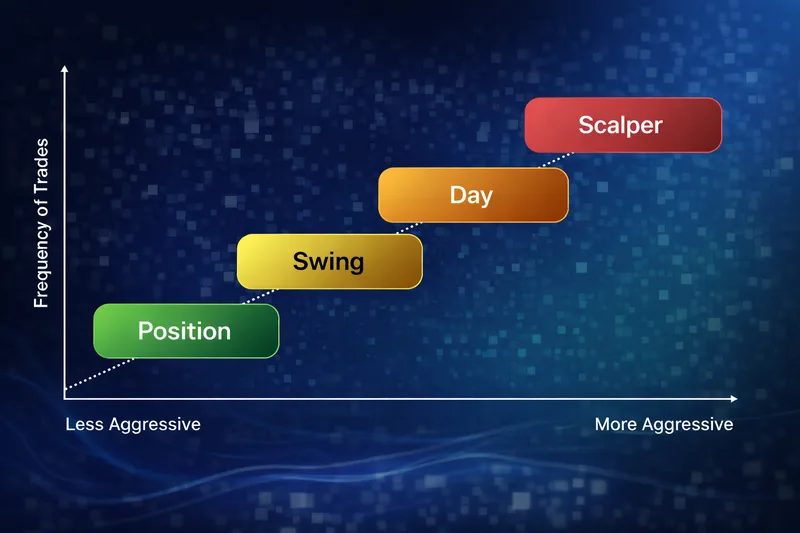
Scalping and short term crypto trading usually live on very low charts like M1 to M5, sometimes M15. The appeal is obvious. You get more setups and faster feedback. The tradeoff is also obvious. You pay more in spread, slippage, and fees because you trade more often and you demand immediacy.
This is where maker fees vs taker fees can decide whether your edge survives. If your average win is small, execution costs are not a detail. They are the strategy. This is also where slippage can turn a “clean” stop into a larger loss during fast moves.
If you want to scalp, you need structure. You need a clear session plan, a fixed risk per trade, and strict limits on overtrading. You also need to accept that not every market regime supports scalping. Low volatility chop can be brutal on M1.
Day trading usually lives on M15, H1, and sometimes M5 for entries. The goal is to capture intraday movement without holding overnight. This style can be a sweet spot for many traders because it reduces noise compared to pure scalping, but it still offers frequent opportunities.
A practical way to build day trading charts is top down. Use H4 or H1 for structure, then execute on M15 or M5. This keeps you aligned with the larger move, but still gives you workable entries. The big mistake is starting on M1 and trying to “figure it out” as you go.
From an EEAT standpoint, it is also worth stating the risk clearly. Investor.gov warns that day trading is extremely risky and can lead to substantial losses in a short period of time. The point is not to scare you. The point is to treat day trading like a discipline, not a hobby.
Swing trading crypto usually lives on H4, daily, and sometimes weekly for context. Trades often last from a few days to a few weeks. This style is about catching a meaningful move with fewer decisions. It also reduces the emotional tax of constant monitoring.
Swing trading usually allows wider stops and larger targets. That changes everything. You trade less often, so fees matter less per week, but execution still matters in moments like entries after a breakout and exits during a sharp reversal. You also must plan for overnight risk and weekend volatility, because crypto never closes.
If your goal is consistency, swing trading is often the most forgiving style for intermediate traders. It gives signals more time to play out. It also reduces the chance you self sabotage by clicking too much.
BTC short term trading often feels cleaner than many alt pairs. Liquidity tends to be deeper, and spreads can be tighter. That can reduce friction on entries and exits. Still, Bitcoin can move fast in event driven moments, and slippage can spike when volatility hits.
If you trade BTC short term, your time frame choice should still follow your holding plan. Many traders mix time frames because Bitcoin “looks tradeable” on everything. The discipline is choosing one lane and building rules that match it.
Time frame and timing are related, but they are not the same. A time frame is your chart interval. Timing is when you place trades.
Crypto is 24/7, but liquidity is not equal all day. Liquidity tends to be stronger during high activity windows and weaker during thin hours. This is basic market structure. More participation usually means tighter spreads and more stable fills. CME Group explains the link between liquidity and immediacy, including why tighter bid offer conditions matter for reasonable execution.
A practical approach is to pair your time frame with your liquidity window. Scalpers often benefit most from high activity periods because they rely on clean fills. Swing traders can be more flexible, but they still want to avoid placing large orders during thin conditions.
Most traders do not fail because they chose the “wrong” time frame. They fail because they trade a time frame with rules that do not fit it. This shows up in predictable ways. Here are the mistakes that ruin performance.
Trading M1 with swing trader patience, or D1 with scalper impatience
Using stops that are too tight for the chart’s noise level
Overtrading because the chart prints constant signals
Ignoring fees and slippage on low time frames
Switching time frames after a loss instead of fixing the process
If you want a simple fix, pick one primary style for 30 days. Keep your execution rules stable. Then review your results with honesty. If you are trading under constraints, the prop trading context matters because rules punish inconsistency. Many traders also benefit from knowing their challenge rules before choosing a style.
The best time frame for crypto trading is the one you can execute with discipline. Scalping rewards precision and speed, but costs are higher. Day trading balances frequency and clarity, but still demands structure. Swing trading reduces noise and decision load, but requires patience and wider risk planning.
Choose a holding period you can actually stick with. Then pick a chart that supports it. If you do that, your strategy gets simpler, your execution improves, and your results become easier to measure.
For many intermediate traders, the best time frame for crypto trading is one that reduces noise but still offers opportunity. That often means using H1 or H4 for structure and M15 for entries if you day trade, or using H4 and daily if you swing trade. The right answer depends on your schedule and your ability to follow rules. If you cannot watch markets all day, scalping is usually a poor fit. If you want fewer decisions and clearer signals, swing time frames are often more stable.
Short term crypto trading is not “better” by default. It is faster and more demanding. It usually has higher execution friction because you trade more often. Swing trading crypto is slower and often cleaner, but you must tolerate holding through larger swings and overnight risk. If your edge relies on speed and you have strong execution, short term can work. If your edge relies on structure and patience, swing trading often fits better. The real goal is alignment. Your time frame must match your temperament and your risk model.
BTC short term trading can work across several time frames because Bitcoin is usually more liquid than many alt pairs. Still, you should choose based on how long you plan to hold. If you are holding minutes, M1 to M5 can be relevant, but costs and noise are higher. If you are holding hours, M15 to H1 often provides a clearer structure. Many traders do best when they define trend on H1 or H4, then execute on a lower chart with strict risk rules. The key is consistency, not switching time frames mid trade.
Share it with your community