All information on this site is provided by Mubite for educational purposes only, specifically related to financial market trading. It is not intended as an investment recommendation, business advice, investment opportunity analysis, or any form of general guidance on trading investment instruments. Trading in financial markets involves significant risk, and you should not invest more than you can afford to lose. Mubite does not offer any investment services as defined under the Capital Market Undertakings Act No. 256/2004 Coll. The content on this site is not directed toward residents in any country or jurisdiction where such information or use would violate local laws or regulations. Mubite is not a brokerage and does not accept deposits.
Mubite s.r.o., Skolska 660/3, ICO: 23221551 Prague 1, 110 00, Czech Republic | Copyright Ⓒ 2025 Mubite. All Rights Reserved.

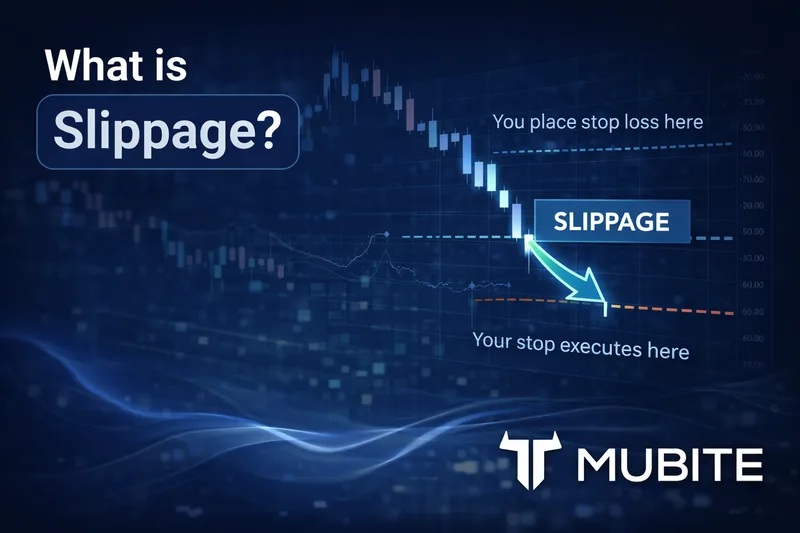
Slippage in crypto is the gap between the price you expect and the price you actually get. It happens when the market moves during execution or when there isn’t enough liquidity at your price – so your order fills worse than planned. You hit buy at one price, but the top of the order book is thin – so your fill averages higher as your order walks through multiple levels.
Crypto markets move fast and order books can change in milliseconds. Your chart can show clean candles but your fills look different.
Slippage crypto is not the same as trading fees, fees are known before you click. Slippage is not always known.

Slippage is mostly a liquidity problem. Your order fills against the order book. If the top level has limited size, your fill moves. It moves through several price levels. This is common when you trade large size. It is also common on smaller pairs. It is also common during fast moves.
This is where liquidity providers matter. A crypto liquidity provider helps keep books deeper. Market makers often play this role. Deeper books usually reduce slippage and spread. When liquidity pulls back, fills get worse. You feel it most on market orders and stops.
Slippage is not random, it spikes when volatility rises and liquidity falls. News moves are a clear example and breakouts are another. Liquidation cascades are also common triggers. In these moments, the book can thin out fast.
Many traders search for the best time to trade crypto. There is no single hour that works for every coin. Still, there is a clear pattern. Slippage tends to be lower during high volume windows. Slippage tends to be worse in thin hours and spreads widen and depth disappears. You also see more gaps around sudden events. Here are the main slippage triggers:
High volatility events and fast news moves
Low liquidity pairs and wide spreads
Large orders compared to book depth
Stops triggering during sharp drops
These triggers show up more often than people expect. They also show up when traders feel rushed. That is why execution rules matter. Rules protect you from your own urgency.
You cannot remove slippage completely. You can control how often it hurts you. You can also control how large it becomes. The biggest lever is order choice. Limit orders can cap the worst price you accept. They can also miss the trade. Market orders usually fill, but price can slip.
Some platforms offer tools that limit execution damage. Stop limits can cap exits, but they can fail to fill. That is a tradeoff. Some venues offer slippage controls on certain order types. Use these tools if they fit your strategy. Do not assume they solve everything.
A crypto trading api can also help, but only as a light mention. An API can enforce discipline. It can split orders. It can apply limit logic. It can stop you from panic clicking. It will not create liquidity. It will not remove volatility. It can still improve consistency. Here are practical ways to reduce slippage.
Use limit orders in normal conditions
Split large orders into smaller parts
Trade deeper pairs when possible
Avoid thin hours when you can
Use protective order settings if available
After you apply these, measure results. Track slippage per trade. Track slippage on exits too. That is often where damage happens. You will then know what to change.
Slippage becomes more dangerous under evaluation rules. The reason is simple. Your planned risk can change at execution. A stop price is not always a stop fill. In fast markets, price can gap, In funded trading, that extra fill distance can turn a normal stop into a drawdown breach – even if your setup was correct.
This is a hidden risk against drawdown limits and it also affects daily loss thresholds. A strategy can look fine in backtests. This is common on high volatility days and also common when traders use high leverage.
Highest leverage crypto trading makes this sharper and your margin for error smaller. A small slippage event can move your P and L fast. It can also push you close to liquidation.
Slippage is part of real cryptocurrency execution – it’s the price you pay for trading in fast markets where liquidity shifts by the second. It tends to spike when volatility rises and the order book thins out, especially around news, breakouts, and liquidation cascades. The best traders don’t complain about slippage; they plan for it.
They choose order types with intent, size for real fills instead of perfect chart prices, and avoid thin conditions when they can. And in prop or funded trading, this matters even more: slippage can turn a well-managed trade into a rule breach if execution gets ugly at the wrong moment.
What does slippage mean in crypto? It means your order filled at a different price than expected. This happens because prices move quickly and order books change fast. Slippage is most common on market orders and stops. It is also common when you trade large size. It can be positive or negative. Negative slippage is more common in fast moves.
What is slippage in crypto trading? It is the gap between your intended price and your filled price. It is not always bad. You can get a better fill sometimes. That is positive slippage. Most traders worry about negative slippage. That happens more in volatility and thin liquidity. The goal is not perfect fills. The goal is predictable fills. You want slippage to be small and rare.
Start with order types. Use limit orders when you can wait for a fill. Use market orders only when certainty matters more than price. Keep size reasonable for the book. Split orders when size is large. Prefer deeper pairs when possible. Avoid thin hours when you can. Watch event risk windows. If your platform supports it, use protective order settings.
Share it with your community