
A complete trend following crypto guide. Learn the exact entry methods, exit rules, and filters that keep you in strong trends.
A mean reversion strategy wins often but fails hard in trends. Learn the exact RSI, Bollinger Band, and ADX rules that define when it works.
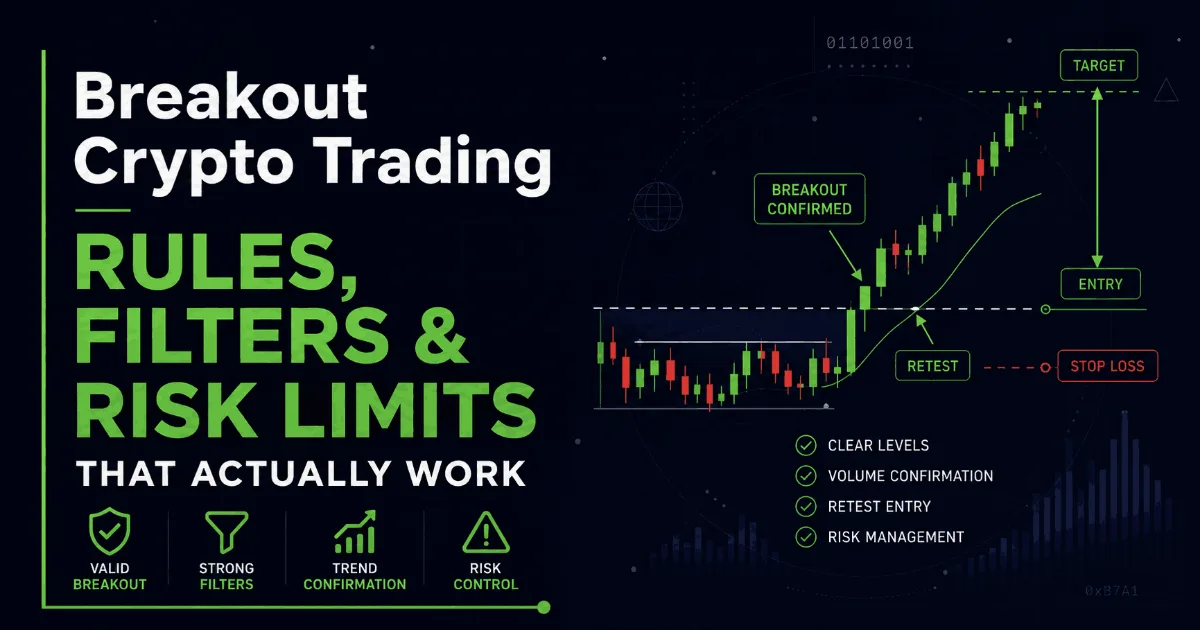
A breakout crypto strategy is only as good as its filters. Learn the exact rules for a valid entry, how to spot false breakouts, and how to size risk.
All information on this site is provided by Mubite for educational purposes only, specifically related to financial market trading. It is not intended as an investment recommendation, business advice, investment opportunity analysis, or any form of general guidance on trading investment instruments. Trading in financial markets involves significant risk, and you should not invest more than you can afford to lose. Mubite does not offer any investment services as defined under the Capital Market Undertakings Act No. 256/2004 Coll. The content on this site is not directed toward residents in any country or jurisdiction where such information or use would violate local laws or regulations. Mubite is not a brokerage and does not accept deposits. All trading accounts provided by Mubite are simulated demo accounts using live market data. No client funds are traded on live markets. Payout figures shown are individual results and are not typical. Past performance does not guarantee future results.
Mubite s.r.o., Školská 660/3, Nové Město, ICO: 23221551 Praha 1, 110 00, Czech Republic | Copyright Ⓒ 2026 Mubite. All Rights Reserved.
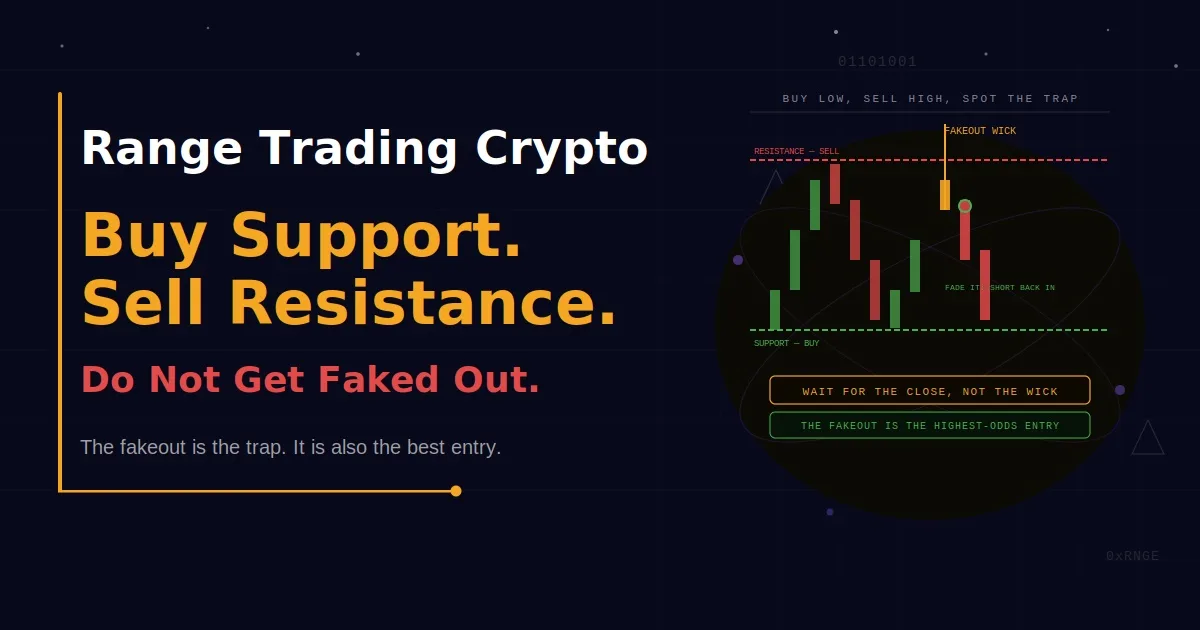
A complete range trading crypto guide. Learn to buy support and sell resistance, avoid the fakeouts and know exactly when a range has ended.
Crypto spends more time moving sideways than trending. Price gets stuck between a ceiling and a floor, chopping back and forth for days or weeks. Most traders hate these conditions. Range traders profit from them.
Range trading is simple in concept: buy near the bottom of the range, sell near the top, repeat until the range breaks. The catch is the fakeout, the false breakout that pokes past the boundary, triggers your stop, then snaps back into the range. Getting faked out is the single biggest reason range traders lose money. This guide covers the strategy and, more importantly, how to avoid the traps.
Range trading buys near support and sells near resistance in sideways markets
It works when price oscillates between clear horizontal boundaries with no trend
The main risk is the fakeout, a false breakout that traps you before reversing
Wait for a candle close beyond the boundary, not just a wick, before believing a breakout
A fast reversal on a big wick and low volume is a fakeout, and often a high-probability entry
Keep leverage low and always stop just beyond the range, never inside it
Range trading is a strategy that profits from price oscillating between a fixed upper and lower boundary, rather than from a directional trend. You are not betting on where the market goes next. You are betting that it keeps doing what it is already doing: bouncing between support and resistance.
A range forms when buying and selling pressure are roughly balanced. Price hits a ceiling, called resistance, where sellers step in, then falls to a floor, called support, where buyers step in. With no catalyst to break the balance, price bounces between the two. In crypto, these consolidation periods happen constantly, especially after a large move when the market pauses to digest.
Range trading is closely related to a mean reversion strategy. The difference is what defines the extreme: mean reversion uses statistical measures like Bollinger Bands and RSI, while range trading uses horizontal support and resistance structure you can draw on the chart. Both profit from price returning to the middle rather than trending away.
Before trading a range, you need to confirm one actually exists. A valid range has specific characteristics.
Multiple touches of both boundaries. Price should have tested support and resistance at least two or three times each. A single touch is not a level, it is a guess
Horizontal, not sloping. The boundaries should be roughly flat. A sloping range is closer to a trend and behaves differently
No clear trend. On the higher timeframe, price should be moving sideways, not making consistent higher highs or lower lows
Contained volatility. A stable range shows contracting or steady ATR. If ATR is expanding sharply, the range is likely about to break
Higher timeframes produce cleaner ranges. The 1-hour and 4-hour charts filter out the noise that makes lower timeframes deceptive. Half the apparent ranges on a 5-minute chart are just noise that will not hold.
The core mechanic is straightforward, but the details separate profitable range traders from trapped ones.
Buy near support. As price falls toward the lower boundary, look for a bullish rejection candle, a hammer or a wick that closes back up, showing buyers defending the level. Enter the long slightly inside the range, not exactly at the line
Sell near resistance. As price rises toward the upper boundary, look for a bearish rejection candle showing sellers stepping in. Enter the short slightly inside the range
Confirm with volume and oscillators. RSI oversold near support or overbought near resistance adds confirmation. Volume concentration at the edges confirms the level is being defended
Target the opposite boundary or the midline. Take partial profit at the range midline and full profit near the opposite edge
The key discipline is entering with confirmation, not anticipation. Do not buy just because price is near support. Buy because price is near support and a rejection candle confirms buyers are actually defending it.
A fakeout, or false breakout, happens when price briefly moves beyond support or resistance, triggers orders and stop-losses, then reverses back into the range. It is the single most frustrating and expensive event in range trading.
Fakeouts happen for structural reasons, and crypto is especially prone to them:
Stop hunting. Stop-loss orders cluster just beyond obvious support and resistance. Large players push price into those clusters deliberately to trigger the stops, grab the liquidity, then let price reverse. Many fakeouts are really liquidation cascades running through a stop cluster
Thin liquidity. Outside the major pairs, shallow order book depth lets a modest order spike price past a level before collapsing back
News reactions. A brief news-driven spike can breach a boundary then fade once the initial reaction passes
A bull trap is a fakeout above resistance that traps buyers before reversing down. A bear trap is a fakeout below support that traps sellers before reversing up. Both exist to separate impatient traders from their money.
This is the section that matters most. You cannot eliminate fakeouts entirely, but these filters cut them down sharply.
Wait for the candle close, not the wick. A wick poking beyond the boundary is not a breakout. Only a decisive candle close beyond support or resistance counts. This single rule filters out the majority of fakeouts, because most false breakouts are wicks that close back inside
Demand volume on a real breakout. A genuine breakout comes with a volume spike. A move beyond the boundary on weak or fading volume is very likely a trap
Use the retest. After a real breakout, price often returns to test the broken level from the other side. A breakout that holds on the retest is real. A breakout that fails the retest and falls back inside was a fakeout
Give your stop room. A stop placed directly at the boundary gets tagged by every wick. Place it beyond the level with an ATR buffer, so normal noise does not stop you out but a genuine break does
Skip ranges around major news. Scheduled catalysts like CPI, FOMC, and ETF rulings spike volatility and break ranges. Wait for the structure to stabilize before trading it
The core principle: patience beats prediction. The trader who waits for a candle close and a retest avoids most traps, at the cost of occasionally entering slightly later. That trade is always worth making.
Here is the sophisticated angle most traders miss. A fakeout is not just a risk to avoid, it is one of the highest-probability entries in range trading, once you learn to recognize it.
When price breaks a boundary, reverses fast on a large wick with low volume, and closes back inside the range, that failed breakout is a signal. The traders who bought the false breakout above resistance are now trapped and will sell to exit, pushing price back toward the opposite boundary. You can enter in the direction of the reversal:
Price fakes out above resistance, then closes back inside on a big wick and weak volume
Enter short as it re-enters the range, with a stop just above the fakeout high
Target the range midline or the opposite boundary
Fading fakeouts gives you a tight stop, just beyond the failed break, and a clear target, the other side of the range. The trapped traders on the wrong side provide the fuel for the move. This is how experienced range traders turn the strategy's biggest danger into its best setup.
Range trading offers smaller moves than trend trading, so risk control matters even more, one oversized loss can erase many small range wins.
Keep leverage low. Ranges produce modest moves, so heavy leverage magnifies small mistakes fast. Low leverage keeps normal range noise from liquidating you
Stop just beyond the boundary. A long gets a stop below support plus an ATR buffer, a short gets a stop above resistance. Never inside the range
Risk a fixed 1 to 2 percent per trade. Proper position sizing keeps the strategy survivable through the fakeouts that will occasionally catch you
Mind the funding rate. Holding perpetual positions across funding windows has a cost that eats into small range profits
The most important skill is knowing when the range has ended. When price closes decisively beyond a boundary on strong volume and holds the retest, the range is over. At that point, stop range trading. Step aside or flip to a breakout strategy. The single biggest danger in range trading is refusing to admit the range has broken and continuing to fade a level that has become a trend. Let the stop do its job.
Entering at the line without confirmation. Buying support with no rejection candle is guessing, not trading
Trusting wicks over closes. Reacting to a wick beyond the boundary instead of waiting for the candle close is how fakeouts trap you
Stops too tight. A stop right at the boundary produces death by a thousand wicks. Give it an ATR buffer
Fighting a real breakout. When the range genuinely breaks, continuing to fade it turns a small loss into a large one
Trading ranges in thin or news-driven conditions. Low liquidity and scheduled catalysts break ranges and multiply fakeouts
Share it with your community