All information on this site is provided by Mubite for educational purposes only, specifically related to financial market trading. It is not intended as an investment recommendation, business advice, investment opportunity analysis, or any form of general guidance on trading investment instruments. Trading in financial markets involves significant risk, and you should not invest more than you can afford to lose. Mubite does not offer any investment services as defined under the Capital Market Undertakings Act No. 256/2004 Coll. The content on this site is not directed toward residents in any country or jurisdiction where such information or use would violate local laws or regulations. Mubite is not a brokerage and does not accept deposits.
Mubite s.r.o., Skolska 660/3, ICO: 23221551 Prague 1, 110 00, Czech Republic | Copyright Ⓒ 2025 Mubite. All Rights Reserved.

Position sizing is the bridge between “good setup” and “survivable risk.” In prop trading, it is also the fastest way to fail without realizing why. Our team sees the same pattern in reviews: traders pick a stop, then pick a size by feel, then wonder why one normal loss knocks them into drawdown.
Many guides stop at one formula. This page goes further. You will learn three sizing systems that professional traders actually use, how to pick the right one, and how to sanity-check size against prop constraints like drawdown and exposure caps. Specialized professionals outline common sizing approaches like fixed dollar, percentage-based, and volatility-adjusted methods, which is exactly the structure we will build on here.
If you are new to the funded model, start with the bigger context in our prop trading hub, then come back here when you are ready to size trades like a funded trader.

Fixed risk sizing means you risk the same dollar amount (or the same percentage of equity) on every trade, regardless of volatility. This is the cleanest base model for prop traders because it keeps losses predictable and makes review simple. The core math is simple:
Dollar risk per trade = Account equity x Risk %
Position size = Dollar risk per trade ÷ Stop distance
Our risk team generally sees prop traders stay consistent when single-trade risk is small enough to survive normal streaks, not just one loss. For retail trading, you will often see the “2% rule” referenced as a risk cap concept.
In prop conditions, that level is often too aggressive because rules add daily limits and overall drawdown thresholds. A simple way to tighten it is to use a smaller fixed risk until you prove stability. A quick example:
Account: 50,000 $
Risk per trade: 0.5% → 250 $
BTC entry: 60,000
Stop: 59,500
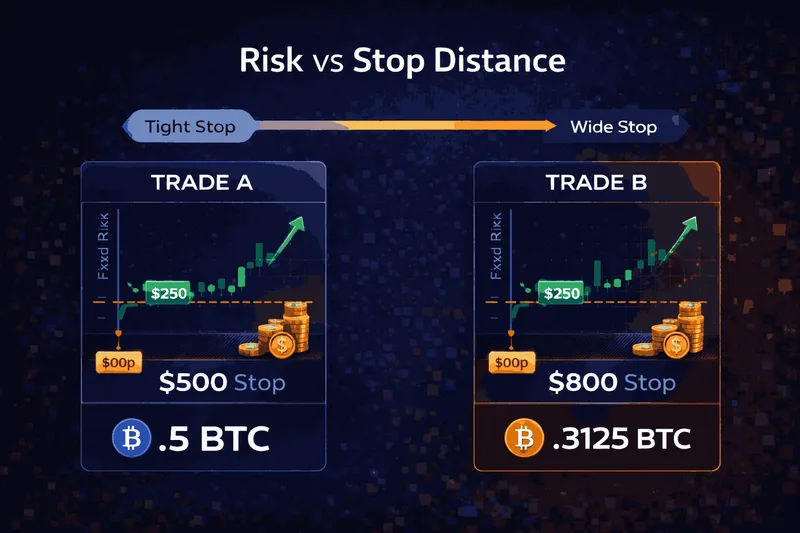
Stop distance: 500 $ per BTC
Position size: 250 $ ÷ 500 $ = 0.50 BTC (notional 30,000 $)
This is why fixed risk works. It forces the size to shrink when the stop is wider. It also prevents “one big bet” behavior. Zerodha founder Nithin Kamath has warned that poor position sizing can wipe traders out even if they are right most of the time, because one oversized loss can erase many wins.
ATR-based sizing solves one big weakness in fixed risk. Many traders set stops that do not match volatility. In quiet markets they use wide stops and waste size. In volatile markets they use tight stops and get clipped. ATR helps you anchor stop distance to real movement.
Average True Range is a volatility indicator created by J. Welles Wilder Jr. It measures how much an asset typically moves over a period, often 14 days by default. Experts describe ATR as a tool to evaluate price volatility and notes Wilder’s 14-day ATR framework.
Fidelity also describes ATR as an average of true ranges and a way to measure volatility, including gaps. ATR sizing usually works like this:
You choose an ATR period (common: 14).
You choose a multiplier (common: 1.5–3.0 depending on style).
Your stop distance becomes ATR x multiplier.
Your position size becomes Dollar risk ÷ that stop distance.
Example:
Account: 50,000 $
Dollar risk: 250 $
BTC ATR(14) on your trading timeframe: 400 $
Stop distance: 2 x ATR = 800 $
Position size: 250 $ ÷ 800 $ = 0.3125 BTC (notional about 18,750 $ at 60,000 $)
Notice what changed. You did not “decide” to trade smaller. Volatility decided, and your sizing followed. This is why ATR risk sizing is one of the most practical upgrades a prop trader can make.
This is also where execution starts to matter. If your stops are volatility-based but your fills are sloppy, your real risk can exceed your planned risk. That is why it is worth understanding slippage in crypto when you rely on stops during fast moves.
ATR risk is already volatility-aware, but “volatility sizing” usually means you go one step further. You scale risk up or down based on how volatile the market is relative to its own normal range.
Zerodha’s Varsity module covers “percentage volatility” style sizing and explicitly links volatility measurement to ATR, noting that Van Tharp suggests ATR as a practical volatility measure for sizing.
In plain terms, volatility sizing answers this question: “Should I risk the same 250 $ today if volatility is double what it was last week?”
A simple approach that works for prop traders:
Define a “normal volatility” baseline, like ATR% over the last 20 sessions.
If ATR% is high relative to baseline, reduce risk per trade.
If ATR% is low relative to baseline, you can keep risk at your normal level, not higher.
This keeps you from doing the most common prop mistake: trading the same size on calm days and on event-driven days. It also helps avoid the emotional trap where volatility feels like opportunity, so traders size up right when risk is highest.
If you trade frequently, volatility sizing also pairs well with cost awareness. In high volatility, spreads widen and market orders slip more. In those moments, understanding maker vs taker fees can help you avoid paying premium execution costs on every entry and exit.
Sizing models are great, but prop rules can override them. This is where funded traders get caught. They sized correctly for stop distance, but they violated an exposure cap, or they stacked correlated positions and pushed total notional too high. On Mubite funded accounts, there are explicit position limits:
Max Position Size: 2x per individual trade
Cumulative Exposure: 3x total combined value of all open positions
Mubite also describes a “soft breach” process with a warning, a short window to reduce exposure, and limits on how often that grace can be used.
This matters because crypto leverage can make exposure feel invisible. Your margin might be small, but your notional exposure can still be large. So you should add a final sanity check step before entering:
Here is the quick decision flow we use internally when reviewing sizing issues.
Does this trade risk my fixed dollar amount if the stop fills cleanly?
If slippage hits, is the loss still survivable inside daily drawdown?
Does the notional position exceed any per-trade cap?
If I add a second trade, does total exposure breach the cumulative cap?
When you build this into your routine, your sizing system becomes rule-aware, not just math-aware. It also keeps you from “passing the formula” and still failing the account.
In crypto perps, leverage changes margin. It does not have to change risk. If you size based on dollar risk and stop distance, leverage becomes a tool for capital efficiency, not a tool for gambling.
Our team covers this in more depth in the crypto derivatives guide, but the key principle is simple. Always size the position from the stop, then choose leverage that keeps liquidation far away from your stop.
If liquidation is closer than your stop, your sizing is not complete. You sized the trade, but you did not size the survival.
Fixed risk sizing gives you consistency. ATR risk sizing makes your stops match volatility. Volatility sizing helps you reduce risk when markets get louder. The best prop traders do not pick one and hope. They pick a base model, then add prop-aware guardrails like exposure checks and slippage buffers.
If you want one simple upgrade today, use fixed risk sizing as your base, then set stops using ATR logic. That one change usually improves both survival and consistency.
For most prop traders, the best starting point is fixed risk sizing, because it keeps losses predictable and makes discipline measurable. You choose a small dollar risk per trade, then calculate position size from the stop distance. Once that is stable, ATR risk sizing is often the best upgrade, because it ties stop distance to volatility instead of guesswork.
Start with dollar risk and stop distance, not leverage. Calculate the position size that loses your chosen dollar amount at the stop. Only then choose leverage based on margin needs. If leverage is so high that liquidation is near your stop, you are not trading a stop-based plan anymore.
ATR is often most useful for stops, and then indirectly for sizing. ATR measures volatility, so it helps you avoid placing stops inside normal noise. Once your stop distance is ATR-based, your position size becomes more realistic because it is tied to how the asset actually moves.
Share it with your community