All information on this site is provided by Mubite for educational purposes only, specifically related to financial market trading. It is not intended as an investment recommendation, business advice, investment opportunity analysis, or any form of general guidance on trading investment instruments. Trading in financial markets involves significant risk, and you should not invest more than you can afford to lose. Mubite does not offer any investment services as defined under the Capital Market Undertakings Act No. 256/2004 Coll. The content on this site is not directed toward residents in any country or jurisdiction where such information or use would violate local laws or regulations. Mubite is not a brokerage and does not accept deposits.
Mubite s.r.o., Skolska 660/3, ICO: 23221551 Prague 1, 110 00, Czech Republic | Copyright Ⓒ 2025 Mubite. All Rights Reserved.

Drawdown is one of the simplest risk metrics in trading, and one of the most misunderstood. If you have ever searched drawdown meaning or what is drawdown, the practical answer is this: it is how far your account or investment falls from a peak before it recovers. Our experts define drawdown as a peak-to-trough decline over a given period.
In real trading, drawdown is not just a number. It is a stress test for your strategy, sizing, and discipline. It also matters a lot in funded evaluations, where passing often depends on staying inside risk limits. If you trade under rules, the prop trading context matters because drawdown is usually the main fail point. You should also read the challenge rules early, because the calculation method changes your risk plan.
A drawdown is the decline from a high point to a later low point. The high point is your recent peak. The low point is the trough that follows. Some traders only think about the percentage loss. Professionals also pay attention to how long recovery takes, because long drawdowns can break discipline even if the percentage is “manageable.” Experts highlight drawdown as a decline from a relative peak to a relative trough and notes that recovery time is part of the concept.
So, what is a drawdown in trading in plain terms? It is the distance between “my account just hit a high” and “my account is now below that high.” You can measure drawdown in dollars or in percent. Percent is easier for comparing accounts and strategies. Dollars are easier for feeling the pain, which is why traders obsess over them.
Two quick clarifications help avoid confusion:
Drawdown is not the same as a single losing trade. It can be one trade or a streak.
Drawdown is not the same as volatility. Volatility describes movement. Drawdown describes loss from a peak.
If you want a connected view of execution costs that can worsen drawdowns, link this topic with slippage and maker vs taker fees. In practice, both can turn a “normal” loss into a deeper drawdown.
Max drawdown and maximum drawdown usually mean the same thing in trading content. It is the biggest peak-to-trough drop over a chosen period. If your account hit $10,000, then dropped to $8,000 before making a new high, the maximum drawdown in that stretch is 20%.
Our experts frames maximum drawdown explanation as the most severe decline from a peak to a trough before a new peak occurs, and it is used to understand downside risk. That is why funds and serious traders track it. It answers a hard question: “How bad did it get, even if it later recovered?”
This is also where the time window matters. A strategy can look stable over a week and ugly over a year. A good risk review always states the period.

You do not need a tool to understand a drawdown calculator. You need the basic inputs and the correct formula. In practical risk work, the simplest drawdown calculation uses your peak value and your current value.
Here is the quick method most traders use for drawdown percentage:
Identify your most recent equity peak.
Identify the lowest equity after that peak.
Compute the percentage drop from the peak.
Here is a simple example how you can calculate your drawdown:
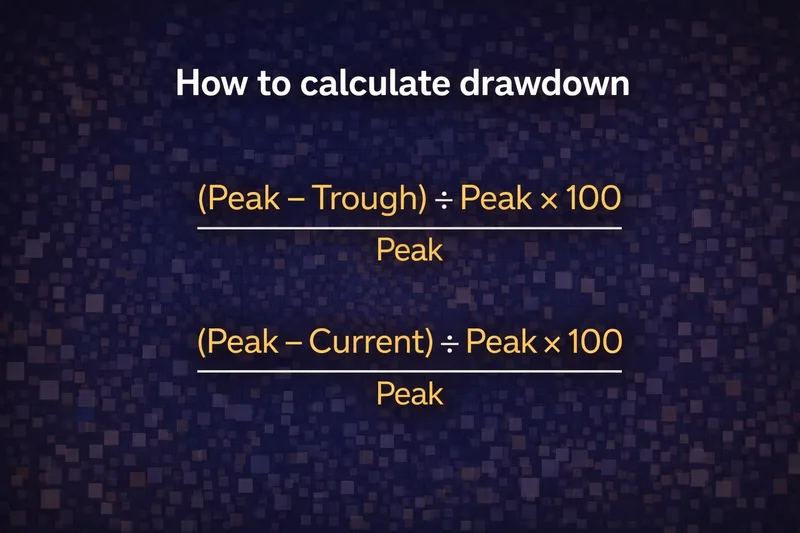
Drawdown % = (Peak − Trough) ÷ Peak × 100
Current drawdown % = (Peak − Current) ÷ Peak × 100
The reason this matters is position sizing. If you know your typical drawdowns, you can size to survive them. If you ignore them, you will eventually size into a hole that forces mistakes.
For maximum drawdown, you scan a period and pick the worst peak-to-trough decline. Many resources describe this same peak-to-trough concept.
Prop firm drawdown explained in one sentence: it is a risk limit that can end your evaluation even if your strategy is “good.” The purpose is risk control. The effect is that you must trade with tighter guardrails. Two things make prop drawdown feel harsher:
The rule is often based on equity, not just closed trades.
The limit can move, depending on the drawdown type.
That is why the calculation method matters more than the headline number. This is also why you should align your style with execution reality. If your approach is high frequency, you should understand how fees and slippage stack into risk. These are not “small costs” when rules are strict.

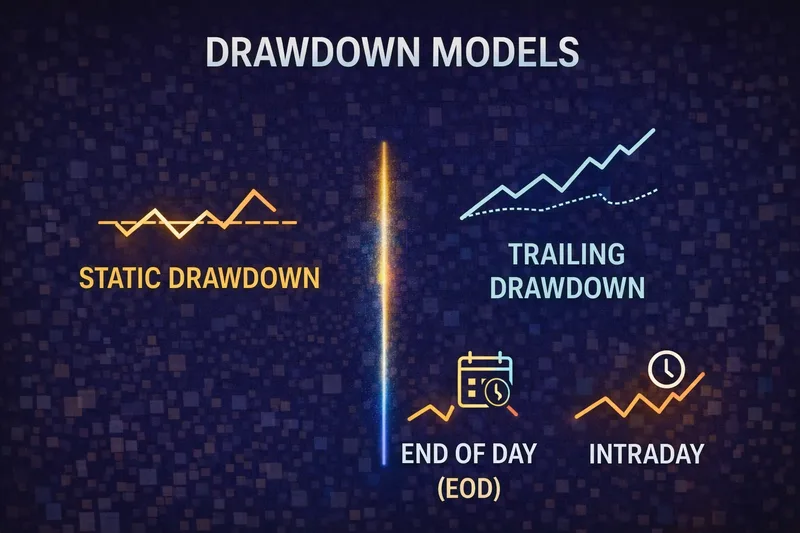
This is where most traders get surprised. Trailing drawdown and static drawdown can produce very different outcomes, even with the same percentage limit.
Trailing drawdown moves up as your account makes new highs. Think of it as a line that follows your growth at a fixed distance. If you increase equity, your trailing threshold can rise. This can protect the firm and can lock in risk control as you earn. For the trader, it can also feel restrictive, because the “floor” can chase you upward.
A clean way to explain trailing drawdown is with the high-water mark idea. When equity hits a new peak, the drawdown limit is recalculated from that peak. We discussed drawdown measurement concepts around peaks and troughs and the importance of identifying the high point properly.
Static drawdown is fixed. The threshold does not rise as you profit. If the rule is “max drawdown 10%,” the limit stays tied to the starting balance or a defined fixed reference. It is simpler to plan around. It can also allow more breathing room after profits, depending on the exact definition.
Assume a $10,000 account and a 10% max drawdown rule.
With static drawdown, your max loss threshold might stay at $9,000.
With trailing drawdown, if you grow to $11,000, the trailing threshold might rise to $9,900, depending on the rule design.
This difference changes how you scale risk. It also changes how aggressive you can be after a good streak.
Drawdown protection is usually not a clever trick. It is routine risk control done the same way every day. Most blowups come from two patterns. The first is taking one oversized loss. The second is forcing trades after a hit to “make it back.” Here are practical ways traders reduce drawdown stress in rule based environments:
Risk a fixed, small amount per trade, then keep it unchanged for the session.
Set a daily stop that triggers before your official rule limit does.
Cut size after a losing streak, so one more loss cannot do maximum damage.
Avoid thin liquidity windows where slippage can turn clean stops into ugly fills.
Track equity highs, because trailing drawdown logic is based on new peaks.
These habits work because they reduce the number of ways you can fail. They also make your trading easier to review and improve over time, which is how most traders build consistency and how they can win overtime. If your main issue is capital constraints, some traders explore crypto loans without collateral, but risk control still comes first.
Many traders look for location-based questions like “drawdown rule in Texas” or “prop firm drawdown rules in California.” The short answer is that drawdown itself is a risk concept, so the math does not change by state. The rule design also usually does not change by state, because firms tend to apply one rule set across eligible users.
What can change by location is eligibility, onboarding requirements, and what products are available to you. That is why the safest approach is this: treat drawdown rules as firm rules, then confirm access requirements for your region inside the platform’s official terms and onboarding flow. Your trading plan should be robust enough that it still works if you move or travel, because the risk math stays the same.
Drawdown is not a theory term. It is a live measurement of stress on your strategy. If you ignore drawdown, you will eventually trade too large for your edge. If you plan for it, you can trade with more calm and more consistency.
Start simple. Know your peak, know your current equity, and know your limit. If you trade prop evaluations, learn whether your rule is trailing drawdown or static drawdown before you size up. That one detail changes the entire risk management plan.
Drawdown is the decline from a peak value to a later trough. In trading, it usually refers to the drop in your account equity from its recent high. It can be measured in dollars or percent, but percent is easier for comparing performance over time. Drawdown is useful because it focuses on downside pain, not just average returns. A strategy can be profitable and still have drawdowns that are too deep for your risk tolerance. That is why professional risk reviews always include drawdown.
What is a drawdown in trading? It is how far your account falls from a high point before it recovers. It matters because it reflects the real stress your strategy creates, including losing streaks and poor execution. Drawdown also shapes decision quality. A deep drawdown often leads to impulsive changes, revenge trading, or abandoning a working strategy. In rule-based programs, drawdown can also end an evaluation. That makes drawdown control a passing requirement, not just a performance metric
A drawdown calculator needs two values: your peak equity and your current or lowest equity after that peak. The standard drawdown percent is the drop from peak to trough divided by the peak, expressed as a percentage. For maximum drawdown, you look over a period and identify the biggest peak-to-trough decline. The practical use is planning risk. If your typical drawdown is 6%, you should not size your trades like you can tolerate 20%. The math keeps you honest.
Share it with your community