
Liquidation cascades are why crypto moves in violent trend days and long wicks. Learn how forced selling snowballs, why it happens, and how to read the terrain.

The best crypto for day trading is not the one that moves the most. It's the one you can enter and exit without slippage eating your profit. Here's how to choose.

You can't predict the top. These systematic take-profit frameworks tell you when to sell crypto using rules instead of guesswork.
All information on this site is provided by Mubite for educational purposes only, specifically related to financial market trading. It is not intended as an investment recommendation, business advice, investment opportunity analysis, or any form of general guidance on trading investment instruments. Trading in financial markets involves significant risk, and you should not invest more than you can afford to lose. Mubite does not offer any investment services as defined under the Capital Market Undertakings Act No. 256/2004 Coll. The content on this site is not directed toward residents in any country or jurisdiction where such information or use would violate local laws or regulations. Mubite is not a brokerage and does not accept deposits. All trading accounts provided by Mubite are simulated demo accounts using live market data. No client funds are traded on live markets. Payout figures shown are individual results and are not typical. Past performance does not guarantee future results.
Mubite s.r.o., Školská 660/3, Nové Město, ICO: 23221551 Praha 1, 110 00, Czech Republic | Copyright Ⓒ 2026 Mubite. All Rights Reserved.
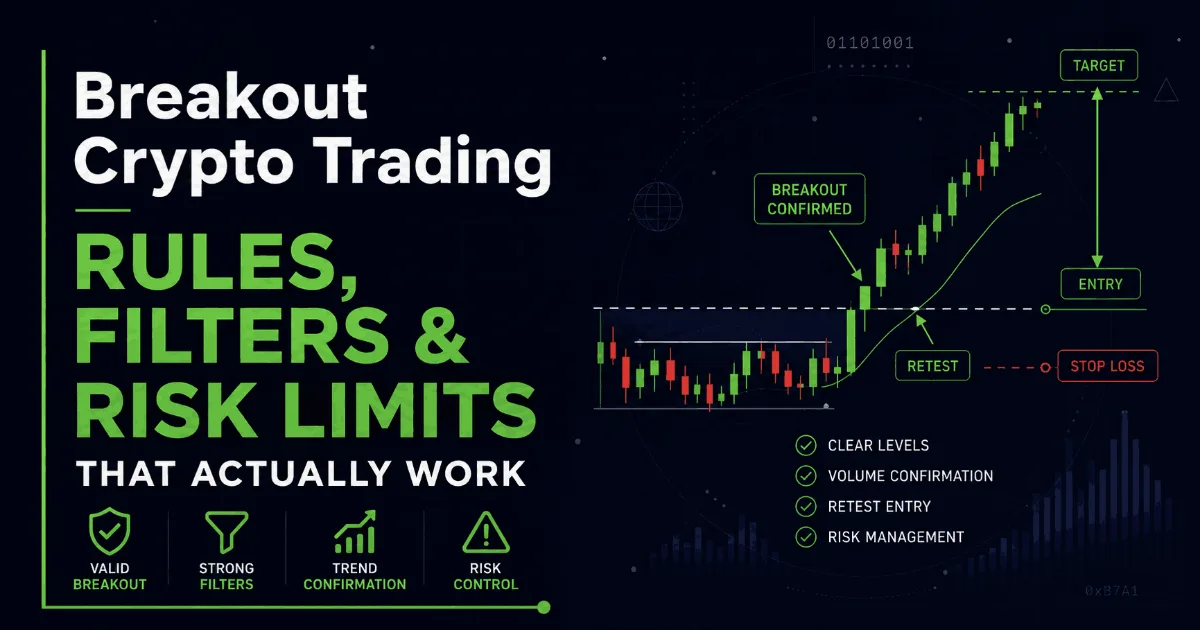
A breakout crypto strategy is only as good as its filters. Learn the exact rules for a valid entry, how to spot false breakouts, and how to size risk.
If you searched for breakout crypto trading, you almost certainly want three things: how to enter a breakout correctly, how to avoid the false breakouts that keep stopping you out, and how to manage risk so a run of fakeouts does not drain your account. This guide answers all three directly, with specific rules rather than vague advice.
A breakout is one of the most powerful setups in crypto because the market's high volatility produces frequent, explosive moves out of consolidation. It is also one of the most punishing setups when traded without discipline, because crypto produces more false breakouts than almost any other market. The difference between the two outcomes is not luck. It is rules, filters, and risk limits.
A valid breakout is a decisive candle close beyond a clear support or resistance level, confirmed by a volume spike
Volume confirmation at 2 to 3 times the recent average is the single most effective filter for separating real breakouts from fakeouts
The retest entry, waiting for price to return to the broken level, filters out a large share of false breakouts
Breakouts only work in trending conditions, in range-bound markets they produce losses
Risk management matters more here than in most strategies, because false breakouts arrive in clusters
A breakout happens when price moves decisively beyond a defined level of support or resistance, signaling a potential new trend or the acceleration of an existing one. Traders watch for these moments because a genuine breakout often marks the start of a sustained directional move, exactly the kind of move that produces large, fast profits in crypto.
The logic is simple. Price spends most of its time inside ranges, bounded by a resistance level above and a support level below. When price breaks out of that range with force, it signals that the balance between buyers and sellers has shifted, and the move that follows can be substantial.
The problem is that not every break of a level is a real breakout. Crypto markets are notorious for false breakouts, where price pokes past a level, pulls in eager traders, then reverses hard and stops them out. Learning to tell the two apart is the entire skill, and it comes down to the rules and filters below.
Before you can filter out false breakouts, you need to define what a real breakout entry actually looks like. These are the non-negotiable rules.
Identify a clear level. The level must be obvious, tested at least two or three times. A resistance or support level that the whole market can see is more significant than a subtle one only you have drawn
Wait for a decisive candle close beyond the level. A wick poking through is not a breakout. The candle must close firmly on the other side of the level. This single rule eliminates a large share of false signals
Trade with the higher timeframe trend. A breakout that agrees with the larger trend is far more reliable than one fighting against it. Check the higher timeframe before entering
Define your entry, stop, and target before you enter. The breakout level itself becomes your reference. Your stop goes on the far side of it, your entry on the confirmed close, your target at the next significant level
These rules alone will not make you profitable, but breaking them will reliably make you lose. They are the foundation everything else sits on. Setting your levels using genuine support and resistance rather than arbitrary lines is what makes the entire setup meaningful.
This is what most traders searching for a breakout strategy actually need. False breakouts are the number one reason beginners lose money trading breakouts. These filters cut them down sharply.
Volume confirmation is the most important filter. A genuine breakout is accompanied by a significant spike in volume, ideally 2 to 3 times the recent average, because a real move requires many participants pushing in the same direction. A breakout on weak volume is a warning, not a signal. If you use only one filter, use this one.
Demand the candle close, not the wick. As covered in the rules, price must close beyond the level, not just spike through it intrabar. A close beyond the level shows the move held, a wick shows it was rejected.
Prefer the retest entry. After a breakout, price often returns to test the level it just broke, turning old resistance into new support or vice versa. Entering on that retest, rather than chasing the initial break, filters out a large share of fakeouts and gives you a tighter, safer stop. The trade-off is that not every breakout retests, so you sometimes miss the move. For most traders, that trade-off is worth it.
Check momentum with a confirming indicator. Combining the breakout with a momentum or trend indicator, such as a moving average or MACD, adds a layer of confirmation. Weakening momentum into a breakout is a red flag.
The core principle across all four filters: confirmation costs you a few points of entry price, but it saves you from most of the traps. That trade is worth making every single time.
Understanding why crypto is especially prone to fakeouts helps you trade the strategy with the right expectations.
Thin order book liquidity. Outside the major pairs, order book depth is shallow. A modest push can spike price through a level and then collapse back when the buying dries up, printing a textbook fakeout
Liquidation hunting. Because leverage is high and liquidation levels cluster near obvious support and resistance, price is often pushed through a level deliberately to trigger stops and liquidations, then reverses once they are cleared. Many false breakouts are really liquidation cascades running through a stop cluster
24/7 markets with variable liquidity. Crypto never closes, and liquidity thins dramatically on weekends and during off-peak hours. A breakout on thin weekend volume is far more likely to fail than the same break during peak liquidity
None of this makes breakout trading unviable in crypto. It makes the volume filter and the retest entry more important than they would be in a deeper, more regulated market.
Here is the part that separates traders who survive the strategy from those who blow up. Even a perfect breakout system is wrong regularly, and false breakouts tend to arrive in clusters during choppy conditions. Without strict risk limits, one bad session of consecutive fakeouts can undo weeks of progress.
Place your stop on the far side of the level, not right at it. A stop directly on the breakout level gets tagged by normal noise. Place it beyond the level, accounting for the asset's typical volatility
Size to your stop, not to your conviction. Decide your maximum loss per trade first, usually 1 to 2 percent of your account, then calculate position size from the distance to your stop. Proper position sizing is what keeps a cluster of false breakouts survivable
Respect the market regime. Breakouts have positive expectancy in trending, high-volatility conditions and negative expectancy in quiet, range-bound markets. Trading breakouts in a chop is how accounts bleed out. If the market is ranging, the breakout strategy is the wrong tool
Account for the drawdown limit if you trade a funded account. This is the rule most breakout traders miss in a prop context. A run of three or four false breakouts, each a small loss, can breach a daily drawdown limit quickly. On a funded account, your remaining daily drawdown buffer, not just your per-trade risk rule, should govern your position size. The smaller constraint always wins
The reason breakout trading fails for most people is not that they cannot spot breakouts. It is that they take every break, ignore the volume filter, and size positions without respecting how often the strategy is wrong. Fix those three things and the strategy becomes viable.
A few mistakes undo traders who otherwise understand the setup:
Chasing the breakout. Entering late, well after the candle closed, means buying at an inflated price with a wide stop. Wait for the close or the retest, do not chase
Ignoring volume. Taking a breakout without a volume spike is the single most common way traders walk into fakeouts
Trading breakouts in a range. Range-bound markets are where breakout strategies lose money. Match the strategy to the regime
Over-sizing after a loss. Increasing position size to recover from a false breakout is how a manageable losing streak becomes an account-ending one
Volume is the most reliable confirmation. A genuine breakout is accompanied by a volume spike of roughly 2 to 3 times the recent average. A breakout on low volume is far more likely to be a false breakout, regardless of how clean the chart looks.
Wait for a full candle close beyond the level rather than a wick, demand a volume spike, and prefer entering on the retest of the broken level rather than chasing the initial move. Checking the higher timeframe trend adds further reliability.
Place your stop on the far side of the broken level, with enough distance to account for normal volatility, rather than directly at the level where it will be triggered by noise. Then size your position so that hitting that stop costs no more than 1 to 2 percent of your account.
Share it with your community