All information on this site is provided by Mubite for educational purposes only, specifically related to financial market trading. It is not intended as an investment recommendation, business advice, investment opportunity analysis, or any form of general guidance on trading investment instruments. Trading in financial markets involves significant risk, and you should not invest more than you can afford to lose. Mubite does not offer any investment services as defined under the Capital Market Undertakings Act No. 256/2004 Coll. The content on this site is not directed toward residents in any country or jurisdiction where such information or use would violate local laws or regulations. Mubite is not a brokerage and does not accept deposits.
Mubite s.r.o., Školská 660/3, Nové Město, ICO: 23221551 Praha 1, 110 00, Czech Republic | Copyright Ⓒ 2026 Mubite. All Rights Reserved.
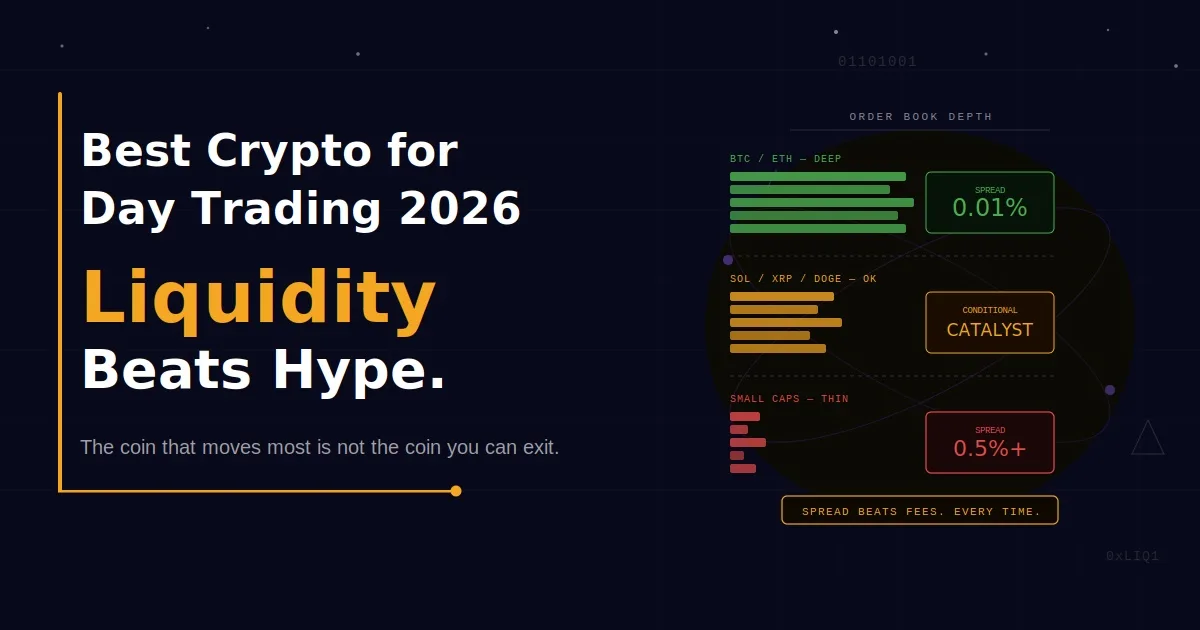
The best crypto for day trading is not the one that moves the most. It's the one you can enter and exit without slippage eating your profit. Here's how to choose.
Most guides to day trading crypto rank coins by how much they move. That is the wrong starting point. A coin that swings 15% in a day is worthless to you if the order book is so thin that you pay 2% in slippage just getting out of the position.
The best crypto for day trading is the asset where you can enter and exit precisely, at the price you expect, in the size you need. Volatility gives you opportunity. Liquidity is what lets you actually capture it. This guide covers which coins deliver both, and which ones quietly destroy accounts.
BTC and ETH are the safest and most reliable day trading assets due to deep order books and tight spreads
SOL, XRP, and DOGE are viable when there is a genuine catalyst, but they lead drawdowns when the market turns
Anything outside the top 50 by market cap carries slippage risk that outweighs the volatility opportunity
Spread matters more than fees for most intraday traders
The right answer changes if you are trading a funded account with a daily drawdown limit
Before naming coins, it is worth being precise about what you are looking for. Four factors matter, in this order:
Liquidity and order book depth. Can you enter and exit your position size without moving the price against yourself? BTC and ETH absorb seven-figure orders within a few ticks. Most altcoins cannot
Spread. BTC/USDT on a major exchange routinely trades at a 0.01% spread. Obscure altcoin pairs on smaller venues run 0.3% or worse. That gap is a cost you pay on every single trade
Volatility. You need enough movement to clear fees, spread, and risk twice over. A reasonable floor is an average true range of at least 2% on the daily
Catalysts. Coins with a constant news flow produce setups. Stagnant coins with no narrative produce flat charts, which are useless for intraday trading
The mistake most traders make is inverting this order, chasing volatility first and discovering the liquidity problem only after they are stuck in a losing position they cannot exit cleanly. Understanding order book depth and liquidity before choosing what to trade is the single most useful habit a day trader can build.
Bitcoin remains the anchor of every serious day trading watchlist. Not because it offers the biggest swings, but because its price action sets the tone for the entire market and its execution quality is unmatched.
Deepest order books in crypto, absorbing large orders with minimal price impact
Spreads routinely at 0.01% on major exchanges, the tightest available anywhere
Extensive catalyst flow: macro data, ETF flows, miner activity, regulatory news
BTC dominance moves drag the entire market, so reading BTC is context for every other trade
The trade-off is that Bitcoin's percentage swings are smaller than most altcoins. In quiet periods, realized volatility can compress enough that intraday opportunity thins out. That is when BTC becomes a range trading instrument rather than a breakout one, pinning between clear levels for days at a time.
For most traders, and especially for beginners, BTC is the right place to start. The liquidity buffer gives you room to make mistakes without paying heavily in slippage to exit a losing trade.
Ethereum combines benchmark-grade liquidity with noticeably wider daily swings than Bitcoin. It is the natural next step for traders who want more movement without sacrificing execution quality.
Second-deepest order books in crypto, comfortably liquid for retail and institutional sizes
Wider daily ranges than BTC, producing more intraday setups
Rich catalyst pipeline: network upgrades, layer 2 launches, ETF flows, DeFi narratives
Behaves similarly to BTC in range-bound conditions, so the same technical frameworks apply
ETH is arguably the best all-round day trading asset in crypto. You get meaningfully more volatility than Bitcoin while keeping the execution quality that makes precise entries and exits possible.
Major altcoins earn a conditional place on the watchlist. They deliver larger intraday moves, but they come with real trade-offs.
Solana is where traders go when BTC and ETH are quiet. Average daily ranges of 3% to 5% make it strong for breakout trading, and liquidity has improved substantially, with deep perpetual books on the major exchanges. The catch is that SOL also leads drawdowns. When risk-off hits, SOL can drop 8% in an hour while BTC drops 3%.
XRP springs to life on legal and ETF news and goes quiet otherwise. Trade it when there is a story, ignore it when there is not.
DOGE moves on memecoin rotation and celebrity-driven catalysts, with 30-day volatility that regularly clears 6%. It is genuinely tradeable during those windows and genuinely dead outside them.
The principle for all three is the same: they are catalyst-dependent. A major altcoin with a live narrative is a good trading vehicle. The same coin with no narrative is a flat chart with worse liquidity than ETH. Check the catalyst before you check the chart.
Coins outside the top 50 by market cap are where most day trading accounts are quietly destroyed. The appeal is obvious, a 30% daily move looks like an enormous opportunity. The reality is different.
Order books are thin, so a modest position walks the book and fills far from your intended price
Spreads of 0.5% to 1% or more mean you start every trade meaningfully underwater
Low liquidity makes them highly susceptible to pump-and-dump manipulation
Narrative-driven pumps reverse violently, and being on the wrong side is expensive
The maths is unforgiving. If you are targeting a 0.4% scalp and paying 0.08% spread plus 0.05% slippage on entry and exit, you have handed back roughly a quarter of your gain before you even account for fees. On a thin altcoin with a 0.5% spread, the trade is unprofitable before it starts.
Spread matters more than fees for most intraday traders, and this is why. The coins that look most exciting on a chart are frequently the ones where the execution cost quietly eliminates the edge.
If you are trading a prop firm challenge rather than a personal account, the calculation changes in one important way: your drawdown limit is a hard boundary, and volatile assets can breach it fast.
On a challenge with a 5% daily drawdown limit, a SOL position caught in a risk-off move that drops 8% in an hour is not a bad trade. It is a challenge-ending event, depending on your position size. Understanding drawdown mechanics and how they interact with asset volatility is essential before choosing what to trade.
Practical guidance for funded traders:
Default to BTC and ETH. Deep liquidity means your stops fill where you place them and slippage does not eat into your daily loss allowance
Size down on alts. If you trade SOL or DOGE, position sizing must account for their higher average true range, not just your standard risk percentage
Watch funding rates on alt perpetuals. Funding rate costs on altcoin perpetuals are often significantly more punishing than on BTC or ETH
Avoid thin markets entirely. A slippage-heavy exit on an illiquid altcoin can push you past your daily limit on a trade that was otherwise within your risk plan
Mubite challenges run on Bybit with access to 700+ USDT perpetual pairs, but the fact that an asset is available does not mean it is a good choice for an evaluation. The challenge rules define the boundaries. Choosing liquid assets is how you stay comfortably inside them.
A practical watchlist for most traders looks like this:
Core: BTC/USDT and ETH/USDT, traded every session regardless of conditions
Conditional: SOL, XRP, DOGE, added only when there is a live catalyst and volume confirms it
Excluded: Anything outside the top 50 by market cap, anything listed only on smaller exchanges, and any pair where the spread exceeds 0.5%
Check 24-hour volume and order book depth on the specific venue you trade before every session, not just aggregate market volume. Liquidity is fragmented across exchanges, and a pair that looks liquid in aggregate can be thin on the venue where your order actually executes.
Share it with your community