The best crypto for day trading is not the one that moves the most. It's the one you can enter and exit without slippage eating your profit. Here's how to choose.
You can't predict the top. These systematic take-profit frameworks tell you when to sell crypto using rules instead of guesswork.
Learn how to read a crypto order book, understand market depth, spot buy and sell walls, and use liquidity to avoid slippage and trade with better execution.
All information on this site is provided by Mubite for educational purposes only, specifically related to financial market trading. It is not intended as an investment recommendation, business advice, investment opportunity analysis, or any form of general guidance on trading investment instruments. Trading in financial markets involves significant risk, and you should not invest more than you can afford to lose. Mubite does not offer any investment services as defined under the Capital Market Undertakings Act No. 256/2004 Coll. The content on this site is not directed toward residents in any country or jurisdiction where such information or use would violate local laws or regulations. Mubite is not a brokerage and does not accept deposits.
Mubite s.r.o., Školská 660/3, Nové Město, ICO: 23221551 Praha 1, 110 00, Czech Republic | Copyright Ⓒ 2026 Mubite. All Rights Reserved.
Liquidation cascades are why crypto moves in violent trend days and long wicks. Learn how forced selling snowballs, why it happens, and how to read the terrain.
A liquidation cascade is a chain reaction of forced sell-offs. When a leveraged trader runs out of margin, the exchange automatically closes their position, and that forced selling pushes the price down far enough to trigger the next trader's liquidation, then the next. One domino knocks over the whole row.
This single mechanic is the engine behind most of crypto's violent price action, the sharp trend days, the long wicks that hunt your stop and reverse, the flash crashes that recover within the hour. Once you understand how a cascade builds and fires, the chart stops looking random. This is how it works, and how disciplined traders read it.
A liquidation cascade is a chain reaction: forced selling triggers more forced selling, each wave feeding the next.
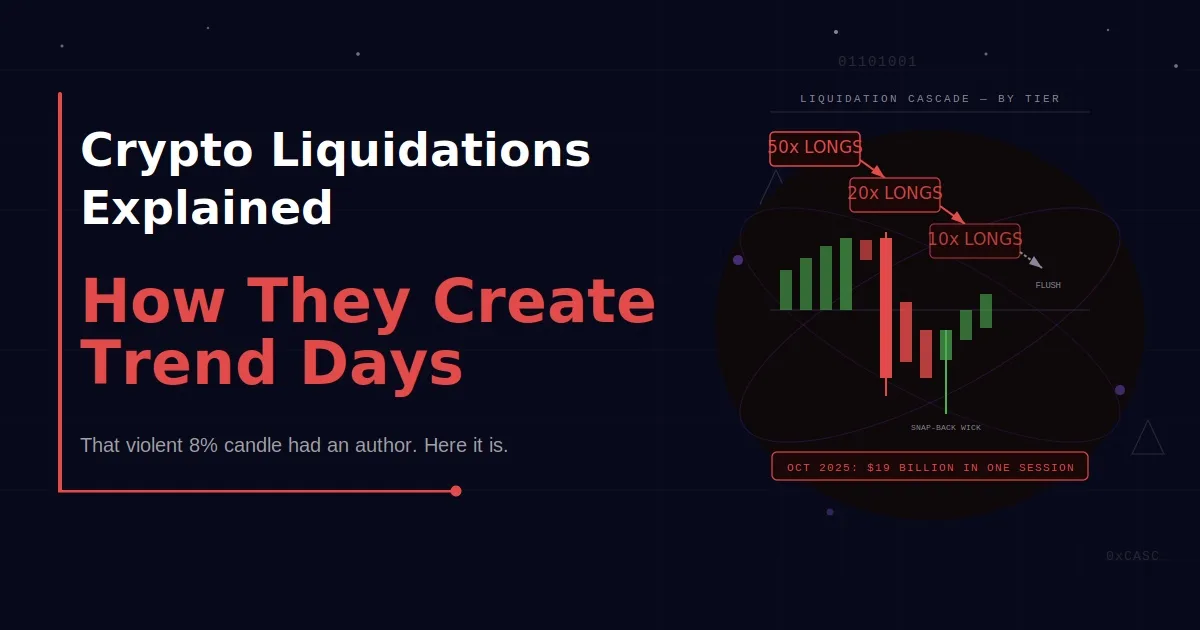
Cascades move in leverage tiers. The 50x positions liquidate first, their selling drags price into the 20x zone, then the 10x zone, until the excess leverage is flushed.
They are the primary engine behind the sharp 5-15% trend days and flash crashes that define crypto price action.
Cascades are built long before they fire, during quiet rising markets when open interest climbs and leverage stacks on one side.
You cannot predict direction from liquidation data, but you can read the terrain, where the fuel sits and where price is likely to accelerate.
The October 2025 crash wiped out over $19 billion in a single session, a textbook cascade.
A liquidation is one trader's forced exit. The exchange closes a leveraged position because its margin can no longer cover the losses. Simple, individual, contained.
A liquidation cascade is what happens when thousands of those forced exits fire in sequence, each one feeding the next. It is a chain reaction. One wave of forced selling pushes price into the next cluster of liquidation levels, which triggers another wave of forced selling, which pushes price further still.
Think of it as dominoes. A single liquidation is one domino falling. A cascade is the whole row going down, each one knocked over by the one before it. The critical detail is that the selling is not a choice. When a position liquidates, the exchange's engine closes it with a market order, dumping into whatever liquidity exists. That forced market order is what moves price to the next tier.
This is why cascades are different from ordinary selling driven by fear or news. There is no psychology involved once it starts. It is pure mechanics, an automated feedback loop running until the leverage is exhausted.
Here is the part most traders miss: the cascade is built long before it fires.
During quiet, rising markets, confidence grows. Traders add size. They raise leverage. Open interest climbs steadily, and in a bull market most of that leverage sits on the long side. This is the setup. A large stack of overleveraged longs, most of them clustered at similar liquidation prices, is fuel waiting for a spark.
Then a catalyst hits. It does not need to be catastrophic. A macro headline, a large spot sale, a geopolitical tremor. Price drops just enough to reach the liquidation level of the most overleveraged longs.
The exchange closes those trades by selling into the market. That selling pushes price lower. The lower price now reaches the next band of liquidation levels, and the engine fires again.
The move travels in tiers:
The 50x positions liquidate first, they have the least room to be wrong
Their forced selling drags price into the 20x liquidation zone
Those close, dragging price into the 10x zone
The process repeats until the excess leverage has been flushed from the system
This tiered structure is exactly why the move accelerates rather than fizzling. Each layer of forced selling creates the precise conditions for the next.
Now connect the mechanic to what you actually see on the chart.
A normal pullback meets buyers and stabilises. A pullback that reaches a dense cluster of liquidation levels does not. It triggers forced selling that overwhelms the buyers, accelerates through them, and turns an ordinary dip into a violent directional day. That is a trend day, and a cascade is one of the most common reasons they happen.
The long wicks work the same way. Three conditions make crypto uniquely prone to this: high leverage, thin order book depth, and the fact that liquidation levels are effectively public. When price spikes into a liquidation cluster, the forced orders blow through the thin book in seconds, printing a long wick, and then, once the overleveraged positions are cleared, the selling exhausts itself and price snaps back. The wick that hunted your stop and reversed was not a coincidence. It was a cascade running its full course through a shallow book.
Crypto makes this worse than any other market for one structural reason: there are no circuit breakers. A stock exchange can halt trading to let a panic cool. Crypto futures run 24/7 with no pause, so a cascade runs its entire course before anyone can step in. That is why a 20-30% flash crash can happen in minutes and why the recovery is often just as fast.
You cannot predict direction from liquidation data. Anyone who tells you otherwise is selling something. What you can do is read the terrain, and that alone stops you being surprised by which moves extend and which reverse violently.
The signals worth watching:
Open interest plus funding. Rising open interest with an extreme funding rate means leverage is accumulating heavily on one side. That is the precondition for a cascade, the fuel is stacking up.
Liquidation heatmaps. Third-party services estimate where liquidation clusters sit at each price level. These clusters act as magnets, sharp moves gravitate toward them because that is where the forced orders are waiting.
The open interest reaction after a spike. A liquidation spike that coincides with a collapse in open interest means the leverage genuinely left the system, which is what durable local bottoms and tops are made of. A spike that barely dents open interest means the crowd simply reloaded, and the fuel is still there.
None of this predicts the next candle. All of it describes where price is likely to accelerate and where the ground is unstable. Traders who read the terrain stop treating trend days as random events and start seeing them as the leverage flush they actually are.
TIP: Before you enter any leveraged trade, open a liquidation heatmap and check what sits between your entry and your stop. If there is a dense cluster in that zone, assume price will be pulled toward it. Either move your stop beyond the cluster or wait for the magnet to get tagged first. The single worst place to put a stop is just in front of a cluster the whole market can see.
Understanding the mechanic changes how you position, both defensively and opportunistically.
Never place stops directly at liquidation clusters. Professional traders and exchanges know where these sit, and price is often pushed into them deliberately to trigger stops before reversing. Place your stop beyond the obvious cluster, not inside it.
Reduce size when trading into a known cascade zone. If a heatmap shows a dense cluster just below, the path of least resistance runs straight through it. Size accordingly.
Respect the tier structure with your leverage. The reason high leverage is dangerous is not just the tight liquidation price, it is that you liquidate in the first tier, funding the cascade for everyone below you. Lower leverage keeps you out of the first dominoes.
Look for the post-flush reversal. Cascades overshoot. Once the forced selling exhausts, the imbalance often reverts quickly. The highest-probability window for a counter-trend entry is after the cascade completes, liquidations slow, volume fades, and price stabilises, not during the move.
For funded traders the lesson is sharper still. A cascade does not care about your analysis. If you are overleveraged in the first tier when one fires, your drawdown limit breaches before you have time to react. Surviving these events is never about being smarter than the market. It is about leverage discipline and margin structure set in place long before the move ever starts.
The traders who get wiped out in a cascade almost always did the damage weeks earlier, when they raised their leverage in a quiet market and became part of the fuel. The ones who survive built their margin buffer before they needed it. In crypto, that difference is everything.
TIP: The best cascade trades are not taken during the cascade, they are taken after it. When you see forced liquidations spike while open interest collapses at the same time, that is the leverage genuinely leaving the market. Wait for volume to fade and price to stop accelerating, then look for your entry in the direction of the reversal. Trying to catch the falling knife mid-cascade is how you become the next domino.
Share it with your community