All information on this site is provided by Mubite for educational purposes only, specifically related to financial market trading. It is not intended as an investment recommendation, business advice, investment opportunity analysis, or any form of general guidance on trading investment instruments. Trading in financial markets involves significant risk, and you should not invest more than you can afford to lose. Mubite does not offer any investment services as defined under the Capital Market Undertakings Act No. 256/2004 Coll. The content on this site is not directed toward residents in any country or jurisdiction where such information or use would violate local laws or regulations. Mubite is not a brokerage and does not accept deposits.
Mubite s.r.o., Školská 660/3, Nové Město, ICO: 23221551 Praha 1, 110 00, Czech Republic | Copyright Ⓒ 2026 Mubite. All Rights Reserved.
Leverage lets you control a larger crypto position with less capital, and amplifies losses just as fast. Here's how leverage works and what each ratio means.
Leverage is the feature that lets a trader turn $1,000 into $10,000 of market exposure. It is also the single most common reason retail traders lose their entire account in a matter of minutes.
Understanding how leverage actually works, what each ratio means in practice, and how disciplined traders use it as a tool rather than a gamble is the difference between surviving in crypto markets and becoming one of the billions in liquidations that happen every year. This guide breaks it all down.
Leverage lets you control a position larger than your capital by borrowing against a margin deposit
A 1% price move at 10x leverage equals a 10% change to your margin, at 100x it equals 100%
The higher the leverage, the closer your liquidation price sits to your entry
Most profitable traders use 5x to 20x, not the maximum available
In prop trading, your drawdown limit matters more than the headline leverage number
Leverage in crypto trading is the use of borrowed capital to open a position larger than your own funds would normally allow. You put down a small amount, called margin, and the exchange supplies the rest, multiplying your market exposure by a chosen ratio.
A simple example:
You have $1,000
You open a Bitcoin position at 10x leverage
You now control $10,000 of exposure
Your profit and loss is calculated on the full $10,000, not your $1,000
If Bitcoin rises 5%, your profit is $500 (5% of $10,000), a 50% return on your $1,000 margin. If Bitcoin falls 5%, you lose $500, half your margin gone on a move that looks small on the chart.
Leverage is expressed as a ratio: 2x, 10x, 50x, 100x. The ratio tells you how many times your margin is multiplied to determine your total position size. Crypto exchanges and prop firms offer anywhere from 2x on conservative platforms up to 100x or more.
The mechanics come down to three concepts: margin, notional, and liquidation.
Margin is the capital you post to open the position
Notional is the full size of the position, your margin multiplied by leverage
Liquidation is the price at which the exchange force-closes your position because your margin can no longer cover the loss
The relationship between leverage and survivable price movement is brutally simple. The approximate adverse move that wipes out your margin is:
100% ÷ leverage = approximate liquidation distance
| Leverage | Liquidation distance | What that means |
|---|---|---|
| 2x | ~50% | Very hard to liquidate |
| 5x | ~20% | Conservative, room to breathe |
| 10x | ~10% | Moderate, one bad candle risk |
| 20x | ~5% | Normal volatility can liquidate |
| 50x | ~2% | Intraday noise ends the trade |
| 100x | ~1% | A single wick wipes you out |
In a market where Bitcoin routinely moves 2% to 3% in an hour, a 100x liquidation buffer of roughly 1% is paper-thin. This is why the majority of profitable leveraged traders stay well below the maximum. Understanding how liquidation price is calculated is essential before using any leverage at all.
Each leverage tier suits a different risk profile and strategy:
2x to 5x (low): Resembles spot trading with amplified returns. Liquidation is far from entry. Suitable for swing trades and beginners learning position management
10x to 20x (medium): Normal crypto volatility starts causing frequent liquidations if positions are sized poorly. Requires active risk management
50x to 100x (high): Demands perfect timing. One wick and the position is gone. Used almost exclusively for very short-term scalps by experienced traders
The key insight most beginners miss: leverage does not change how much you should risk per trade. It only changes how much margin is reserved. A disciplined trader risking 1% per trade has the same dollar risk whether they use 5x or 50x, because they size the position to their stop loss, not to the maximum leverage available.
High leverage is the primary reason traders blow up. The data is stark:
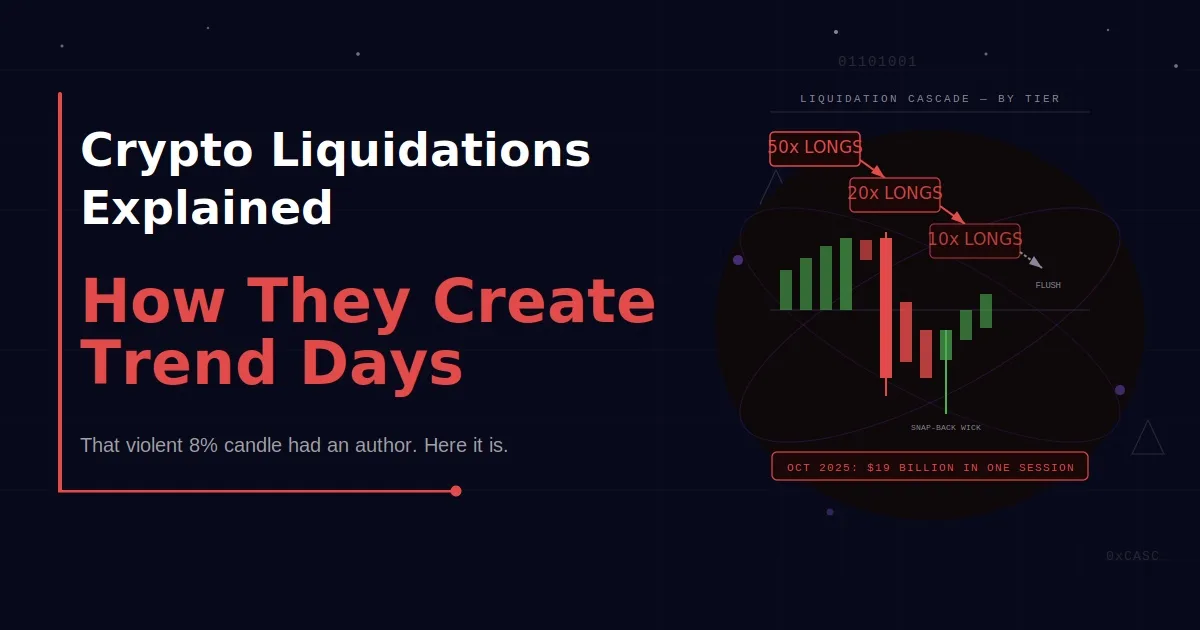
2025 saw roughly $150 billion in total forced crypto liquidations
The October 2025 cascade alone exceeded $19 billion in a single day, with 85% to 90% being long positions
Most retail liquidations happen at 10x leverage or higher
The trap is that many traders are directionally right but get liquidated anyway, because the position was too leveraged to survive short-term volatility on the way to being correct. A trader who buys Bitcoin at the right level but uses 50x leverage can be liquidated by a 2% dip before the price moves in their favour.
Other hidden costs of high leverage:
Funding rate exposure: Higher leverage means a larger position, which means larger funding rate payments every 8 hours on perpetual futures
Fee impact: Trading fees are charged on the full notional, so leverage amplifies fees as well as exposure
Emotional pressure: Watching a 100x position swing wildly leads to panic decisions that compound losses
Here is what most articles about crypto prop firms get wrong. They advertise leverage up to 100x as a selling point. In a prop trading context, that headline number is almost meaningless.
What actually constrains you is the drawdown limit, not the leverage ratio.
Consider a Mubite challenge with a $10,000 account and a 5% daily drawdown limit:
Your daily loss limit is $500
It does not matter whether the platform offers 50x or 100x leverage
The moment your account drops $500 in a day, trading stops
Your real constraint is the $500, not the leverage available
This means your effective leverage is governed by how much you can lose before breaching a rule, not by the maximum the platform allows. A trader who understands this sizes positions based on the drawdown limit and their stop loss, then uses whatever leverage is needed to open that position size, rather than chasing the maximum multiplier.
This is also why getting funded is itself a form of leverage. Instead of using 100x on a small personal account and risking liquidation, a funded trader controls a large account, up to $200,000 on Mubite, while only risking the challenge fee. The funded capital is the real multiplier, applied through position sizing rather than through dangerous leverage ratios.
On Mubite, challenges run on real Bybit infrastructure with up to 100x leverage available, but the challenge rules and drawdown limits are what actually shape how that leverage should be used.
Whether on a personal account or a funded challenge, the principles are the same:
Risk a fixed small percentage per trade. Never more than 1% to 2% of your account on a single position, regardless of leverage available
Size to your stop loss, not to the maximum leverage. Decide your exit point first, then calculate the position size that keeps your loss within your risk limit
Keep your stop loss well above your liquidation price. A stop loss next to your liquidation level offers no protection
Use isolated margin where possible. This limits the damage to a single position rather than your entire balance
Account for funding and fees on larger leveraged positions, especially when holding across multiple funding windows
Strong risk management is what separates traders who use leverage as a precision tool from those who use it as a gamble. The most profitable trading strategies all share conservative leverage and disciplined position sizing at their core.
Most experienced traders recommend beginners start with spot trading or very low leverage of 2x to 5x. This keeps the liquidation price far from entry and allows time to learn position management without normal volatility wiping out the account.
Higher leverage amplifies both profit and loss equally. It increases potential returns on a winning trade but moves your liquidation price closer to entry, increasing the probability of being wiped out before the trade works.
It varies. Some firms offer 1x to 5x on crypto, others up to 100x. Mubite offers up to 100x on Bybit perpetuals. However, the more important number in any prop firm is the daily drawdown limit, which is the real constraint on how much leverage you can effectively use.
Share it with your community