All information on this site is provided by Mubite for educational purposes only, specifically related to financial market trading. It is not intended as an investment recommendation, business advice, investment opportunity analysis, or any form of general guidance on trading investment instruments. Trading in financial markets involves significant risk, and you should not invest more than you can afford to lose. Mubite does not offer any investment services as defined under the Capital Market Undertakings Act No. 256/2004 Coll. The content on this site is not directed toward residents in any country or jurisdiction where such information or use would violate local laws or regulations. Mubite is not a brokerage and does not accept deposits.
Mubite s.r.o., Školská 660/3, Nové Město, ICO: 23221551 Praha 1, 110 00, Czech Republic | Copyright Ⓒ 2026 Mubite. All Rights Reserved.
Most traders spend months searching for the perfect strategy. The uncomfortable truth is that no single strategy is universally the most profitable. What separates consistently profitable traders from the majority is not the strategy itself but how consistently and correctly they execute it under real market pressure.
That said, data from decades of backtesting, academic research, and live trading does show that certain strategies produce better results than others across different market conditions and trader profiles. This guide breaks them down without the fluff, with real numbers, and with an honest look at what works inside a funded trading environment.
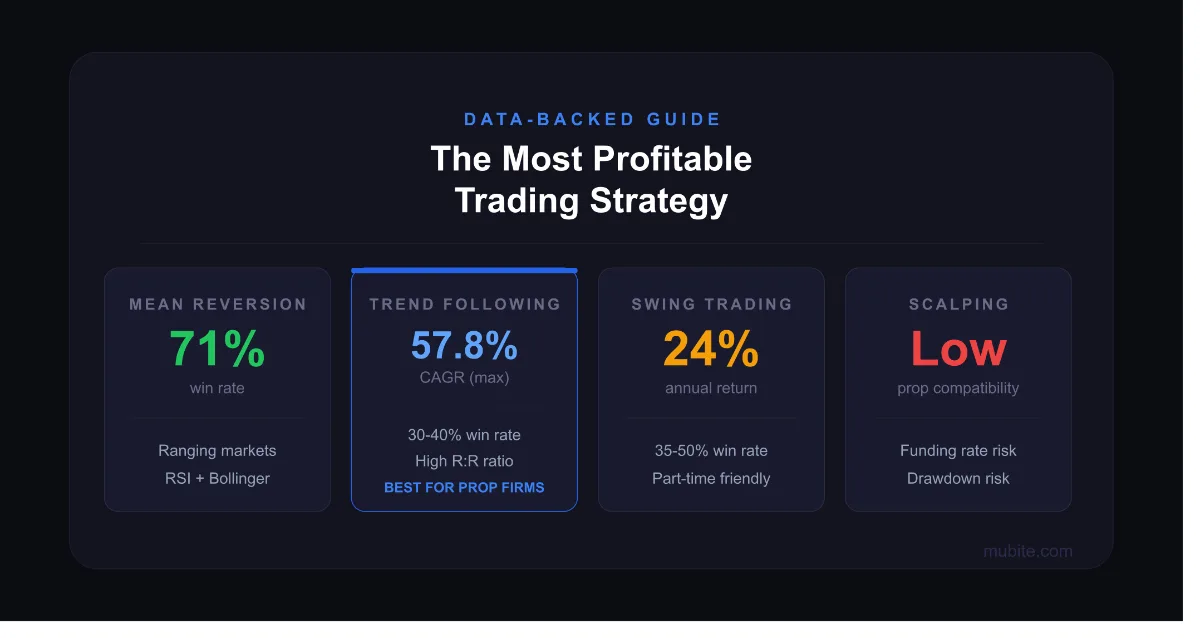
Highest win rate (68% to 71%): Mean reversion and range trading, best in sideways markets
Highest long term returns (29% to 57% CAGR): Trend following, best for patient systematic traders
Best for part time traders: Swing trading on the daily chart, 2% per month compounds to 24% annually
Best for crypto specifically: Trend following and swing trading, both adapt cleanly to perpetual futures on Bybit
Best for prop firm challenges: Swing trading and trend following, consistent risk per trade stays within daily drawdown limits
Avoid for beginners: Scalping, high pressure, funding rate costs, and difficulty staying within daily drawdown limits make it the hardest strategy to pass a challenge with
No strategy works without risking 1% to 2% per trade maximum and sticking to the rules during losing streaks. The data below shows exactly why.
Before looking at the strategies themselves, it is worth understanding why the majority of traders fail. The numbers are stark:
A study tracking 1,551 day traders over two years found that only 1.1% earned more than minimum wage from trading
Data from the Securities and Exchange Board of India (SEBI) showed that 91% of retail traders incurred losses between 2024 and 2025
Research from UC Berkeley and UC Davis analysing 15 years of Taiwan Stock Exchange data found that less than 1% of day traders consistently earned positive returns net of fees
The reason is rarely the strategy. Traders fail because of three consistent causes:
Poor risk management, risking too much per trade relative to account size
Emotional decision making, abandoning a strategy during its natural drawdown period
Undercapitalisation, not having enough capital to survive the variance of even a good strategy
Every strategy discussed below can be profitable. Whether it is profitable for you depends on whether you apply it with discipline and proper position sizing.
Mean reversion strategies profit from the statistical tendency of prices to return to their average after moving too far in either direction. When an asset becomes statistically oversold or overbought, the trader enters a position expecting a snap back to the mean.
The numbers:
Bollinger Band strategies combined with RSI have demonstrated 71% win rates during ranging market conditions on forex pairs, generating an average of 2.3% per trade
Pairs trading approaches show 68% success rates when correlation coefficients remain above 0.8
Prices trade within two standard deviations approximately 95% of the time, which forms the statistical foundation of the strategy
How it works in practice:
Wait for RSI to reach extreme oversold territory (below 30) or overbought (above 70)
Confirm the signal with price touching or exceeding the outer Bollinger Band
Enter a counter position with a tight stop just beyond the extreme point
Target a return to the moving average as the take profit level
Mean reversion fails badly in trending markets. If a market is genuinely trending rather than ranging, the strategy produces a sequence of small losses as the price continues moving away from the mean. Correctly identifying whether a market is ranging or trending before applying this strategy is the critical skill.
Best for: Traders with higher risk tolerance for lower reward per trade, who prefer a high win rate psychological profile over large individual winners.
Trend following identifies the direction of an established price move and enters in that direction, holding until signs of reversal appear. Breakout trading, a subset of trend following, specifically targets the moment when price breaks through a key level of support or resistance with momentum.
The numbers:
Research by Curtis Faith on trend following systems showed compound annual growth rates ranging from 29.4% to 57.8% across different implementations
A 2024 SSRN study found that long only trend following portfolios generated 15.19% CAGR and 6.18% annualised alpha from 1991 to 2024
Win rates for trend following typically sit between 30% and 40%, however the high payoff ratio (average win significantly larger than average loss) makes the strategy profitable overall
How it works in practice:
Identify the dominant trend using a 200 day moving average (price above = uptrend, price below = downtrend)
Wait for a pullback or consolidation within the trend
Enter on the resumption of the trend direction with a breakout candle close
Set a stop below the most recent swing low (long) or swing high (short)
Let profits run, tightening the stop as the move extends
Trend following has a psychologically difficult profile for most traders. Winning only 35% to 40% of trades means tolerating long sequences of small losses. Traders who cannot sit through those drawdown periods abandon the strategy exactly when the next large winning trade is approaching.
Best for: Patient, systematic traders who can tolerate a low win rate in exchange for large individual winners that drive overall profitability.
Swing trading captures medium term price movements over several days to a few weeks using technical analysis to identify optimal entries and exits. Unlike day trading, positions are held overnight and monitored on higher timeframes (daily and 4 hour charts).
The numbers:
Experienced swing traders report win rates between 35% and 50%, with returns of 12% to 45% on individual trades according to VectorVest data
A swing trader averaging 2% profit per month compounds to 24% annually, which historically outperforms the S&P 500 average annual return
The Weekend Trend Trader backtested system achieved 22.9% CAGR from 1990 to present
How it works in practice:
Analyse the daily chart to identify trend direction and key support or resistance zones
Step down to the 4 hour chart to find a precise entry signal (RSI divergence, pin bar, engulfing candle)
Enter the trade with a stop below the key level
Set a target at the next significant resistance (long) or support (short)
Check the trade once or twice per day, not every five minutes
The biggest risk in swing trading is overnight gap risk. News events, earnings, and macro data releases can cause price to gap significantly beyond a stop loss level, resulting in larger than expected losses. Position sizing matters more in swing trading than in any intraday strategy for this reason.
Best for: Traders who cannot monitor screens all day, including those with full time jobs. Swing trading is widely regarded as the most accessible profitable trading style for beginners who have already learned the fundamentals.
Crypto markets are structurally different from stocks and forex in ways that matter significantly for strategy selection. Any strategy that works on equities needs to be adapted before it can be applied to digital assets effectively.
Key structural differences in crypto:
24/7 trading: There is no closing bell. Price can move significantly at 3am on a Sunday. Strategies that rely on overnight gaps behaving predictably (as in equities) need adjustment
Perpetual futures and funding rate: On platforms like Bybit, traders use perpetual futures contracts rather than spot assets. The funding rate, paid every 8 hours between longs and shorts, adds a real cost or credit to held positions that does not exist in stock or forex swing trading. Understanding funding rate is not optional for crypto traders
Liquidation cascades: When leverage users get liquidated, it triggers a chain reaction of forced selling or buying that amplifies price moves beyond what traditional technical analysis predicts. Understanding open interest helps anticipate where these cascades are likely
Mark price vs last price: Bybit and other exchanges use mark price (a smoothed index price) rather than last traded price to calculate liquidations. This prevents manipulation but means your liquidation level is not where you might expect based on chart price alone. Understanding mark price is critical for leveraged traders
Volatility: Bitcoin regularly moves 5% to 10% in a single day. Ethereum and altcoins can move 20% to 30%. Stop losses that are appropriate for forex (10 to 20 pips) would get hit constantly in crypto without adjustment
Which strategies translate best to crypto:
Trend following works exceptionally well in crypto given the extended directional moves common in bull markets and bear markets alike
Mean reversion works during sideways accumulation phases but must be abandoned quickly when a real breakout occurs
Scalping works on BTC/USDT and ETH/USDT pairs due to high liquidity and tight spreads, but funding rate costs eat into profits on leveraged scalping positions held across funding windows
Swing trading on the daily chart is arguably the most transferable strategy from traditional markets to crypto with minimal adaptation required
Selecting a strategy is only half the equation when trading a funded account. Every strategy must also fit within the challenge rules to avoid a forced account reset.
The constraints that matter most are:
Daily drawdown limit: Most prop firm challenges enforce a maximum daily loss of 4% to 5%. A scalping session that goes wrong can hit this limit within hours if position sizing is not conservative
Maximum drawdown: The total account drawdown limit means your strategy must have a maximum realistic losing streak that stays within the overall drawdown boundary
Consistency: Prop firms including Mubite monitor for consistency. A single massive winning day followed by multiple losing days raises flags. The best strategies for funded accounts produce steady, repeatable results
Strategy suitability for prop firm environments:
Swing trading: High compatibility. Holds positions for days, uses wider stops set properly at technical levels, produces consistent returns that fit the risk profile prop firms want to see. The risk management principles required for swing trading map directly to prop firm challenge rules
Trend following (breakouts): High compatibility. Clear entry and exit rules, systematic position sizing, defined risk per trade. Works well with the 1% to 2% risk per trade rule that keeps daily drawdown under control
Mean reversion: Medium compatibility. The high win rate is appealing but the strategy requires tight sizing because a losing trade in a strongly trending market can accumulate quickly. Not recommended as a primary strategy for beginners attempting their first challenge
Scalping: Low compatibility. The volume of trades, funding rate exposure on leveraged positions, and difficulty staying within the daily drawdown limit makes scalping a challenging approach for most prop firm environments. Experienced scalpers can make it work but it is not the recommended starting point
Understanding drawdown mechanics before starting your challenge will help you map your strategy's natural variance to the challenge's limits before risking your fee.
The most beginner friendly starting point is a simple swing trading approach on the daily chart:
Use the 50 day and 200 day moving averages to identify trend direction
Only take trades in the direction of the trend
Risk 1% of account per trade with a fixed stop at a technical level
Target a minimum 2:1 reward to risk ratio on every trade
This produces a win rate around 40% to 50% with a positive expectancy even if it does not feel exciting. The Mubite free trial account allows you to test this approach on real Bybit market execution with no financial risk before committing to a paid challenge.
Before jumping into live markets, it is also worth reviewing the most common crypto trading habits that beginners get wrong so you can avoid the pitfalls before they cost you a challenge fee.
A strategy that works in backtesting or feels logical is not necessarily a strategy that is profitable in live markets. Before trading a funded account, every trader should complete these steps:
Backtest on at least 2 to 3 years of historical data, covering both trending and ranging market conditions
Forward test for a minimum of 30 to 50 trades on a demo or free trial account to confirm live performance matches backtested results
Track your metrics, not just profit and loss. Win rate, average risk to reward, maximum consecutive losses, and maximum drawdown all matter
Define your invalidation criteria before going live. At what point does the data tell you the strategy has stopped working, versus it just being in a normal drawdown? Without a clear answer, you will abandon profitable strategies too early
The Mubite free trial is the safest environment to forward test a strategy under real market conditions. Real Bybit execution, real spreads, real funding rate, but with no capital at risk. Once your metrics confirm the strategy produces consistent results over 30 or more trades, you have the data to commit to a paid challenge with confidence.
Share it with your community