All information on this site is provided by Mubite for educational purposes only, specifically related to financial market trading. It is not intended as an investment recommendation, business advice, investment opportunity analysis, or any form of general guidance on trading investment instruments. Trading in financial markets involves significant risk, and you should not invest more than you can afford to lose. Mubite does not offer any investment services as defined under the Capital Market Undertakings Act No. 256/2004 Coll. The content on this site is not directed toward residents in any country or jurisdiction where such information or use would violate local laws or regulations. Mubite is not a brokerage and does not accept deposits.
Mubite s.r.o., Školská 660/3, Nové Město, ICO: 23221551 Praha 1, 110 00, Czech Republic | Copyright Ⓒ 2026 Mubite. All Rights Reserved.
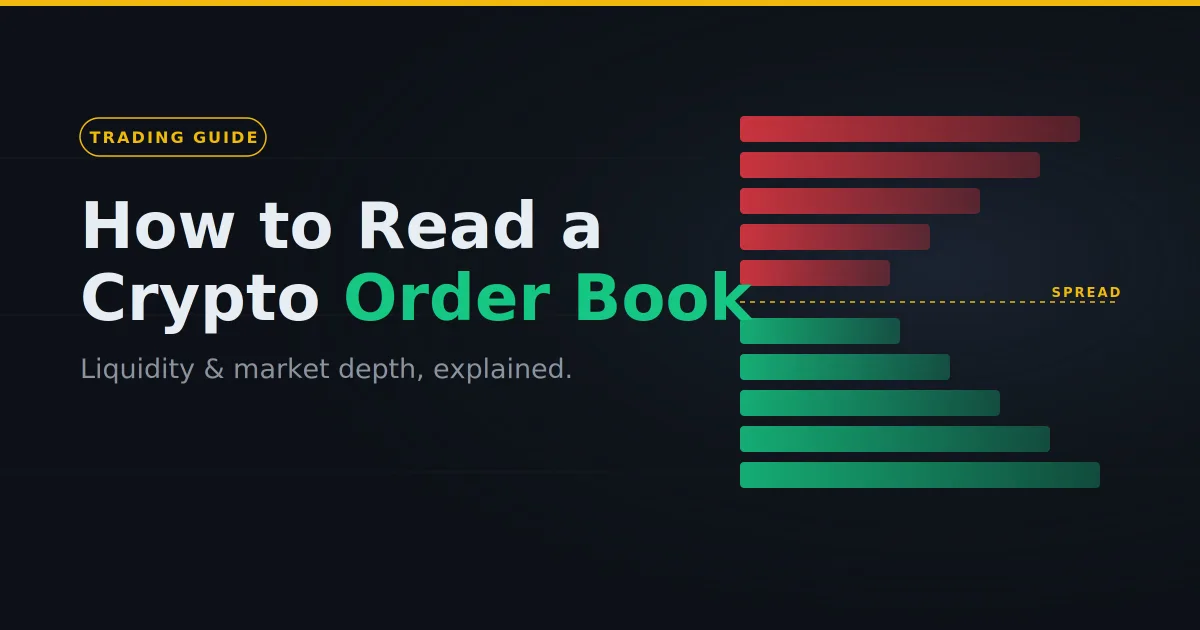
Learn how to read a crypto order book, understand market depth, spot buy and sell walls, and use liquidity to avoid slippage and trade with better execution.
Every trade you place interacts with the order book, whether you look at it or not. It is the live record of supply and demand that determines what price you actually get, how much slippage you pay, and whether a large order moves the market against you.
Most traders only watch the price chart. The traders who also read the order book see what is happening beneath the price: where liquidity sits, where large players are positioned, and where the next move is likely to meet resistance. This guide explains how to read a crypto order book from the ground up.
An order book is a live list of all buy orders (bids) and sell orders (asks) for a trading pair
The highest bid and lowest ask form the top of the book, the gap between them is the spread
Market depth shows how much volume sits at each price level, revealing liquidity
A tight spread and deep book mean high liquidity and low slippage
A wide spread and shallow book mean low liquidity and high slippage risk
Large orders, called walls, can act as support or resistance, but can also be fake
An order book is a real-time, continuously updating list of all the buy and sell orders for a specific trading pair, such as BTC/USDT or ETH/USD. It is the engine behind every centralized exchange, matching buyers with sellers as their prices align.
The order book has two sides:
Bids are buy orders, listed from the highest price down. The highest bid is the most anyone is currently willing to pay
Asks are sell orders, listed from the lowest price up. The lowest ask is the least anyone is currently willing to accept
When a buy order and a sell order meet at the same price, the exchange's matching engine executes the trade and removes those orders from the book. This happens thousands of times per second on liquid pairs.
The order book reflects real-time supply and demand. A heavy concentration of bids suggests strong buying interest, while a stack of asks suggests selling pressure. Reading these dynamics gives traders information that the price chart alone does not show.
Reading an order book starts with three numbers: the best bid, the best ask, and the spread between them.
Here is a simplified BTC/USDT snapshot:
| Side | Price | Size |
|---|---|---|
| Ask | $99,900 | 2.1 BTC |
| Ask | $99,870 | 1.4 BTC |
| Ask | $99,850 | 0.8 BTC (best ask) |
| Bid | $99,800 | 1.2 BTC (best bid) |
| Bid | $99,780 | 2.5 BTC |
| Bid | $99,750 | 3.0 BTC |
From this snapshot:
The best bid is $99,800, the highest price a buyer will pay
The best ask is $99,850, the lowest price a seller will accept
The bid-ask spread is $50, roughly 0.05%, which is very tight and typical for Bitcoin on major exchanges
A market buy order fills at the ask ($99,850), a market sell fills at the bid ($99,800)
The spread is the fastest proxy for liquidity. A narrow spread means high liquidity and low cost to enter or exit. A wide spread means low liquidity, and you pay more simply to cross from one side to the other. On major pairs like Bitcoin, spreads are fractions of a percent. On obscure altcoins, spreads can be several percent, an immediate and often overlooked cost.
Most retail traders see Level 2 data, which shows multiple price levels and the volume at each. Market makers and high-frequency firms use Level 3 data, which shows individual orders with timestamps. For most traders, Level 2 is enough to understand where liquidity sits.
Market depth, also called depth of market or DOM, is the total volume of buy and sell orders stacked across all price levels around the current price. It is the clearest measure of how much liquidity a market actually has.
The distinction that matters is deep versus shallow:
Deep order book: Many large orders across many price levels. Big trades execute with minimal price impact. Typical of BTC/USDT on major exchanges
Shallow order book: Few orders with large gaps between price levels. Even a modest trade can move the price sharply. Typical of low-cap altcoins
Market depth is usually visualized through a depth chart, a graph plotting cumulative buy and sell volume against price. The buy side slopes up as price decreases, the sell side slopes up as price increases, and the gap where they meet is the current price and spread. A steep depth chart on both sides signals a liquid, stable market. A flat or lopsided chart warns of thin liquidity and volatility risk.
Understanding depth matters because it tells you what will actually happen when you place an order. If you want to buy 100 BTC but only 30 BTC sits across the first several ask levels, your average fill price will be well above the best ask. That difference is slippage, and depth is what determines how much of it you pay.
A wall is an unusually large order, or cluster of orders, sitting at a single price level. They are some of the most visible features on an order book and carry useful but unreliable information.
A buy wall is a large concentration of bids below the current price. It can act like a support level, since price has to absorb all that buying interest to move lower
A sell wall is a large concentration of asks above the current price. It can act like a resistance level, since price has to consume all that selling interest to move higher
Walls can genuinely indicate where large players are positioned. But they are also one of the most common tools of market manipulation. Spoofing is the practice of placing a large wall to create the impression of support or resistance, then cancelling it before it fills, tricking other traders into reacting. Layering is a related tactic using multiple fake orders at different levels.
Because of spoofing, a wall is never a guarantee. The reliable way to read walls is to watch how they behave: a genuine wall absorbs trades and holds, while a spoofed wall appears and disappears repeatedly without ever filling. Always confirm what the order book suggests against the actual trade flow.
Liquidity is the measure of how easily an asset can be bought or sold without moving its price. It is the single most underappreciated factor in execution quality, and it directly affects every trade you make.
In a liquid market:
Spreads are tight, so the cost to enter and exit is low
Depth is high, so large orders fill near the expected price
Slippage is minimal, your fill matches your intended price
In an illiquid market:
Spreads are wide, adding immediate cost
Depth is thin, so orders walk up or down the book
Slippage is high, your fill diverges sharply from your intended price
Liquidity is not constant. Crypto trades 24/7, but depth clusters during the European and US session overlap and fades during quieter hours. During volatile events, displayed liquidity can vanish in seconds as market makers pull their orders, widening spreads exactly when you most need to exit. Liquidity is also fragmented across exchanges, so aggregated volume can look strong while a single venue's book is thin. Checking depth on the specific venue you are trading, not just total market volume, is a practical habit that improves execution.
The relationship between liquidity and funding rate and open interest is also worth understanding for perpetual futures traders, since these metrics together paint a fuller picture of market positioning than the order book alone.
The order type you choose interacts directly with liquidity, and in thin markets the difference is significant.
A market order executes immediately at the best available price, walking up or down the book until filled. In a deep market this is fine. In a thin market, a market order can fill at a far worse price than expected as it consumes multiple price levels
A limit order executes only at your specified price or better. It protects you from slippage but may not fill if the market moves away from your price
The practical rule is straightforward. In liquid markets with tight spreads, market orders are convenient and the slippage cost is negligible. In illiquid markets with wide spreads and shallow depth, limit orders protect you from the price impact that a market order would trigger. Splitting a large order into smaller pieces is another way to reduce price impact in a thin market.
The cost difference between maker and taker orders also matters here, since limit orders that add liquidity often carry lower fees than market orders that remove it. Understanding maker vs taker fees helps you factor execution cost into your order choice.
Share it with your community