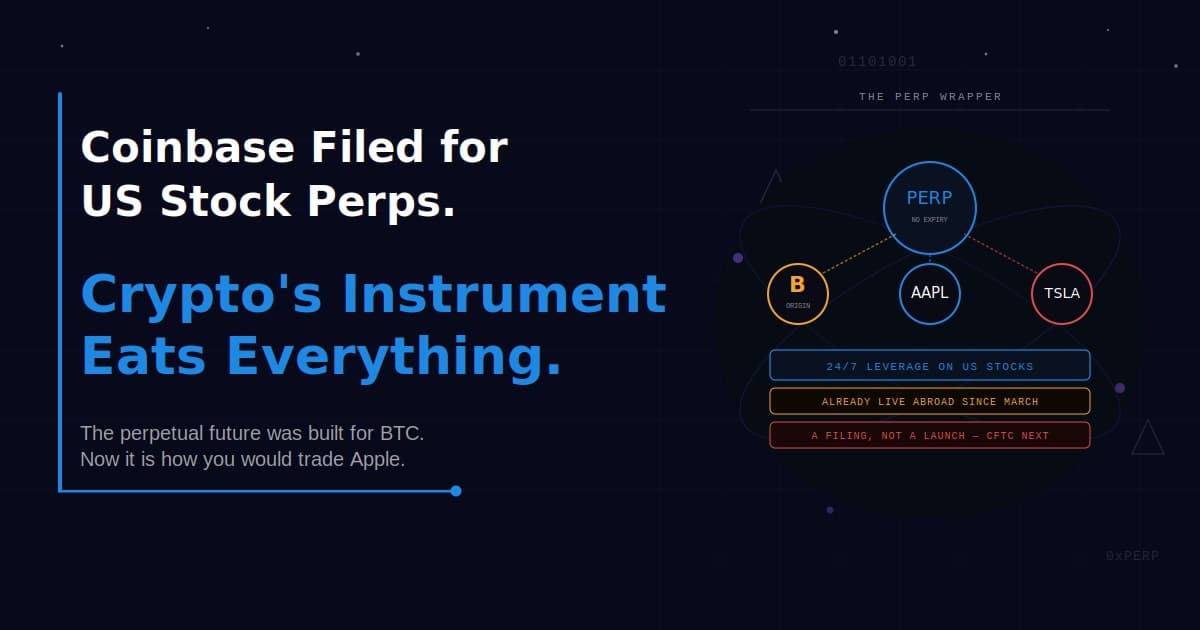
Coinbase Just Filed to Bring Single-Stock Perpetuals to the US. Crypto's Defining Instrument Is Becoming the Wrapper for Everything.
Charles Schwab is adding Solana, Avalanche, and Chainlink to Schwab Crypto, putting three altcoins in front of 36 million brokerage accounts.
Bitcoin surged toward $80,000 for its best week since 2023, up 24% as a record short squeeze liquidated over $3 billion in bearish bets.
All information on this site is provided by Mubite for educational purposes only, specifically related to financial market trading. It is not intended as an investment recommendation, business advice, investment opportunity analysis, or any form of general guidance on trading investment instruments. Trading in financial markets involves significant risk, and you should not invest more than you can afford to lose. Mubite does not offer any investment services as defined under the Capital Market Undertakings Act No. 256/2004 Coll. The content on this site is not directed toward residents in any country or jurisdiction where such information or use would violate local laws or regulations. Mubite is not a brokerage and does not accept deposits. All trading accounts provided by Mubite are simulated demo accounts using live market data. No client funds are traded on live markets. Payout figures shown are individual results and are not typical. Past performance does not guarantee future results.
Mubite s.r.o., Školská 660/3, Nové Město, ICO: 23221551 Praha 1, 110 00, Czech Republic | Copyright Ⓒ 2026 Mubite. All Rights Reserved.
Ethereum's Glamsterdam upgrade went live on the Sepolia testnet on October 6, rewiring how blocks get built with ePBS. Here is what it changes for traders and why mainnet is still months out.
On October 6 at 13:53 UTC, Ethereum's Glamsterdam upgrade activated on the Sepolia test network, marking the start of public testing for the most significant change to how Ethereum builds blocks in years. This was not a mainnet launch and no ETH holder needed to do anything. It was the dress rehearsal.
Glamsterdam rewrites the mechanics underneath every transaction on the network, including the way orders get sequenced and the way value leaks out of trades through MEV, and that plumbing matters to anyone trading on or against Ethereum even though the live rollout is still months away.
The upgrade went live at a specific point in the chain, epoch 353,024, and it bundles two structural changes that have been in research for years.
The headline change is Enshrined Proposer-Builder Separation, known as ePBS and defined in EIP-7732. Today, the validators who propose Ethereum blocks almost all rely on off-chain relays and software like MEV-Boost to actually assemble those blocks. That separation exists, but it lives outside the protocol, held together by trusted middlemen. ePBS writes the split between proposing a block and building a block directly into Ethereum itself, removing the dependence on those external relays.
The second change is Block-Level Access Lists, defined in EIP-7928. The key points of what Sepolia is now testing:
ePBS moves builder commitments, payload reveals, and proposer payments into Ethereum's own consensus process rather than trusted off-chain relays
Block-Level Access Lists let the network process transactions in parallel and give validators more time to verify execution payloads
A set of state-cost changes reprices how the network charges for the storage that larger blocks create
Testing moves to the Hoodi testnet next, tentatively October 27, before any mainnet activation
Vitalik Buterin framed the longer arc as Ethereum evolving into a hybrid of blockchain and advanced cryptography. Glamsterdam is the step that makes the block-building layer ready for it.
From the analysis we have built across this series all year, the part of Glamsterdam that matters most to a trader is the one getting the least attention in the general coverage.
Every trade you place on an Ethereum-based venue sits inside a block that someone builds. The builder decides the order of transactions in that block, and that ordering power is where maximal extractable value, or MEV, comes from.
Builders can place their own transactions ahead of yours, sandwich your trade between theirs, or reorder a block to capture value that would otherwise have been yours. Today that power sits with a small set of off-chain relays that validators trust by convention. ePBS pulls that arrangement into the protocol itself, which over time changes who controls transaction ordering and how transparent that process is.
For a trader, ordering is not an abstraction. It is the difference between the price you expected and the price you got. The same forces that produce slippage on a fast market are shaped by how blocks are built and who gets to build them. A structural change to that layer is a structural change to execution quality, and from what we have observed tracking market structure this year, execution quality is where most traders quietly lose an edge they never measured.
The temptation with a major upgrade headline is to treat it as a reason to position in ETH. That would be a mistake here, and the timeline is the reason.
October 6 was a testnet activation. The mainnet rollout is targeted for the fourth quarter of 2026 with no confirmed date, and large upgrades routinely slip as testing surfaces edge cases. Glamsterdam has already been pushed back once. The Sepolia fork also went live with roughly a seven-day audit buffer, half the usual two-week window, and developers had flagged concerns about builder-level attacks disrupting the testnet. None of that threatens real funds, but it does mean the path from here to mainnet is a monitoring exercise, not a settled date.
Ethereum is trading in a market that has spent the last month reacting to macro and regulatory developments far more than to protocol upgrades. A successful testnet fork is a constructive signal for the Q4 target. It is not a near-term price catalyst, and treating a rehearsal as the main event is how traders get caught paying for news that will not land for months.
Know your liquidation price and your drawdown buffer before you enter, not after. Glamsterdam tells you where Ethereum's architecture is heading over the coming quarters. It tells you nothing about the next candle, and the gap between those two timeframes is exactly where discipline earns its keep.
Share it with your community