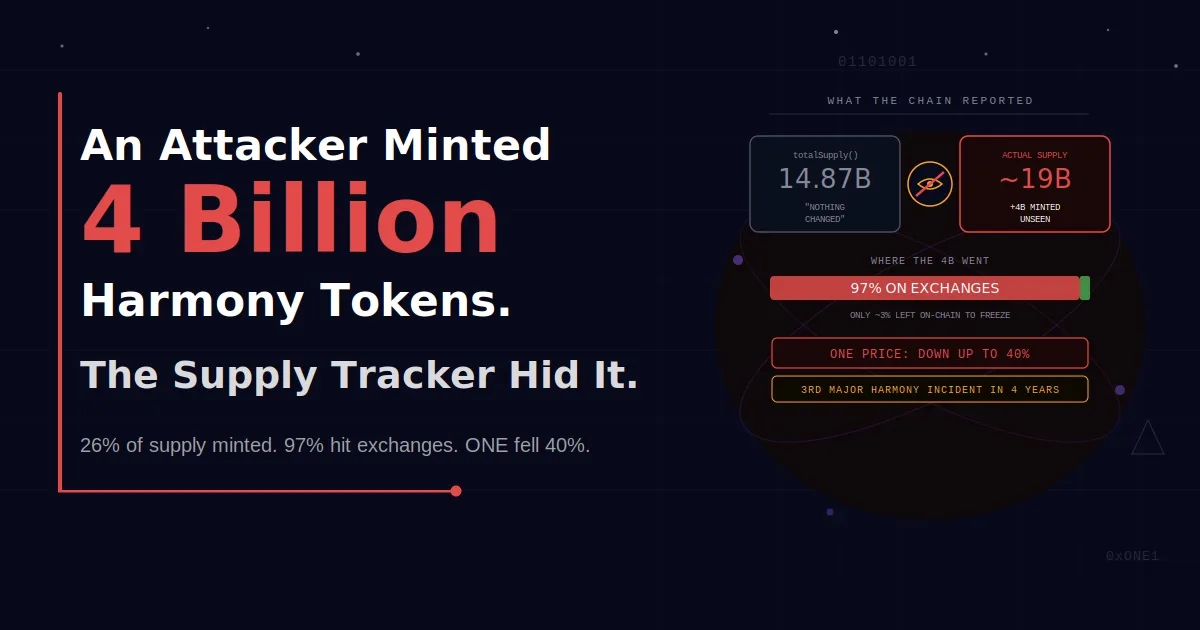
Harmony confirmed an initial 4B ONE mint on August 12, while a later reconstruction points to 3.01T forged ONE. Here is what happened and why it matters.
Circle named BlackRock, DTCC, Visa, Mastercard and ICE as founding validators of its Arc blockchain, launching September 16.
New York sued Kalshi on July 31, calling its prediction markets illegal gambling. The real conflict is a federal versus state jurisdiction fight.
All information on this site is provided by Mubite for educational purposes only, specifically related to financial market trading. It is not intended as an investment recommendation, business advice, investment opportunity analysis, or any form of general guidance on trading investment instruments. Trading in financial markets involves significant risk, and you should not invest more than you can afford to lose. Mubite does not offer any investment services as defined under the Capital Market Undertakings Act No. 256/2004 Coll. The content on this site is not directed toward residents in any country or jurisdiction where such information or use would violate local laws or regulations. Mubite is not a brokerage and does not accept deposits. All trading accounts provided by Mubite are simulated demo accounts using live market data. No client funds are traded on live markets. Payout figures shown are individual results and are not typical. Past performance does not guarantee future results.
Mubite s.r.o., Školská 660/3, Nové Město, ICO: 23221551 Praha 1, 110 00, Czech Republic | Copyright Ⓒ 2026 Mubite. All Rights Reserved.
Bitcoin surged toward $80,000 for its best week since 2023, up 24% as a record short squeeze liquidated over $3 billion in bearish bets.
Bitcoin is trading around $78,600 on Saturday after gaining roughly 24% this week, its strongest weekly move since March 2023. The six-week range between $62,000 and $66,000 is over. At the same time, the Fear and Greed Index has jumped from 27 in fear territory into the low 70s in greed.
Several real catalysts drove the move. But a large part of the rally was mechanical. Traders who had spent weeks betting against Bitcoin were forced to buy it back as their short positions were liquidated. That distinction matters. Part of this rally came from new demand. Another part came from traders who had no choice but to buy.
Three major catalysts arrived within the same window this week.The first came from macro markets. On August 19, the US Treasury announced plans to at least double long-dated bond buybacks. Yields moved lower and risk appetite improved. The same day, President Trump met crypto industry leaders at the White House and urged Congress to pass the CLARITY Act, the market-structure bill we have tracked since its committee vote in May.
The SEC also advanced a new crypto rule proposal, adding to the more constructive regulatory tone. The main catalysts were:
US Treasury doubling long-dated bond buybacks on August 19
Trump's White House crypto summit and push for the CLARITY Act
A new SEC crypto rule proposal
Roughly $1.6 billion in US spot Bitcoin ETF inflows during the week
The ETF flows ranked among the ten strongest flow days of 2026.
These catalysts were important, but they do not explain the full size of the rally. They started the move. Positioning amplified it. CoinShares research head James Butterfill described the move mainly as a macro and liquidity story rather than a crypto-specific one, with Bitcoin reacting to falling real yields.
The most important mechanical part of the rally was the short squeeze. Bitcoin had spent six straight weeks trading sideways more than 50% below its October 2025 all-time high near $126,000. It had also fallen to around $58,600 in late June.
That weakness encouraged traders to keep adding bearish positions. Once Bitcoin broke higher after the Treasury announcement, those positions started closing rapidly. According to CoinGlass, August 19 produced $1.74 billion in crypto short liquidations. It was the second-largest short liquidation event on record, behind only the October 2025 crash.
Short positions represented roughly 92% of all liquidations that day. Across the broader move, total crypto liquidations reached between $3.3 billion and $3.5 billion. The mechanism creates a feedback loop. When a short position is liquidated, it is closed with a buy order. That buying pushes Bitcoin higher. Higher prices then trigger the next group of short liquidations, creating even more buying pressure.
In other words, traders who spent weeks betting against Bitcoin helped drive the rally once their positions were forced closed. Understanding how liquidation mechanics work is important here. A 24% weekly gain does not automatically mean the entire move came from investor conviction.
A short squeeze can be powerful, but the buying behind it eventually runs out. Once most vulnerable short positions have been liquidated, that source of demand disappears.
The key question now is whether real spot demand can replace it. So far, the signals are positive but mixed. Bitcoin ETFs recorded some of their strongest inflows of the year. CryptoQuant data also shows spot and perpetual futures demand turning positive together for the first time since the October 2025 peak.
But there is also selling pressure. More than 44,300 BTC have moved to exchanges since the rally began. That is commonly associated with holders preparing to take profits. Bitcoin has also moved above the level suggested by an inverse head and shoulders pattern that had been developing since the June lows.
That is constructive technically, but the next test is close. Weekend liquidity is thinner and ETF buying will not return until Monday. Analysts are also divided on whether this is a new leg higher or a squeeze that fades once forced buying disappears. Butterfill highlighted $80,000 as the important level.
A decisive break may need more evidence that Federal Reserve policy is moving toward easing. Next week's Jackson Hole symposium could provide more clarity.
The temptation after a rally like this is to chase it. Bitcoin finally looks strong, so traders may assume the bottom is confirmed and increase long exposure. But that can mean buying near the end of a squeeze. The same leverage that liquidated shorts can also punish overleveraged longs if Bitcoin turns lower. A market that can gain 24% in one week can also give back a large part of that move quickly.
Thin weekend liquidity increases that risk. Bitcoin also remains well below its all-time high near $126,000. That leaves room for further upside, but also for another sharp pullback. The rally is real. Its durability is still uncertain.
Know your liquidation price and your drawdown buffer before entering a trade. The traders liquidated this week made the same mistake on both sides. They treated a strong move as if it were a safe one. Size positions for the volatility that is actually in the market.
Share it with your community