All information on this site is provided by Mubite for educational purposes only, specifically related to financial market trading. It is not intended as an investment recommendation, business advice, investment opportunity analysis, or any form of general guidance on trading investment instruments. Trading in financial markets involves significant risk, and you should not invest more than you can afford to lose. Mubite does not offer any investment services as defined under the Capital Market Undertakings Act No. 256/2004 Coll. The content on this site is not directed toward residents in any country or jurisdiction where such information or use would violate local laws or regulations. Mubite is not a brokerage and does not accept deposits.
Mubite s.r.o., Školská 660/3, Nové Město, ICO: 23221551 Praha 1, 110 00, Czech Republic | Copyright Ⓒ 2026 Mubite. All Rights Reserved.
Trade journaling turns your trading from “I feel like I’m improving” into measurable proof. It shows whether your edge is real, whether your risk is stable, and why you broke a rule when it happens. For funded accounts, a solid prop firm trading journal often matters more than a new indicator, because it prevents repeat mistakes.
Trade journaling works best when it tracks rules, execution, and decision quality, not just PnL.
A trading journal for funded traders should log risk per trade and how close you were to limits.
If you trade crypto, record liquidity conditions because they affect fills and stops.
The best platform for trade journaling is the one you will use daily, without friction.
Free trade journaling software is enough at first if you review weekly and keep fields consistent.
Use one trade journaling template, then improve it slowly as patterns become obvious.

What is trade journaling? It is a structured log of each trade that captures numbers plus the decision behind the trade. A normal journal tracks entries and exits. A funded trader journal must also track rule proximity and execution quality, because those are the silent causes of most failures.
This is why the journal should align with your environment. In a challenge context, you are trading under defined limits, so your journal should reflect the challenge rules you are operating under. If you want the broader context for evaluations and funded conditions, that fits naturally inside crypto prop trading.
The most effective trade journaling best practices are simple and repeatable. Our team’s rule is that every field must answer one of two questions: “Was this a good trade?” or “Was this a compliant trade?” If a field does not help you review, remove it.
Here is what to track on every trade. These fields work in any trade journaling software, and they also work in a spreadsheet.
Setup tag and market context (trend, range, event risk)
Entry, stop, target, and planned R multiple
Position size and risk per trade in dollars and percent
Execution notes (limit or market, and why)
Rule proximity notes tied to drawdown and daily limits
A chart screenshot at entry and exit, plus one sentence for each
Discipline grade (followed plan, partly followed, broke plan)
If you trade crypto, add one extra habit. Note liquidity and volatility conditions, because they drive stop quality. This is where tracking slippage in crypto becomes practical, not theoretical.
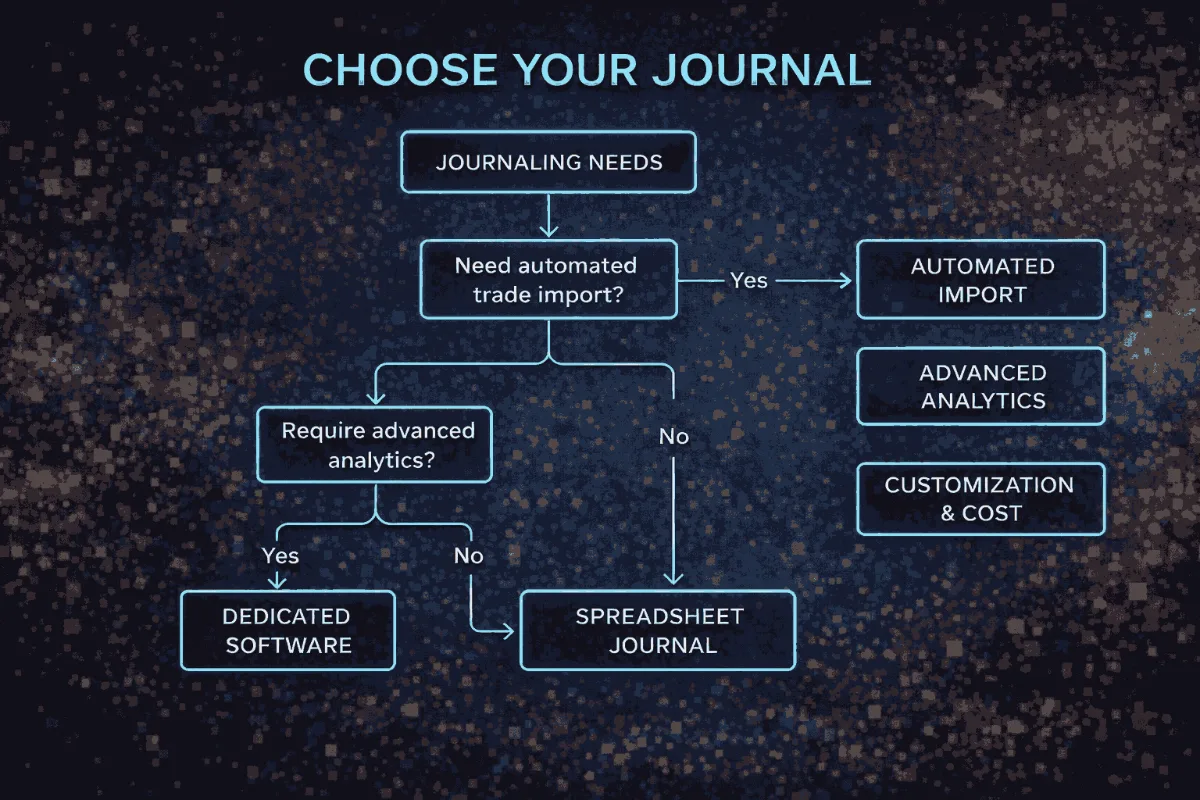
When people search for best trade journaling software or the best platform for trade journaling, they usually want one of two benefits: automatic imports, or faster review. For funded traders, the best tool is the one that makes weekly review unavoidable, because that is where improvement actually happens.
Use this table as a practical comparison. It keeps the focus on workflow, not hype.
| Platform | Best for | Free option | What it does well | Watch-outs for traders |
|---|---|---|---|---|
| TradesViz | Deep analytics | Free tier avaiable | Flexible tagging, dashboards, multi-asset tracking | Easy to overtrack |
| TraderSync | Structured journaling | Trial available | Rule-style tagging, habit tracking, reports | Worth it only with volume |
| Tradervue | Clean journal | Free plan available | Simple workflow, quick filtering and exports | Less flexible custom tracking |
| Edgewonk | Mistake tracking reviews | Paid Tool | Strong review structure and psychology fields | Needs consistent review habits |
| Google Sheets or Notion | Simple DIY journal | Free | Full control, easy templates | Manual work scales poorly |
This trade journaling template is designed for funded trading. It captures what actually explains outcomes: risk, execution, and rule proximity. You can paste it into Notion, Sheets, or any journaling tool as custom fields.
Trade ID:
Date / Session:
Market / Pair:
Setup Tag:
Timeframe:
Entry / Stop / Target:
Planned Risk ($) and Risk (%):
Position Size:
Order Type (limit/market) and reason:
Execution notes (fees, slippage, spread):
Rule proximity note (daily limit, max limit):
Screenshot link(s):
Entry thesis (1 sentence):
Exit reason (1 sentence):
Discipline grade (A/B/C) and why:
One improvement for next time:
Two quick upgrades make this template “funded ready.” First, add a field that links your sizing logic to your position sizing framework, so risk stays consistent even when volatility changes. Second, track whether fees impacted your outcome. For active traders, that naturally ties into maker vs taker fees without turning the journal into a fee spreadsheet.
Trade journaling works when it is built for your reality. Funded traders need a journal that tracks risk, execution, and rule proximity, not just results. Start simple, keep fields consistent, and run a weekly review that produces one clear fix. Over time, your journal becomes your edge, because it shows exactly what to repeat and what to remove.
The best platform for trade journaling is the one you will use every trading day. Many funded traders start with Sheets or Notion, then move to software once volume grows.
Free trade journaling software is enough if you log consistently and review weekly. Paid tools mainly help by saving time with imports and cleaner analytics.
A funded trader journal should track risk per trade, stop distance, and how close you were to limits. It should also note execution quality, because slippage and fees can change real outcomes.
Share it with your community