Ethereum's Glamsterdam upgrade went live on the Sepolia testnet on October 6, rewiring how blocks get built with ePBS. Here is what it changes for traders and why mainnet is still months out.
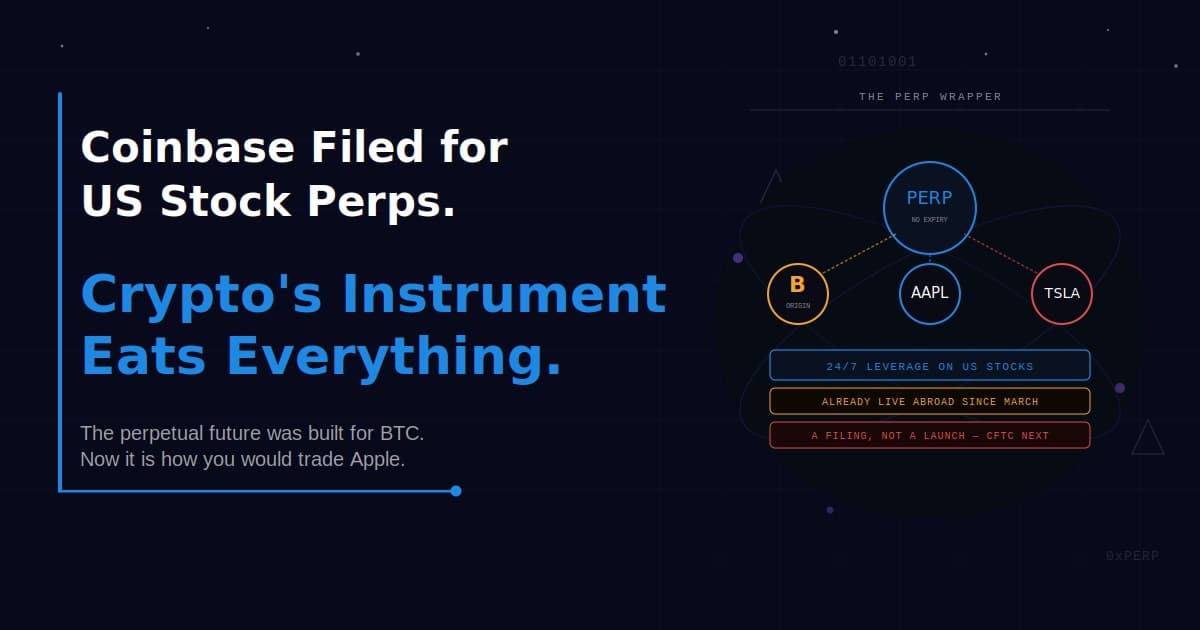
Coinbase Just Filed to Bring Single-Stock Perpetuals to the US. Crypto's Defining Instrument Is Becoming the Wrapper for Everything.
Charles Schwab is adding Solana, Avalanche, and Chainlink to Schwab Crypto, putting three altcoins in front of 36 million brokerage accounts.
All information on this site is provided by Mubite for educational purposes only, specifically related to financial market trading. It is not intended as an investment recommendation, business advice, investment opportunity analysis, or any form of general guidance on trading investment instruments. Trading in financial markets involves significant risk, and you should not invest more than you can afford to lose. Mubite does not offer any investment services as defined under the Capital Market Undertakings Act No. 256/2004 Coll. The content on this site is not directed toward residents in any country or jurisdiction where such information or use would violate local laws or regulations. Mubite is not a brokerage and does not accept deposits. All trading accounts provided by Mubite are simulated demo accounts using live market data. No client funds are traded on live markets. Payout figures shown are individual results and are not typical. Past performance does not guarantee future results.
Mubite s.r.o., Školská 660/3, Nové Město, ICO: 23221551 Praha 1, 110 00, Czech Republic | Copyright Ⓒ 2026 Mubite. All Rights Reserved.
September CPI came in hot on October 14, pushing core inflation to 2.6% and knocking Bitcoin to a one-month low near $80,650. Here is why one data point reset the rate-cut trade.
On October 14, the September Consumer Price Index landed above forecast, and crypto gave up roughly 4.5% in twenty-four hours. Bitcoin fell toward a one-month low near $80,650 before steadying around $82,000, and Ether slid under $2,450. The number itself was not dramatic. What it did to the rate-cut trade was.
A single data point pulled the Federal Reserve's expected path out from under a market that had spent weeks positioning for cuts, and the leverage built on that assumption got flushed. This is the setup heading into the October 28 Fed decision, and it is worth understanding before you size your next position.
The headline number is the one that made the news, but the detail underneath it is what moved the market.
Headline CPI rose 0.6% month on month and 3.7% year on year, up from 3.4% in August. Core CPI, which strips out food and energy and is the figure the Fed watches most closely, rose 0.3% on the month and 2.6% on the year. Forecasts had been 0.2% and 2.5%. A tenth of a percent over consensus sounds like nothing. In a market priced for inflation to keep falling in a straight line, it was enough to break the story traders had been telling themselves.
The report did not arrive in isolation. Brent crude had already spiked to $107.25 on October 12 after a tanker was reported hit in the Strait of Hormuz, and the US 10-year Treasury yield touched 5.37% during the week, its highest level since 2002. Hot inflation, rising oil, and a bond market demanding more yield all point the same direction, and none of it is friendly to risk assets.
Crypto did not fall because inflation is bad for Bitcoin in some mechanical sense. It fell because of how the asset is positioned.
From the data we have analysed across rate-sensitive selloffs this year, the pattern is consistent. Crypto trades as the highest-beta expression of the liquidity trade. When the market believes rate cuts are coming, cheaper money and a weaker dollar flow fastest into the most speculative corner of the risk curve, and that corner is crypto. When a single inflation print pushes those expected cuts further out, the same leverage that amplified the move up amplifies the move down. The asset that ran hardest on the promise of easing is the one that unwinds hardest when the promise fades.
That is why spot flows turned defensive almost immediately. Digital asset investment products saw over $1.2 billion in outflows for the week, and US spot Bitcoin ETFs printed net outflows across the first half of the month before a modest $175.6 million inflow on October 13. Institutions do not panic sell, but they do reprice, and the repricing showed up in the flow data before it showed up in the headlines.
The clearest evidence of what happened is in the forced-selling numbers, and they tell a story of leverage being worked off in stages.
October 8 to 9 saw roughly $1.191 billion in liquidations as the first leg of selling hit
October 13 produced another $488.61 million
By October 14, with much of the leveraged long positioning already cleared, daily liquidations had fallen to around $140 million
That declining sequence matters. When liquidations spike and then shrink across consecutive sessions, it usually means the forced sellers are running out, not that buyers have returned in force. The market is lighter on leverage now than it was two weeks ago, which removes some fuel for a further cascade but does nothing to guarantee direction. A cleaner book can still fall on fresh bad news. It just falls in a more orderly way.
For anyone holding leveraged positions through this, the mechanics are not abstract. Knowing your liquidation price before a macro print, not after it, is the difference between a managed stop and a forced one. The same applies to how funding rates behave when the market flips from crowded longs to balanced positioning, which is exactly what the liquidation sequence above describes.
Everything in the market right now is pointing at a single date. The Federal Open Market Committee announces its decision on October 28, and the September CPI report just made the outcome less certain than it looked a month ago.
Markets are no longer confidently pricing a cut. Rate-hike odds for the meeting, though still low at under 20%, have crept higher, and the more realistic debate is now whether the Fed cuts at all or holds and signals patience. From what we have observed tracking how crypto behaves around scheduled Fed events, the setup is binary in a way that punishes oversized positions in both directions. A dovish surprise can reverse weeks of selling in hours. A hawkish hold can extend the drawdown just as fast. The move is large, the direction is unknowable in advance, and leverage turns both outcomes into a liquidation risk.
This is not a reason to sit out. It is a reason to size for the event in front of you rather than the one you are hoping for. Check your drawdown buffer against a realistic adverse move, not an average day. Set your liquidation price with room for a volatile reaction, and assume the first move after the announcement may not be the real one. The traders who survive binary macro events are rarely the ones who called them correctly. They are the ones who were sized to be wrong and still in the game the next morning.
One inflation print reset the rate-cut trade this month, and the market is still adjusting to it. That is a genuine shift in the macro backdrop, and it deserves attention.
It is also a reminder of how little one data point should dictate about your position. The September CPI report moved the Fed's expected path, but it did not change the fundamentals of any crypto asset you hold. Markets that move this fast on a single number can move just as fast on the next one, in either direction. Crypto remains the most volatile liquid asset class on the planet, and that volatility cuts both ways regardless of how convinced you are about the macro story. Trade the environment you are in, keep your size honest, and let the October 28 decision resolve on its own schedule.
Share it with your community