US spot Bitcoin ETFs lost $1.065 billion this week across seven straight outflow sessions as BTC fell below $67,000, its lowest since August.
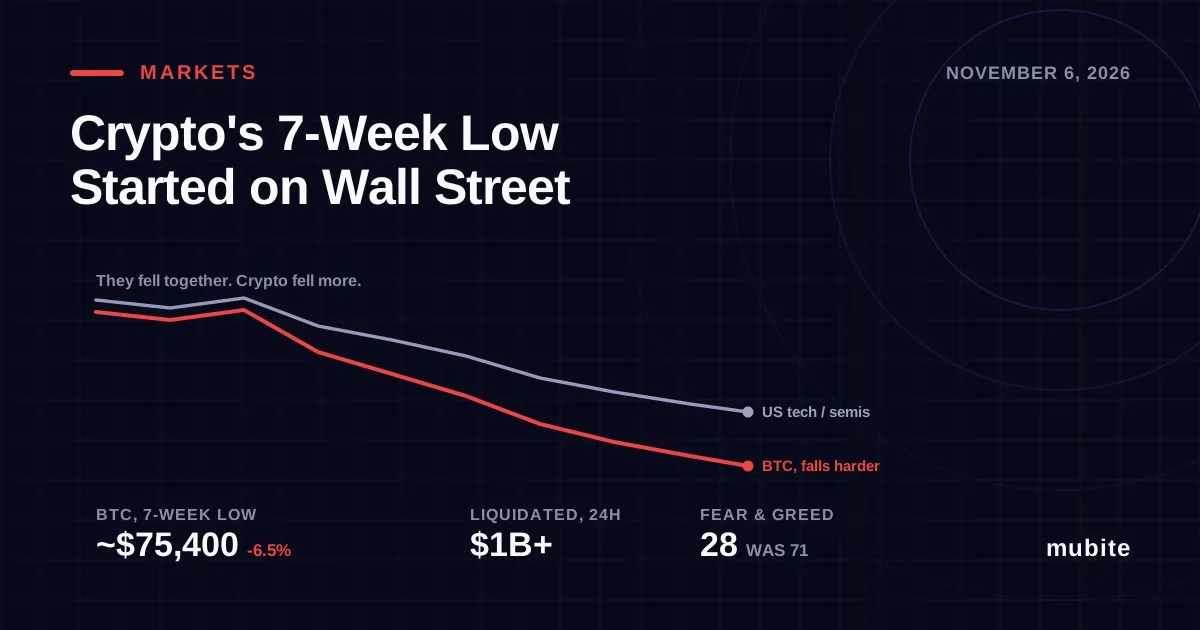
Bitcoin fell to a seven-week low near $75,400 and Ethereum dropped 8.7% as more than $1 billion in positions liquidated. The trigger came from US tech stocks.

Important update: Cleo trading platform will undergo scheduled maintenance on Nov 7 (08:00-10:00 UTC). Trading will be paused and SL/TP orders won't trigger. We recommend closing positions beforehand.
All information on this site is provided by Mubite for educational purposes only, specifically related to financial market trading. It is not intended as an investment recommendation, business advice, investment opportunity analysis, or any form of general guidance on trading investment instruments. Trading in financial markets involves significant risk, and you should not invest more than you can afford to lose. Mubite does not offer any investment services as defined under the Capital Market Undertakings Act No. 256/2004 Coll. The content on this site is not directed toward residents in any country or jurisdiction where such information or use would violate local laws or regulations. Mubite is not a brokerage and does not accept deposits. All trading accounts provided by Mubite are simulated demo accounts using live market data. No client funds are traded on live markets. Payout figures shown are individual results and are not typical. Past performance does not guarantee future results.
Mubite s.r.o., Školská 660/3, Nové Město, ICO: 23221551 Praha 1, 110 00, Czech Republic | Copyright Ⓒ 2026 Mubite. All Rights Reserved.
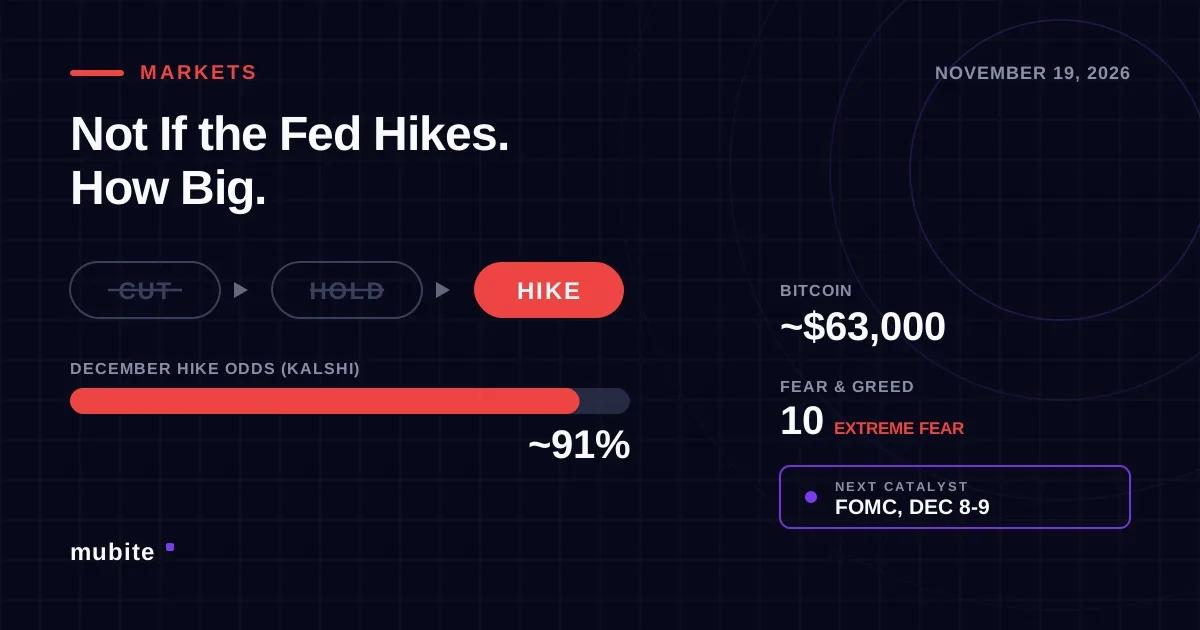
The October FOMC minutes show almost all officials expect further rate hikes, and markets now price a 91% chance of a December hike. Bitcoin fell toward $62,000.
Three weeks ago, the Fed held rates and crypto sold off because the market read the hold as hawkish. The minutes from that meeting, released on November 18, confirmed the read and went further. Almost all officials believe more rate hikes will likely be needed. Prediction markets now put the odds of a December hike at about 91%. Bitcoin slipped below $63,000 again and briefly approached $62,000, while the Crypto Fear and Greed Index fell to 10. The question the market is asking has changed. It is no longer whether the Fed cuts. It is how hard it tightens.
The minutes cover the October 27 and 28 meeting, where the Fed held rates at 3.75% to 4.00% in a 10 to 2 vote. Both dissenters, Lisa Cook and Beth Hammack, wanted a quarter point hike.
The detail released this week shows how far the committee has moved:
Almost all participants judged that further rate increases would likely be necessary
Two participants said a December move larger than 25 basis points could be warranted if inflation data worsened
Officials flagged two AI-related risks: rising costs for equipment, energy and services that could spread inflation, and concerns about the scale and financing of AI investment
Governor Christopher Waller then added his own view. He said the Fed needs to be more aggressive, and argued that if it does not signal a January hike, it should raise rates by 50 basis points in December.
The dollar climbed to a 19-month high, and gold fell about 3% on Wednesday. Kalshi markets priced the chance of a 25 basis point December hike at roughly 91%. That is a near-certainty, and it means the next Fed meeting on December 8 and 9 is no longer a question of direction, only of size.
For crypto, the repricing landed on a market that was already weak. Bitcoin traded near $63,000 on November 19 after briefly approaching $62,000. Ether fell below $1,800, to about $1,777. US spot Bitcoin ETFs have recorded roughly $2.6 billion in net outflows so far in November, extending the selling we covered last week.
From the data we have analysed across this tightening cycle, crypto reacts to the expected path of rates more than to any single decision. When markets expected cuts, cheaper money and a softer dollar supported risk assets, and crypto, as the highest-beta corner of that trade, benefited most. When the expected path turns toward hikes, the same mechanism runs in reverse.
A stronger dollar and higher yields raise the cost of holding non-yielding assets. They also raise the cost of leverage itself. Funding for leveraged longs becomes harder to justify when cash pays more and the trend points down. That is why the minutes hit crypto harder than equities. The asset that depends most on cheap liquidity feels its withdrawal first.
From what we have observed tracking positioning since October, there is also a sentiment layer. A Fear and Greed reading of 10 reflects a market that has absorbed several weeks of hawkish news. Readings this low have sometimes come near local bottoms, but they can also persist for weeks while prices keep falling. Extreme fear on its own is not a buy signal.
Analysts have flagged $62,000 as near-term support for Bitcoin. A clean break below it opens a possible test of $60,000. On the upside, resistance sits at $65,000 to $66,000, then $69,000 to $70,000.
Two dates matter between now and the December decision:
November 25: PCE inflation and GDP data. A hot print strengthens the case for a larger hike
December 8 and 9: The FOMC meeting, where the market now expects a hike and is debating its size
The PCE release is the more immediate risk. If inflation surprises to the upside, the conversation shifts from 25 basis points toward 50, and that is not yet fully priced.
A 91% probability sounds like the hike is already in the price, and to a large extent it is. What is not priced is the size of the move, the tone of the statement, and what the Fed signals for January. Any of those can move crypto sharply in either direction on the day.
If you are trading with leverage into this window, plan for volatility around the November 25 data and the December decision. Know your liquidation price before each release. Watch funding rates, since crowded shorts in an extreme fear market can fuel sharp squeezes. And keep your drawdown buffer wide enough to absorb a move against you on the day the Fed speaks.
Share it with your community