
Important update: Cleo trading platform will undergo scheduled maintenance on Nov 7 (08:00-10:00 UTC). Trading will be paused and SL/TP orders won't trigger. We recommend closing positions beforehand.
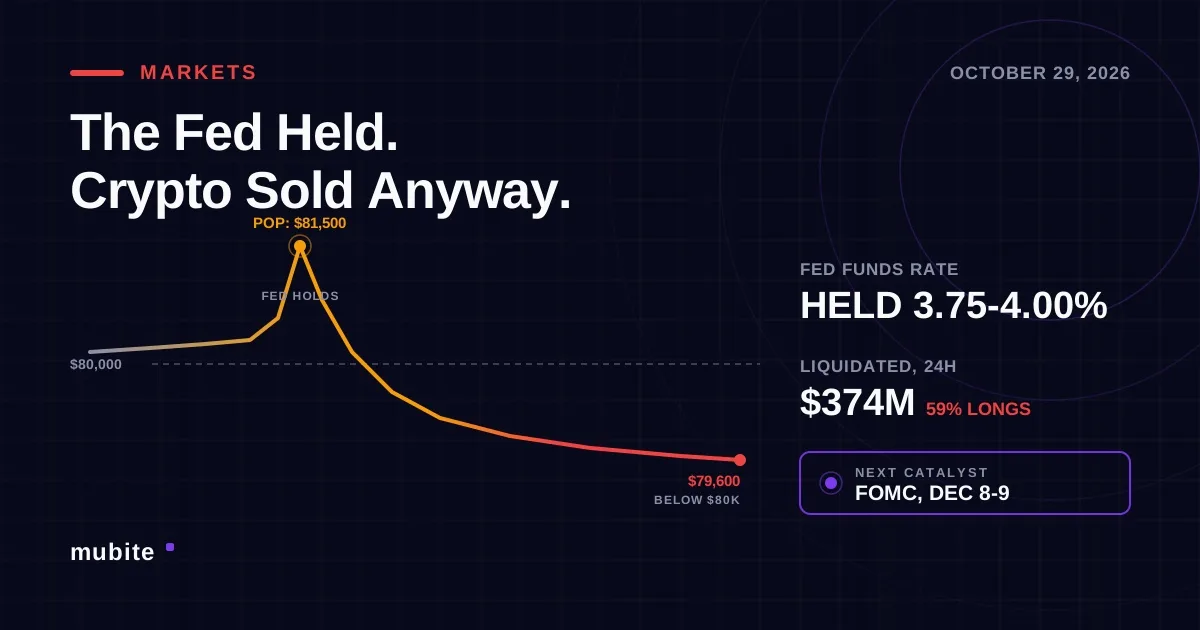
The Fed held rates at 3.75% to 4.00% on October 28 in a 10-2 vote, with both dissents wanting a hike. Bitcoin popped above $81,500, then fell below $80,000.

Mubite's new Nitro Challenge lets you start a one-step challenge on any account up to $100,000 for just $19.90. Here is how the new challenge works.
All information on this site is provided by Mubite for educational purposes only, specifically related to financial market trading. It is not intended as an investment recommendation, business advice, investment opportunity analysis, or any form of general guidance on trading investment instruments. Trading in financial markets involves significant risk, and you should not invest more than you can afford to lose. Mubite does not offer any investment services as defined under the Capital Market Undertakings Act No. 256/2004 Coll. The content on this site is not directed toward residents in any country or jurisdiction where such information or use would violate local laws or regulations. Mubite is not a brokerage and does not accept deposits. All trading accounts provided by Mubite are simulated demo accounts using live market data. No client funds are traded on live markets. Payout figures shown are individual results and are not typical. Past performance does not guarantee future results.
Mubite s.r.o., Školská 660/3, Nové Město, ICO: 23221551 Praha 1, 110 00, Czech Republic | Copyright Ⓒ 2026 Mubite. All Rights Reserved.
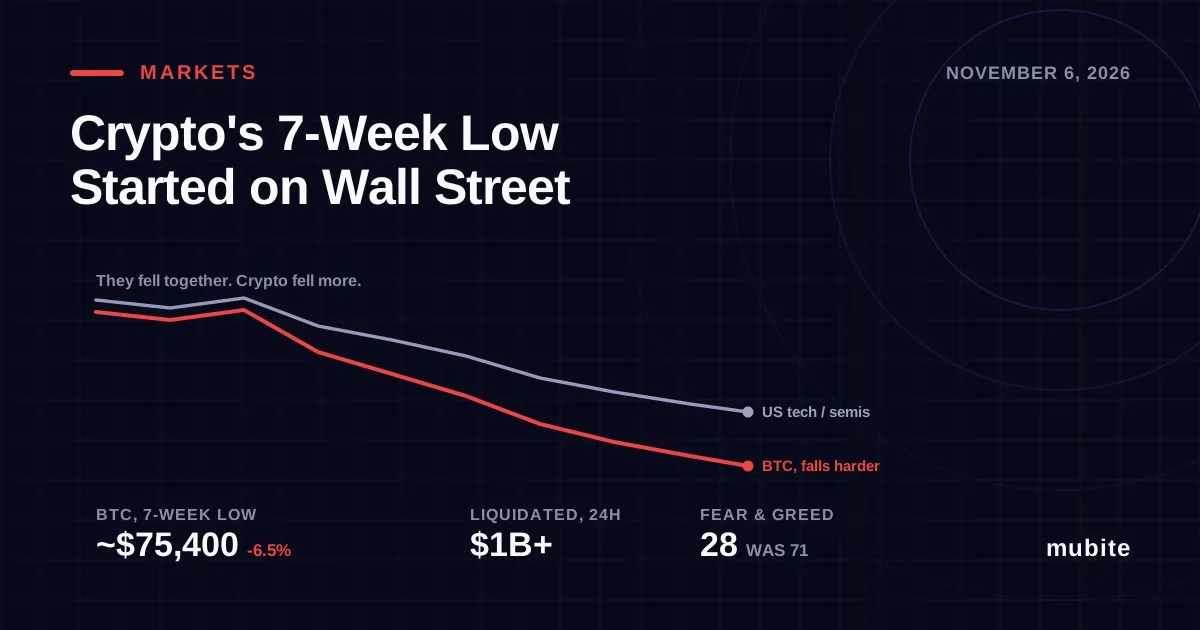
Bitcoin fell to a seven-week low near $75,400 and Ethereum dropped 8.7% as more than $1 billion in positions liquidated. The trigger came from US tech stocks.
On November 6, Bitcoin fell to a seven-week low near $75,400, down about 6.5% on the day, and Ethereum dropped roughly 8.7% to around $2,220. More than $1 billion in positions were liquidated across the market. The reflex is to look for the crypto headline that caused it. There isn't one. The move that dragged crypto to its lowest level in almost two months started in the US stock market, in tech and semiconductor shares, and crypto simply did what the highest-beta risk asset on the board always does. It followed, harder.
The numbers describe a leverage flush, not a slow bleed.
Bitcoin lost roughly 6.5% in a single session to touch about $75,400, its weakest level in seven weeks. Ethereum fell further in percentage terms, down about 8.7% to around $2,220, trading in a 24-hour range between $2,208 and $2,425. The brief recovery attempt earlier in the week, which had carried Ether back toward $2,450, was completely erased.
The liquidation data shows where the damage landed:
More than $1 billion in total crypto liquidations over 24 hours
Ethereum alone accounted for over $210 million of that
Long positions made up $179 million of the Ethereum total, roughly 85% of it
The Crypto Fear and Greed Index collapsed to 28, down from 50 a day earlier and 71 a month ago
That last figure matters as much as the price. Sentiment did not drift lower. It fell off a cliff in a single session, which is the signature of a forced move rather than a considered one.
Here is the part most crypto-native coverage will underplay. Nothing broke in crypto this week. Something wobbled in equities.
The selloff was set off by heavy losses in US technology and semiconductor stocks on November 5, driven by concerns about the scale of AI infrastructure spending and the cost of the borrowing funding it. When the market that has led risk appetite all year suddenly questions its most crowded trade, the repricing does not stay in one asset class.
From the data we have analysed across cross-asset selloffs this year, crypto consistently trades as a leveraged expression of the same risk appetite that drives high-growth tech. When semiconductors sell off on funding and valuation fears, Bitcoin and Ethereum are not insulated by their own fundamentals. They are the most sensitive instrument pointed at the exact same sentiment.
This is why the move was broad rather than selective. Bitcoin, Ethereum and the major altcoins fell together, in proportion to their beta, not in proportion to any project-specific news. A broad, correlated, single-session drop is the market telling you that the driver sits above the asset class, not inside it.
A trigger only produces a billion dollars of liquidations if the positioning was primed for it. This positioning was.
From what we have observed tracking derivatives through this correction, the market had been quietly de-risking for weeks, and the leverage that remained was concentrated and exposed. Open interest in crypto derivatives had already drained to about $11.4 billion by November 6, down from nearly $16 billion in late September.
That is a market that had been bleeding leverage steadily, leaving a thinner, more fragile book of positions behind. Spot ETH ETFs added to the pressure with nearly $100 million in outflows on November 5, part of a multi-day run of institutional withdrawals. When a shrinking pool of leveraged longs meets a sharp external shock, the result is exactly what printed: cascading long liquidations that accelerate the very move they are reacting to.
For anyone carrying leverage, this is the mechanical lesson. Your liquidation price does not care where the shock originated. A long flushed by a semiconductor selloff is liquidated on exactly the same terms as one flushed by a crypto headline, and the funding rates that reset after a cascade like this punish anyone who adds leverage into the reversal expecting a clean bounce.
The practical takeaway is uncomfortable but useful. On days like this, your crypto analysis is not the analysis that matters.
If Bitcoin is moving because Nvidia and the semiconductor index are moving, then the chart that determines your crypto position is not a crypto chart. Traders who were watching on-chain flows and Bitcoin support levels while ignoring the equity tape got blindsided, because the signal was never going to show up in the place they were looking.
This does not mean crypto has no independent drivers. It means that during cross-asset risk-off episodes, correlation temporarily overrides everything else, and sizing a crypto position as though it is isolated from the broader risk complex is the specific mistake these sessions punish.
The defence is not prediction. It is respecting the correlation while it is active. When equities are the driver, your drawdown buffer has to be sized for a move that can be triggered overnight by a market you are not even trading, and your leverage has to assume that a crypto-specific thesis offers no protection against a macro-wide flush.
Share it with your community