All information on this site is provided by Mubite for educational purposes only, specifically related to financial market trading. It is not intended as an investment recommendation, business advice, investment opportunity analysis, or any form of general guidance on trading investment instruments. Trading in financial markets involves significant risk, and you should not invest more than you can afford to lose. Mubite does not offer any investment services as defined under the Capital Market Undertakings Act No. 256/2004 Coll. The content on this site is not directed toward residents in any country or jurisdiction where such information or use would violate local laws or regulations. Mubite is not a brokerage and does not accept deposits.
Mubite s.r.o., Školská 660/3, Nové Město, ICO: 23221551 Praha 1, 110 00, Czech Republic | Copyright Ⓒ 2026 Mubite. All Rights Reserved.
$356M was liquidated in 24 hours as BTC broke $80,000. One trader lost $1.94M wiping out 11 winning trades in a single exit.
When Bitcoin broke above $80,000 on May 5, most of the coverage focused on the price move. What we think deserves more attention is what happened on the other side of that candle. One trader closed a 700 BTC short position at a $1.94 million loss, wiping out the profits from 11 consecutive winning trades in a single exit. That is not a story about bad luck. It is a story about position sizing, negative funding rates, and a trap that funded traders fall into more often than most are willing to admit.
Total crypto liquidations hit $356 million in 24 hours, with $170 million coming from Bitcoin short positions alone. The move was not random. It was the product of a very specific market structure that had been building for weeks.
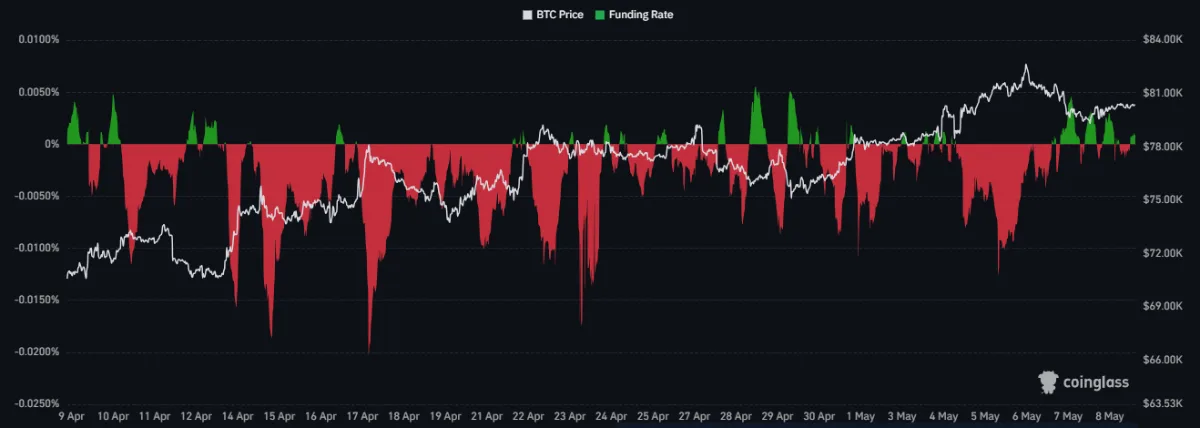
Bitcoin futures funding rates had averaged negative 5% over the past 30 days — historically unusual territory indicating that leveraged short sellers had dominated positioning throughout the Q1 drawdown. When funding is deeply negative for that long, it means the majority of leveraged traders are short and paying longs to hold their positions. It feels like consensus. It feels safe. That consensus is exactly what makes the eventual squeeze so violent.
The trigger came from two directions simultaneously. Trump's Project Freedom announcement eased Middle East tensions, sending crude futures down nearly 5%, and April spot BTC ETF inflows totaled $2.44 billion, the strongest monthly figure since October 2025. Neither of those was predictable on timing. Both hit the same overcrowded short position at once.
The result was a feedback loop. Price moves up, shorts get liquidated, those forced market buys push price higher, more shorts get liquidated. The move briefly reversed when Iran's Fars news agency issued a false report claiming missiles had struck a US warship.
Bitcoin dropped from $80,594 to $79,000 in minutes before the US denied the report and prices recovered. That two-minute drop and recovery tells you everything about how thin the conviction was on both sides during the squeeze.

We have seen this pattern repeatedly in the data we analyze across funded account performance. A trader builds a strong run, confidence grows, position size creeps up, and the one trade where the sizing is finally wrong erases everything that came before it.
The 700 BTC short that produced the $1.94M loss was not the trader's first short. It was their largest. That is almost always how it ends. A sequence of correct calls creates a psychological anchor, the trade feels right, the thesis feels proven, and the position size expands to match the conviction. What it does not account for is the structural risk that was sitting underneath the entire short side: 30 days of negative funding rates telegraphing exactly how crowded the position had become.
On a funded account, this dynamic has a specific consequence. The drawdown limit does not care how many winning trades came before the loss. It measures equity from the peak, and a single oversized position in a short squeeze environment can breach a daily limit that 11 winning trades were never going to breach individually.
The liquidation mechanics on a crowded short are also worse than normal — spread widens, slippage increases, and the mark price moves faster than the last traded price during the squeeze itself.
The practical lesson we draw from this event is not "do not short Bitcoin." It is that funding rate extremes are a position sizing signal, not just a cost of carry.
When funding has been negative for 30 consecutive days, the short side is structurally overcrowded. That does not mean the trade is wrong directionally. It means the risk management math changes. A position that would be normal sizing in a balanced funding environment becomes oversized in a crowded one, because the magnitude of the squeeze when it comes is proportional to how many people are on the wrong side.
A few principles worth taking into the next session:
Check funding rate history before sizing any short position, not just the current rate. Thirty days of negative funding is a structural warning, not a green light.
Winning trades do not justify larger sizing on the next one. Each trade on a funded account starts from the same challenge rules and the same drawdown constraints regardless of what came before it.
A macro catalyst you cannot predict does not excuse ignoring the structural setup you can see. The funding data was visible. The crowding was measurable. The catalyst was the only unknown.
The trader who lost $1.94 million in one exit was not wrong for being short. They were wrong for being short that size in that environment. On a funded account, that distinction is the difference between a bad trade and a failed challenge.
Share it with your community