
T. Rowe Price launched TKNZ on July 16, the first actively managed multi-token spot crypto ETF.
Strategy sold 3,588 BTC for $216 million between June 29 and July 5, its largest Bitcoin sale in history, at a 20% loss to its own cost basis.
Binance exits EU markets after failing to secure a MiCA license, while the US crypto market structure bill advances in the Senate. What it means for traders.
All information on this site is provided by Mubite for educational purposes only, specifically related to financial market trading. It is not intended as an investment recommendation, business advice, investment opportunity analysis, or any form of general guidance on trading investment instruments. Trading in financial markets involves significant risk, and you should not invest more than you can afford to lose. Mubite does not offer any investment services as defined under the Capital Market Undertakings Act No. 256/2004 Coll. The content on this site is not directed toward residents in any country or jurisdiction where such information or use would violate local laws or regulations. Mubite is not a brokerage and does not accept deposits.
Mubite s.r.o., Školská 660/3, Nové Město, ICO: 23221551 Praha 1, 110 00, Czech Republic | Copyright Ⓒ 2026 Mubite. All Rights Reserved.
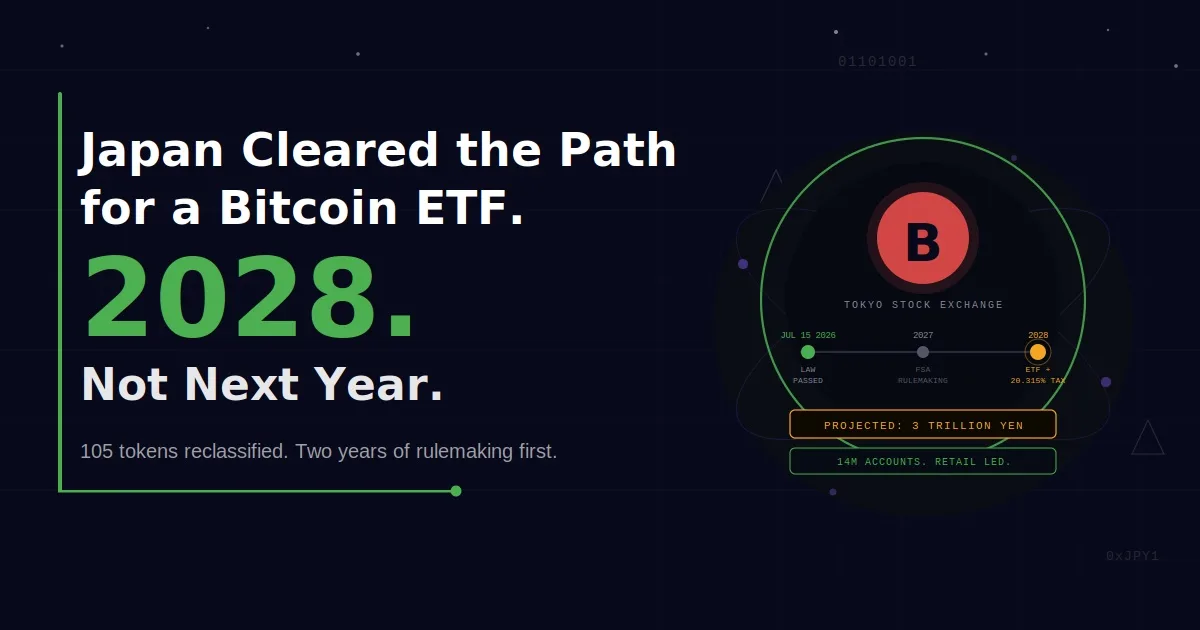
Japan's July 15 law change cleared the legal path for a spot Bitcoin ETF on the Tokyo Stock Exchange. Here is why the launch is still targeted for 2028.
On July 15, Japan's National Diet gave final approval to an amendment moving Bitcoin, Ethereum, XRP and roughly 105 other crypto assets out of the Payment Services Act and into the Financial Instruments and Exchange Act, the same statutory framework that governs stocks and bonds. This week, Nikkei reported that the change could produce Japan's first spot Bitcoin ETF as early as 2028, with projected inflows of up to ¥3 trillion, roughly $20.3 billion, by the end of that fiscal year. Both halves of that sentence matter. The legal barrier is gone. The product is still two years away, and the timeline is provisional.
The reclassification is the whole story. Everything else follows from it.
Under the Payment Services Act, crypto was treated as a means of payment, and Japanese investment trusts were restricted from holding digital assets as underlying property. That single restriction is what kept a spot Bitcoin ETF off the Tokyo Stock Exchange regardless of investor demand. Moving crypto into the Financial Instruments and Exchange Act places it inside the securities perimeter, which makes it an eligible asset for regulated funds.
The amendment carries four other changes worth knowing:
A flat 20.315% tax rate on crypto gains, down from a progressive structure reaching 55%, effective January 1, 2028 and applying only to assets traded through FSA-licensed exchanges
New insider trading prohibitions and market conduct rules that did not previously apply to crypto
Maximum prison terms for unregistered crypto operators raised from three years to ten
Self-custody, DeFi and staking left entirely to FSA secondary rulemaking, meaning those areas remain unresolved
From the data we have analysed across this regulatory series since April, the tax change is the one that actually moves capital. The 55% top rate was the clearest single reason Japanese high-volume traders operated offshore for years. A flat 20.315% aligns crypto with equities and investment trusts, which is the same treatment that normalised equity derivatives participation in Japan decades ago.
Most of the English-language coverage of the Nikkei report reads as though a Japanese Bitcoin ETF is imminent. It is not.
The FSA still has to revise investment trust rules before any product can be filed. Individual ETFs then require separate regulatory approval. Japan Exchange Group was earlier considering listings as early as 2027, and the latest reporting has moved that to 2028. No Bitcoin ETF has been formally approved, and the FSA has not guaranteed that any product will trade in that year.
The tax reform lands on the same schedule. The 20.315% rate takes effect January 1, 2028, which means the ETF and the tax treatment that makes it attractive arrive at roughly the same moment rather than in sequence.
There is a second product on that timeline. The Osaka Exchange has separately floated plans for a Bitcoin futures market, also targeted for 2028. That ordering differs from the United States, where CME listed Bitcoin futures in 2017 and spot ETFs did not arrive until January 2024, a seven year gap. Japan is building spot access and hedging infrastructure to land together.
This is where Japan diverges from every ETF launch we have covered in this series.
The Nikkei report specifically flagged that demand is expected to skew toward individual investors rather than institutions. The underlying numbers support it:
The FSA has reported more than 14 million domestic crypto accounts
Roughly 70% of those account holders earn less than ¥7 million annually
Rakuten plans to distribute crypto investment trusts through smartphone services
Institutional adoption remains limited, though some Japanese pension managers have begun testing small allocations
That inverts the pattern. The US spot Bitcoin ETF launch was an institutional access story first, with BlackRock and Fidelity as the dominant vehicles and retail arriving later through advisors. Japan's version looks likely to run the other way, with retail investors gaining exposure through securities accounts they already hold, and institutional participation following behind.
From what we have observed tracking institutional adoption across the US, Korea and now Japan, the distribution channel shapes the flow profile more than the headline product does. A retail-led ETF market behaves differently from an institution-led one, with smaller average positions, higher sensitivity to price momentum, and different redemption behaviour during drawdowns. SBI Holdings and Nomura are both reportedly preparing products in anticipation.
The Japanese reform is genuinely significant. It is also a 2028 event, and 2028 is a long way from the market in front of you.
Bitcoin is trading near $65,000 with the Fear and Greed Index at 28, deep in fear territory, and total crypto market capitalisation around $2.3 trillion. The ¥3 trillion inflow figure is a projection from a single report, not a commitment. It depends on the FSA completing its rulemaking, asset managers filing products, and Bitcoin still being an asset Japanese retail investors want to own two years from now.
Structural signals like this one tell you where the asset class is heading. They tell you nothing about next week. Know your liquidation price and your drawdown buffer before the next session opens, and let the long-term story play out on its own schedule.
Share it with your community