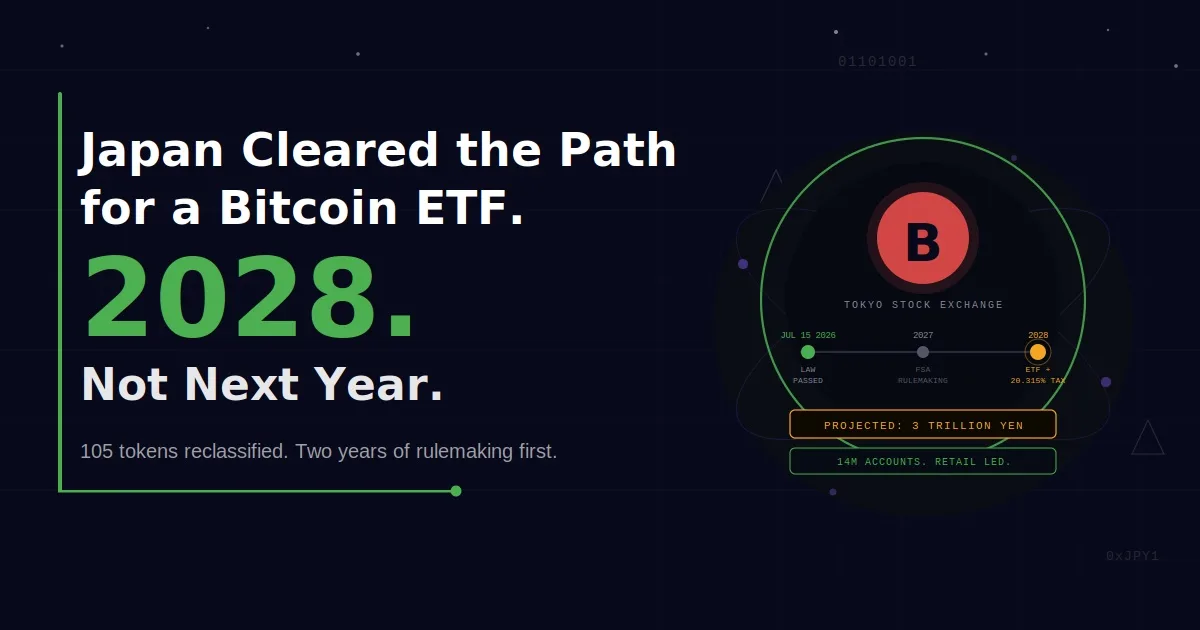
Japan's July 15 law change cleared the legal path for a spot Bitcoin ETF on the Tokyo Stock Exchange. Here is why the launch is still targeted for 2028.
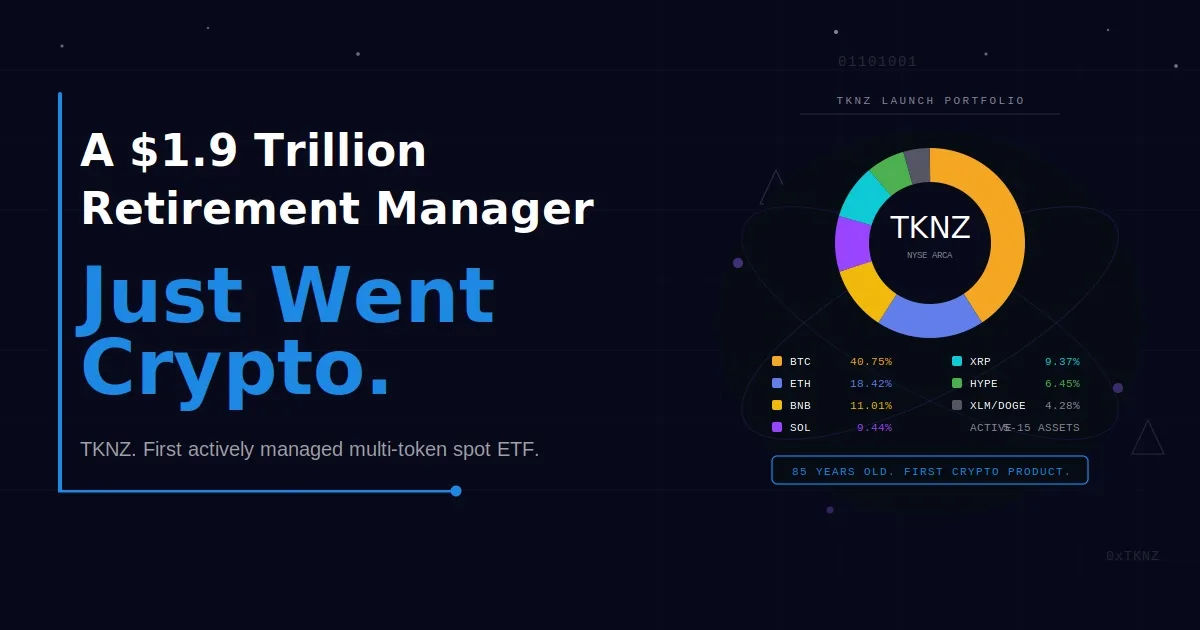
T. Rowe Price launched TKNZ on July 16, the first actively managed multi-token spot crypto ETF.
Strategy sold 3,588 BTC for $216 million between June 29 and July 5, its largest Bitcoin sale in history, at a 20% loss to its own cost basis.
All information on this site is provided by Mubite for educational purposes only, specifically related to financial market trading. It is not intended as an investment recommendation, business advice, investment opportunity analysis, or any form of general guidance on trading investment instruments. Trading in financial markets involves significant risk, and you should not invest more than you can afford to lose. Mubite does not offer any investment services as defined under the Capital Market Undertakings Act No. 256/2004 Coll. The content on this site is not directed toward residents in any country or jurisdiction where such information or use would violate local laws or regulations. Mubite is not a brokerage and does not accept deposits.
Mubite s.r.o., Školská 660/3, Nové Město, ICO: 23221551 Praha 1, 110 00, Czech Republic | Copyright Ⓒ 2026 Mubite. All Rights Reserved.
New York sued Kalshi on July 31, calling its prediction markets illegal gambling. The real conflict is a federal versus state jurisdiction fight.
On July 31, New York Governor Kathy Hochul and Attorney General Letitia James sued prediction market platform Kalshi in a Manhattan state court, calling it an illegal, unlicensed gambling operation and asking a judge to bar it from operating in the state. James put it bluntly in the announcement, saying that no matter what they call themselves, platforms like Kalshi are gambling, plain and simple. Kalshi fired back that a state cannot shut down a federally licensed financial exchange. That single disagreement, not the gambling label, is the actual story, and it reaches further into crypto than a headline about one platform suggests.
The lawsuit is specific about what it wants, and the scale of the demand signals how serious the state is.
New York alleges Kalshi failed to obtain a New York State Gaming Commission license and let users wager on the outcomes of sports, elections, and cultural events. The petition, filed in the New York Supreme Court, does not ask for a small fine. It seeks:
An order barring Kalshi from operating in the state as an unlicensed gambling business
Triple Kalshi's gains from New York users
A civil penalty of $100,000 per unauthorized or attempted wager offer
A full accounting of customer bets, losses, and company profits
Restitution to customers
The state's core argument is that Kalshi's event contracts are quintessentially gambling, and that the platform exposes New Yorkers, including those under the legal gambling age of 21, to financial and personal harm. This is not an isolated action. In April 2026, James filed near-identical suits against Coinbase Financial Markets and Gemini Titan over their own event-contract products, and Governor Hochul signed an executive order banning state employees from using prediction markets like Kalshi for insider trading.
Here is the part the gambling headline misses. Kalshi is not an unregulated operator hiding from oversight. It is registered with the Commodity Futures Trading Commission as a federal designated contract market, the same category of regulation that governs commodity futures exchanges.
That creates a direct jurisdictional collision. Kalshi's position is that its event contracts are federally regulated financial instruments, and that a state gaming commission has no more authority over them than it would over a crude oil futures contract. New York's position is that calling a sports bet an event contract does not change what it is.
The courts have been split and the timeline is moving fast. From the pattern we have tracked across this regulatory series, the sequence matters:
A federal judge denied Kalshi's bid to block state regulators on July 7
The same judge rejected an injunction pending appeal on July 27
The CFTC filed for a temporary restraining order against New York's enforcement actions just before the state's lawsuit landed
The CFTC had already sued New York in April, seeking a permanent injunction against the state enforcing its gambling laws on commission-registered platforms
The CFTC Chairman framed the state's move as an attempt to force an unprecedented sudden shutdown of prediction markets nationwide. That is the genuine stakes. This is not one state versus one company. It is a federal regulator and a state government making incompatible claims about who controls a market that did not meaningfully exist five years ago.
Prediction markets and crypto have become deeply intertwined, which is why this lawsuit is not a sports-betting story that traders can ignore.
Throughout this series we have referenced Polymarket odds as a real-time gauge of market sentiment on everything from the CLARITY Act's passage to whether Strategy would sell Bitcoin. Polymarket, Kalshi's largest rival, settles many of its markets in stablecoins and runs on crypto rails. The prediction-market boom and the crypto derivatives boom have grown from the same demand: traders who want direct, liquid exposure to a specific outcome without the friction of traditional intermediaries.
From what we have observed tracking market structure this year, regulators tend to move against a category once, then apply the precedent broadly. A ruling that state gaming law can override federal commodity registration would not stop at Kalshi. It would reach every event-contract and prediction-market product operating under the same federal framework, including the crypto-native platforms that traders now rely on for sentiment data and hedging. Understanding how funding rates and positioning shift when a regulatory regime is suddenly thrown into doubt is the same skill that protects a position when any structural rule changes without warning.
The Kalshi lawsuit is a structural story that will play out over months of litigation and appeals. It is not a same-day price catalyst for any crypto asset, and treating a headline like this as a reason to reposition is usually a mistake.
Bitcoin is trading near $64,000 with month-end profit-taking and a major options expiry driving the day's volatility far more than any regulatory filing. The jurisdictional question at the heart of this case is genuinely important for the long-term shape of both prediction markets and crypto derivatives, but its resolution is a 2026 and 2027 story, not a today one.
Know your liquidation price and your drawdown buffer before the next session opens. Structural regulatory battles tell you where the ground is shifting over the long term. They tell you nothing about the next candle, and the traders who confuse the two are the ones who get caught.
Share it with your community