All information on this site is provided by Mubite for educational purposes only, specifically related to financial market trading. It is not intended as an investment recommendation, business advice, investment opportunity analysis, or any form of general guidance on trading investment instruments. Trading in financial markets involves significant risk, and you should not invest more than you can afford to lose. Mubite does not offer any investment services as defined under the Capital Market Undertakings Act No. 256/2004 Coll. The content on this site is not directed toward residents in any country or jurisdiction where such information or use would violate local laws or regulations. Mubite is not a brokerage and does not accept deposits.
Mubite s.r.o., Školská 660/3, Nové Město, ICO: 23221551 Praha 1, 110 00, Czech Republic | Copyright Ⓒ 2026 Mubite. All Rights Reserved.
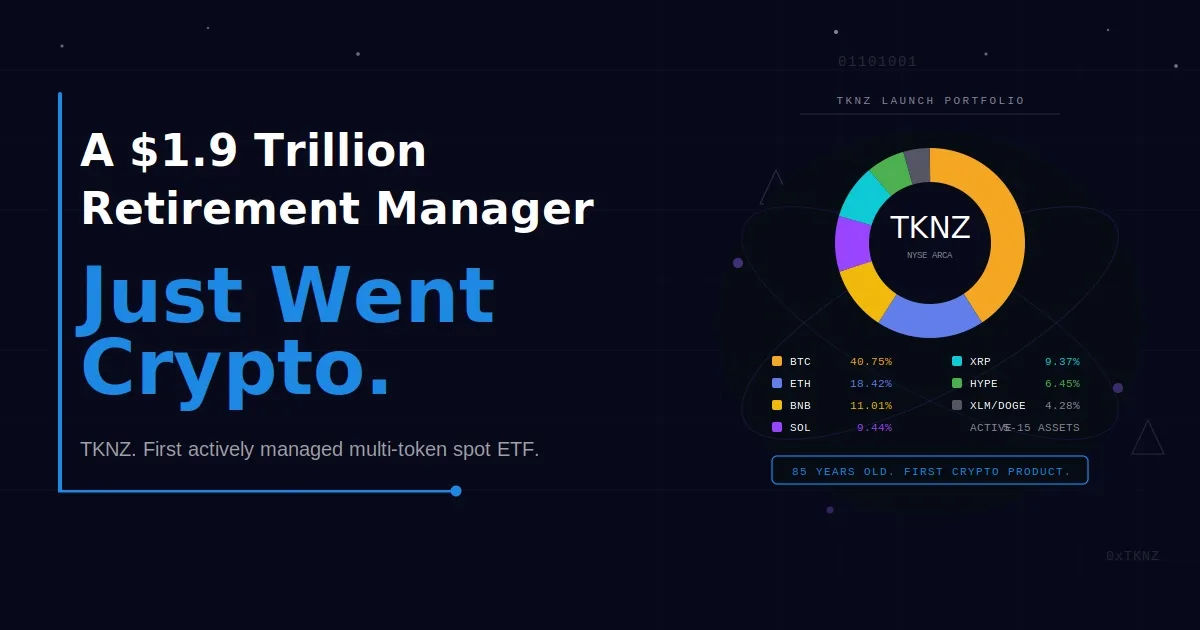
T. Rowe Price launched TKNZ on July 16, the first actively managed multi-token spot crypto ETF.
T. Rowe Price launched TKNZ this week, the crypto industry's first actively managed multi-token spot exchange-traded fund, which began trading on NYSE Arca on July 16. This is not another single-asset Bitcoin fund. It is an 85-year-old firm managing approximately $1.89 trillion in client assets, roughly two-thirds of it tied to retirement accounts, entering crypto with a product no competitor has tried.
The significance is not the launch itself. It is who launched it, and what the structure of the product signals about how traditional finance now approaches this asset class.
Most crypto ETFs track a single asset. A spot Bitcoin fund holds Bitcoin. An Ethereum fund holds Ethereum. TKNZ takes a fundamentally different approach that has not existed in a regulated US product until now.
The fund holds a basket of major crypto assets and, crucially, allows its portfolio managers to actively adjust those holdings as market conditions change rather than tracking a fixed index. At launch, the reported weights were:
Bitcoin at 40.75%
Ethereum at 18.42%
BNB at 11.01%
Solana at 9.44%
XRP at 9.37%
Hyperliquid at 6.45%
Stellar at 3.00%, Dogecoin at 1.28%, plus small USDC and cash positions
The filing states the fund will normally hold between five and fifteen eligible assets. It is a spot product, meaning it holds the underlying crypto directly rather than using futures, which avoids the roll costs that erode futures-based products but introduces the operational realities of crypto custody. The launch portfolio held roughly $15 million in assets, with a management fee of 0.75% under a temporary waiver through May 2027, rising to 0.90% afterward.
From the analysis we have built across this institutional adoption series since April, the identity of the issuer is the real story here, not the product mechanics.
T. Rowe Price is not a crypto-native firm. It is not a hedge fund chasing a hot narrative. It is one of the most conservative, retirement-focused asset managers in the United States, with roughly two-thirds of its $1.89 trillion in assets connected to retirement accounts. When a firm whose core business is managing the retirement savings of ordinary Americans decides to launch a crypto product, the signal is different in kind from a crypto specialist doing the same thing.
The pattern we have documented through this series makes the context clear. XRP crossed $63 billion in regulated CME futures volume. Morgan Stanley filed for a Solana ETF with staking. JPMorgan, Citi, and Bank of America began building a shared tokenized deposit network. Each of those was a step in traditional finance moving toward crypto. T. Rowe Price launching an actively managed multi-token fund aimed partly at the retirement-adjacent investor is the same trend reaching one of its most conservative possible endpoints.
The active management angle reinforces this. A passive index fund is a bet that crypto as a category goes up. An actively managed fund is a firm saying it believes it can add value through research and rotation in this asset class specifically. That is a deeper institutional commitment than simply offering exposure.
One detail in the TKNZ portfolio deserves specific attention because it says something about where institutional thinking has moved.
The fund launched with a 6.45% allocation to Hyperliquid, a decentralized perpetuals exchange token that did not exist in any institutional portfolio conversation a year ago. For a conservative retirement manager to include HYPE in its debut crypto product, at a weight larger than its XLM and DOGE positions combined, signals that the institutional definition of an investable crypto asset has broadened considerably.
From what we have observed tracking this market since the spring, this is the kind of detail that matters more than the headline. Bitcoin and Ethereum in an ETF is expected. A major traditional manager allocating to a decentralized exchange token in its first crypto product is a genuine shift in what counts as institutionally acceptable.
TKNZ is a meaningful signal for the long-term institutional adoption of crypto. It is not a short-term price catalyst, and it is important to hold both of those truths at once.
The fund launched with roughly $15 million in assets, a modest figure against a multi-trillion-dollar crypto market. It will not move Bitcoin's price this week. What it does is widen the on-ramp. T. Rowe Price's distribution network reaches financial advisors, retirement platforms, and conservative investors who would never open an account on a crypto exchange. Over months and years, that access is how institutional capital actually enters the asset class, not in a single dramatic inflow.
The broader market context has not changed because of this launch. Bitcoin is trading in the low $60,000s with the Fear and Greed Index sitting in the twenties, firmly in fear territory, and total crypto market capitalisation around $2.27 trillion. The institutional infrastructure is being built while sentiment remains cautious and prices remain well below last year's highs. That divergence between what institutions are building and what the market is pricing has been the defining feature of 2026.
The temptation with a story like this is to treat a major institutional launch as a reason to add risk. That is usually a mistake. TKNZ tells you where the asset class is heading over years. It tells you nothing about where price goes this week.
A retirement manager launching a crypto ETF does not change your drawdown limit, your liquidation price, or the funding rate you pay on an open position. Those are determined by current market conditions, not by long-term adoption narratives. Understanding how funding rates and current volatility shape your actual risk is what protects an account. The institutional thesis is real and it is worth understanding. Just do not confuse a multi-year signal for a short-term trade. Size for the market in front of you, and let the adoption story play out on its own timeline.
Share it with your community