All information on this site is provided by Mubite for educational purposes only, specifically related to financial market trading. It is not intended as an investment recommendation, business advice, investment opportunity analysis, or any form of general guidance on trading investment instruments. Trading in financial markets involves significant risk, and you should not invest more than you can afford to lose. Mubite does not offer any investment services as defined under the Capital Market Undertakings Act No. 256/2004 Coll. The content on this site is not directed toward residents in any country or jurisdiction where such information or use would violate local laws or regulations. Mubite is not a brokerage and does not accept deposits.
Mubite s.r.o., Varšavská 488/23, ICO: 23221551 Prague 2, 120 00, Czech Republic | Copyright Ⓒ 2025 Mubite. All Rights Reserved.

If you’ve ever searched for stop loss meaning or what is a stop loss in trading, you’re not alone. A stop loss is one of the simplest and most important risk management tools in the market — and also one of the easiest to misuse.
Used correctly, it protects your account from the one bad trade that ruins a week or a month of progress. Used poorly, it turns into a frustration machine that keeps stopping you out right before the market moves in your favor.
In this guide, we’ll explain:
what a stop loss in trading actually is
how a stop loss order works
the difference between stop loss vs stop limit orders
where to place a stop loss properly
how traders use stops in day trading and volatile markets
A stop loss is a predefined price level where your position automatically closes if the market moves against you.
The purpose of a stop loss is simple: limit your potential loss on a trade.
For example:
You buy Bitcoin at $40,000
You set a stop loss at $39,200
If the price drops to $39,200, the platform automatically exits your trade.
The goal is not to predict the market perfectly. The goal is to protect your capital so one trade cannot damage your account too much.
Experienced traders think about stop losses differently than beginners. Instead of asking:
“How much money am I willing to lose?”
they ask:
“At what price is my trade idea proven wrong?”
That level is where the stop loss belongs.
Also remember: stop loss trading is not a strategy on its own. It is a risk management layer that makes any strategy sustainable over time.
A stop loss order is the instruction that tells your trading platform to close a position when a certain price is reached. You set two things:
the stop price (trigger level)
the order type used once that level is hit
For a long trade, the stop loss is typically a sell order placed below the entry price. For a short trade, the stop loss is a buy order placed above the entry price. Once the market touches the stop level, the platform automatically submits the exit order.
However, one important detail many beginners miss is this: A stop loss does not guarantee the exact exit price. It guarantees that your position will attempt to close once the trigger level is reached. In fast markets or during news events, the actual fill price may differ slightly due to slippage.
A common point of confusion for traders is the difference between stop loss orders and stop limit orders.
A stop loss order is usually executed as a stop-market order. When the stop price is triggered, the system sends a market order to exit the position immediately. The priority is getting out of the trade.
A stop limit order works differently. After the stop price is triggered, the order becomes a limit order. This gives you more control over the exit price but introduces a risk: if the market moves too quickly, the order might not fill. In practice:
Stop-market orders are safer when the priority is guaranteed exit, especially during high volatility or sudden market moves.
Stop-limit orders are used when traders want precise price control, but they accept the possibility that the order might not execute. If you are trading under prop firm rules or strict drawdown limits, stop-market orders are often safer because a missed exit can cause a much larger loss than expected.

The question “where to place stop loss” is where most trading advice becomes too simplistic. A good stop loss is not simply tight or wide. It must reflect two things:
the point where your trading idea is invalid
the natural volatility of the market
Professional traders usually rely on three main approaches.
Structure stops are placed beyond important market levels such as:
swing highs
swing lows
support or resistance zones
For example, if you enter a long trade during an uptrend, the stop loss is often placed below the previous swing low. If the market breaks that level, the structure of the trend changes and the trade idea becomes invalid. This method works best when:
the market is trending
price respects technical levels
the chart shows clear swing points
ATR stands for Average True Range, an indicator that measures how much the market typically moves during a given period. Using an ATR stop loss helps ensure that your stop is not placed inside normal market fluctuations.
For example: If the average movement of the market is $150 per candle, placing a stop only $30 away from entry will likely get triggered by normal noise. Many traders combine both methods:
place the stop at the invalidation level (structure)
check whether that distance makes sense relative to ATR volatility
If the stop is too tight relative to volatility, the trade will likely fail even if the idea is correct.
Some traders use a fixed percentage stop, such as 1% or 2% from the entry price. While this approach sounds simple, it can ignore market conditions. Different assets move differently:
crypto markets are extremely volatile
forex pairs move less
stocks may behave differently during earnings season
A fixed percentage stop can sometimes be too tight in volatile markets and too wide in calm markets. Because of this, percentage stops work best when they also align with structure and volatility levels.
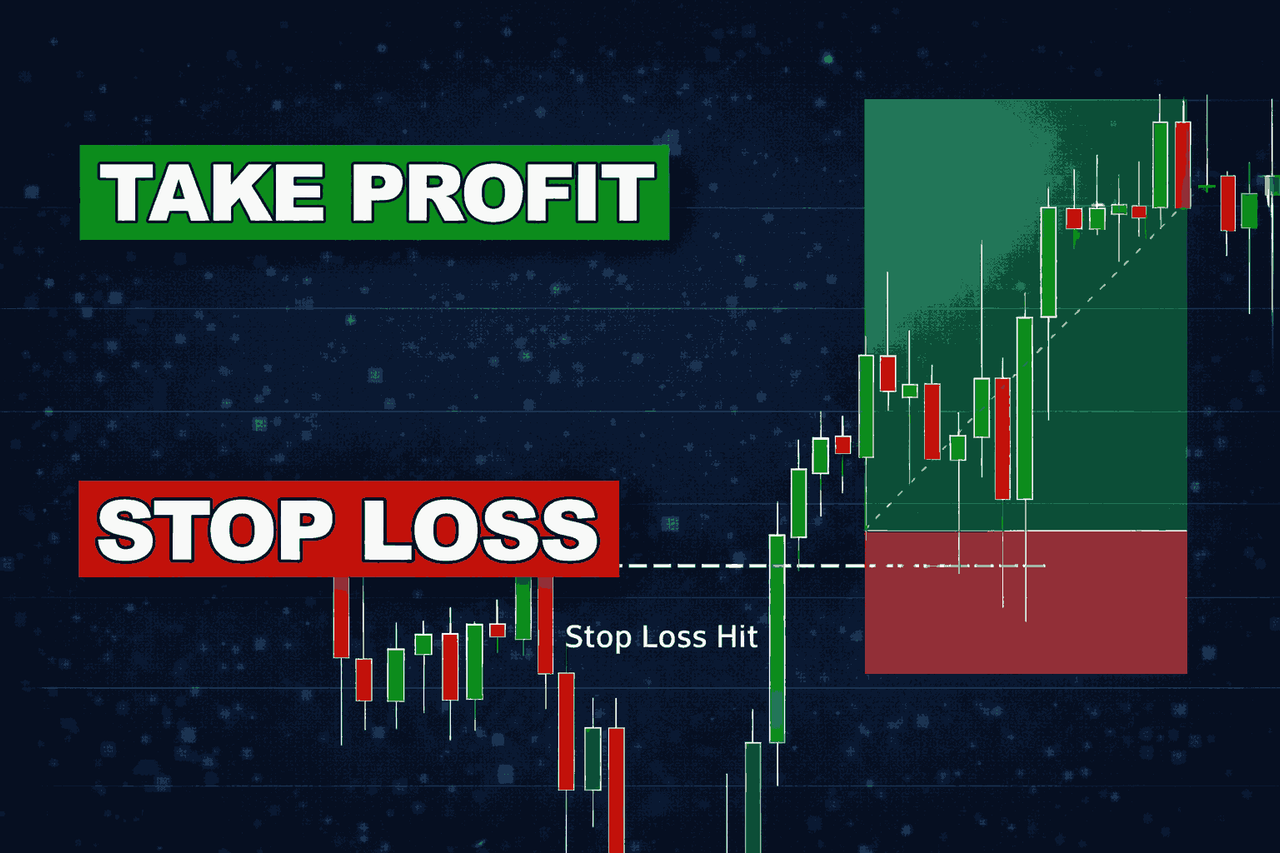
Another important concept in trading is the relationship between stop loss and take profit orders. A stop loss protects you when the trade goes wrong. A take profit locks in gains when the market moves in your favor. For example:
Entry: $40,000
Stop loss: $39,200
Take profit: $41,200
In this scenario, the potential loss is $800, while the potential gain is $1,200.
This creates a risk-reward ratio of 1:1.5, which means the potential reward is larger than the risk. Many professional traders focus heavily on this relationship. Even with a win rate below 50%, a good risk-reward ratio can make a strategy profitable over time.
A trailing stop loss automatically moves in the direction of a profitable trade. If the market continues to move in your favor, the stop follows the price and gradually locks in profit.
If the price rises to $110, the stop moves to $105. If the market then reverses, the trade closes with profit. Trailing stops work well in strong trends because they allow profits to run while still protecting gains.
However, they can perform poorly in sideways markets, where price fluctuations repeatedly trigger the stop. Many experienced traders prefer trailing stops based on market structure rather than purely mechanical distances.
A common question is: What is the best stop loss percentage for day trading?
There is no single number that works for every market. Day trading happens in fast and noisy environments. What matters is not the percentage itself but whether the stop is outside the normal volatility of the timeframe you are trading.
Professional day traders usually follow a simple framework:
Define the level where the trade idea fails
Check volatility to avoid placing the stop inside noise
Adjust position size so the risk per trade stays consistent
This approach ensures that even if stops are wider on some trades, the actual monetary risk remains controlled.
Many traders feel like their stops are constantly being “hunted”. In reality, the cause is usually mechanical. The most common mistakes include:
placing stops inside normal volatility
entering trades too late, forcing tight stops
placing stops at obvious liquidity levels
using the wrong order type during high volatility
immediately re-entering trades after a stop-out
The final point is especially dangerous. One loss is manageable, but emotional reactions after a stop can lead to revenge trading and rapid drawdowns. Successful traders treat stop losses as part of the process, not as failures.
A stop loss is a predefined exit level that closes a trade if the market moves against the position. Its purpose is to limit potential losses and protect trading capital.
A stop loss order is the instruction sent to the trading platform that triggers when the market reaches a specific price level. Once triggered, it typically executes as a market order to close the position.
A trailing stop loss moves with the market as a trade becomes profitable. It helps lock in profits while still allowing the position to continue running if the trend continues.
There is no universal stop loss percentage for day trading. The best approach is to place stops at logical invalidation levels and adjust position size according to the distance of the stop.
Share it with your community