All information on this site is provided by Mubite for educational purposes only, specifically related to financial market trading. It is not intended as an investment recommendation, business advice, investment opportunity analysis, or any form of general guidance on trading investment instruments. Trading in financial markets involves significant risk, and you should not invest more than you can afford to lose. Mubite does not offer any investment services as defined under the Capital Market Undertakings Act No. 256/2004 Coll. The content on this site is not directed toward residents in any country or jurisdiction where such information or use would violate local laws or regulations. Mubite is not a brokerage and does not accept deposits.
Mubite s.r.o., Školská 660/3, Nové Město, ICO: 23221551 Praha 1, 110 00, Czech Republic | Copyright Ⓒ 2026 Mubite. All Rights Reserved.
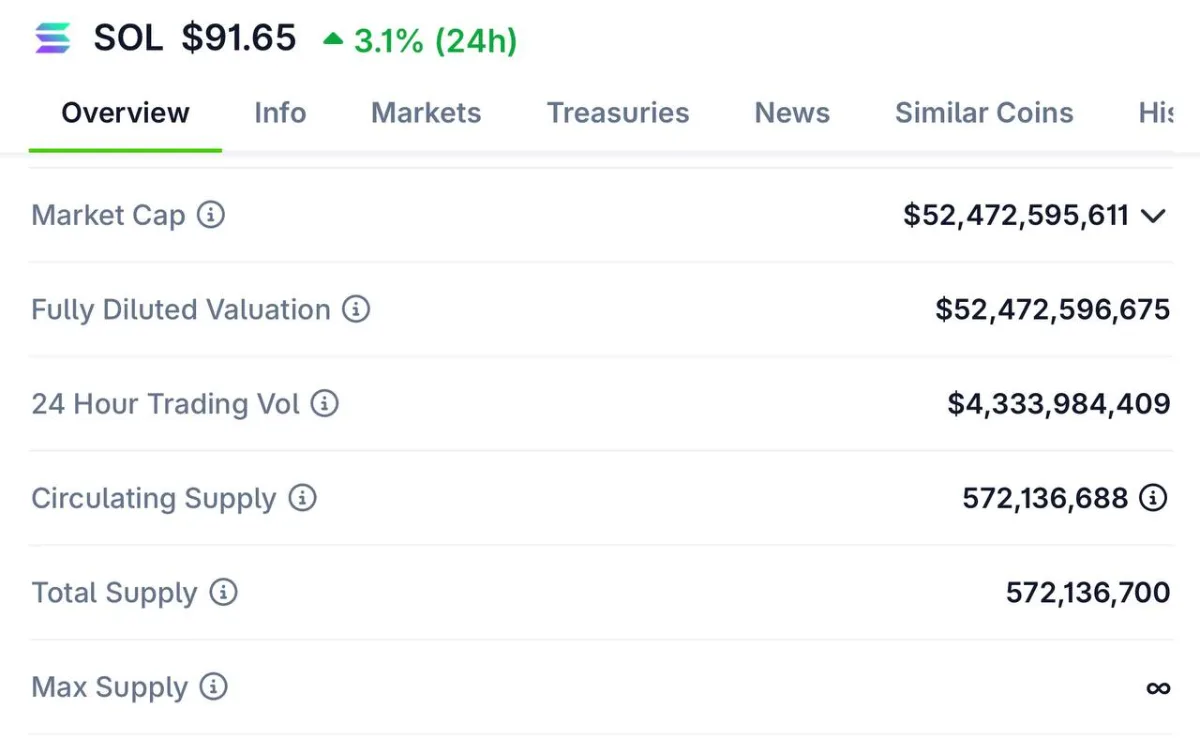
Solana surged 6% on March 4 to $91.45 as 24-hour trading volume hit $7.5 billion. That bounce came after weeks of SOL price consolidation near $88. Yet the real story is not the price move. Solana network activity is already running at levels you would expect to see with SOL trading closer to $100. The question is why the price has not caught up yet.

Solana network activity tells a different story from the SOL price chart. The blockchain is processing around 150 million transactions per day. Dune Analytics data shows the chain handled roughly 105.3 million transactions per day as of late February 2026, more than all other major blockchains combined.
The on-chain numbers from February 2026 alone are significant:
3.4 billion transactions processed in February excluding votes, one of the most active months on record
$650 billion in stablecoin transfers in February, more than doubling the previous record and overtaking both Ethereum and Tron
Total Value Locked at approximately $6.9 billion, a record high
Real World Asset tokenization surpassing $1.8 billion on the Solana network
These are not speculative metrics. They reflect real economic activity settling through the chain.
Grayscale and Standard Chartered analysts argue this shift away from memecoins toward payments and tokenized finance justifies a structurally higher SOL valuation. Understanding what makes crypto move starts with recognizing when on-chain fundamentals and price diverge this sharply.

Strong Solana network activity has not translated into a sustained SOL price recovery. Several forces are working against it at the same time.
First, broader market conditions remain challenging. Macro uncertainty and tariff-related risk-off sentiment have weighed on high-beta crypto assets throughout early 2026. SOL dropped 17% in February despite almost uninterrupted institutional ETF buying.
Second, technical resistance near $95 to $100 has capped every rally attempt. The $96 to $116 zone is what analysts at BeInCrypto describe as the gateway to structural recovery. SOL has not been able to close above it.
Third, a whale unlocked 1.82 million SOL worth approximately $163 million from staking on March 21. That kind of supply event creates real sell-side pressure regardless of underlying demand.
Finally, the memecoin engine that powered Solana's late 2025 performance has cooled. That activity drove massive fee revenue and speculative demand. Its absence leaves the network relying on more durable but slower-moving demand from payments and DeFi. Managing positions through these conditions requires clear stop loss rules before the trade.
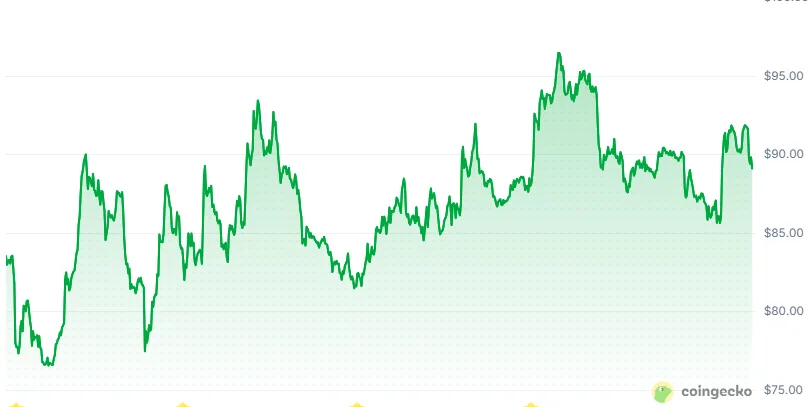
SOL technical analysis currently shows a broad trading range between $80 and $100. The chart is not trending in either direction. It is compressing. Here are the key levels that define the current structure.
These levels define two clear scenarios for traders. A weekly close above $96 opens the path toward $116, the January fail-safe level that now acts as the gateway to structural recovery. A break below $80 exposes SOL to continuation toward $64 and potentially the head-and-shoulders target near $59.
SOL is not a liquid trade during ranging conditions. Slippage in fast markets becomes a real cost when price breaks from compression with volume.
| Level | Price Zone |
|---|---|
| Strong resistance | $96 to $116 |
| Key resistance | $95 to $100 |
| Key support | $80 |
| Breakdown target | $64 to $59 |
Any honest solana price prediction right now must account for two competing forces: strong on-chain fundamentals pulling valuation higher and persistent macro headwinds keeping risk appetite suppressed. Here are the two most likely scenarios.
Base case: SOL consolidates between $80 and $96. The network continues to process record activity but the SOL breakout does not materialize until macro conditions improve or institutional ETF flows accelerate. Price grinds sideways with occasional sharp moves in both directions. Analysts at CoinMarketCap model a path toward $116 by end of 2026 in this scenario.
Bullish case: SOL reclaims $96 and closes a weekly candle above that level. That would trigger a retest of $116, the January structural high. If ETF inflows pick up and the Alpenglow consensus upgrade launches on mainnet, a move toward $130 to $150 becomes technically feasible within weeks. Grayscale analysts target $250 as a base case for 2026 under this scenario, with a bull case extending to $320.
Extended ranging periods create invisible risks that compound over time. Tracking your drawdown across open positions is especially important when a chart refuses to trend.
Most analyst models for 2026 sit in a wide range. The base case from CoinMarketCap targets around $116 by year-end. Grayscale analysts target $250 in a scenario where ETF inflows accelerate and the Alpenglow upgrade delivers. A confirmed break below $80 would shift the picture toward $64 and potentially lower.
Solana network activity and SOL price have diverged because macro conditions, technical resistance near $95 to $100, and large staking unlocks are absorbing demand. ETF inflows exist but have not yet been large enough to offset consistent sell-side pressure. On-chain strength is a necessary condition for a SOL breakout but not a sufficient one.
The most important levels in the current Solana technical analysis are $80 support and $96 resistance. A weekly close above $96 opens the path toward $116. A break below $80 exposes SOL to a move toward $64 and potentially the head-and-shoulders target near $59. The $95 to $100 zone has capped every rally attempt in early 2026.
Share it with your community