All information on this site is provided by Mubite for educational purposes only, specifically related to financial market trading. It is not intended as an investment recommendation, business advice, investment opportunity analysis, or any form of general guidance on trading investment instruments. Trading in financial markets involves significant risk, and you should not invest more than you can afford to lose. Mubite does not offer any investment services as defined under the Capital Market Undertakings Act No. 256/2004 Coll. The content on this site is not directed toward residents in any country or jurisdiction where such information or use would violate local laws or regulations. Mubite is not a brokerage and does not accept deposits.
Mubite s.r.o., Školská 660/3, Nové Město, ICO: 23221551 Praha 1, 110 00, Czech Republic | Copyright Ⓒ 2026 Mubite. All Rights Reserved.
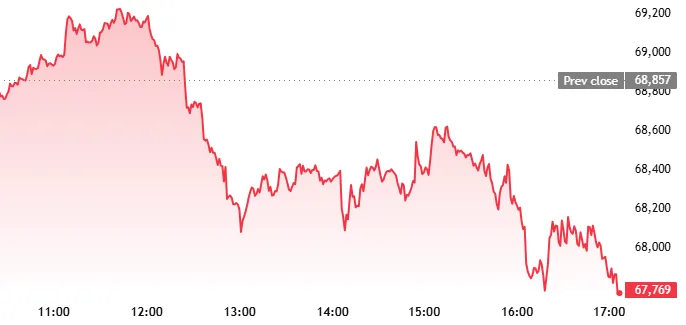
Crypto markets turned defensive on April 7 after Donald Trump warned that “a whole civilization will die tonight” if Iran did not meet U.S. demands tied to the Strait of Hormuz. The rhetoric hit already fragile sentiment, with Bitcoin dropping toward $67,860 and altcoins also moving lower as traders cut risk.
The sell-off was not driven only by Trump’s warning. Markets were also reacting to the growing risk of escalation around Iran, the Strait of Hormuz, and key regional infrastructure. Reuters reported Brent at $111.69, up more than 50% since the war began, while physical oil prices moved far above futures as supply fears intensified.
The main pressure points were clear:
rising odds of a wider conflict involving Iran
stronger fears around the Strait of Hormuz
higher oil prices feeding inflation concerns
broader risk-off sentiment across global markets
That matters for crypto because Bitcoin and altcoins still trade like risk assets in this kind of macro environment. When traders expect tighter liquidity, weaker growth, and more inflation pressure, speculative assets usually come under pressure first. This is exactly the kind of setup where risk management matters more than conviction.
Bitcoin held up better than many altcoins, but it still came under pressure. Barron’s reported BTC down 2.6% to $67,860, while a separate market wrap showed Bitcoin around $68,560 and major altcoins such as Ether, XRP, Solana, and Dogecoin posting deeper percentage losses.
That relative performance is important. In risk-off phases, Bitcoin often acts as the least-weak asset in crypto, while altcoins take the heavier hit. If this geopolitical story worsens, traders should expect higher beta names to remain more vulnerable than BTC. The same logic applies to position sizing and timing, which is why the best time frame for crypto trading becomes more important when headlines start driving price.

The deeper risk here is not only a one-day sell-off. It is the possibility that higher oil feeds into inflation expectations and keeps financial conditions tighter for longer. Reuters said the Strait of Hormuz disruption is cutting off around 12 million barrels per day, roughly 12% of global output, while physical crude prices pushed close to $150 a barrel.
That kind of shock is bad for speculative markets. If energy keeps rising, traders may have to price in slower growth, stickier inflation, and fewer chances of easier policy. In a setup like that, crypto hedging stops being theoretical and starts becoming practical.
The first thing to watch is whether this remains headline volatility or turns into a longer macro trend. If oil stays elevated and the rhetoric escalates further, crypto could remain under pressure even if intraday bounces appear. Reuters, AP, and Barron’s all pointed to the same message today: markets are nervous, and safe-haven behavior is back.
The second thing is execution. In fast, headline-driven conditions, entries can deteriorate quickly and thin books can amplify losses. That is exactly when slippage in crypto becomes more relevant, especially for altcoins that react harder than Bitcoin.
Trump’s “whole civilization” threat was the catalyst, but the real market move was about risk. Oil surged, equities weakened, and crypto followed the same risk-off script, with Bitcoin slipping toward $68,000 and altcoins showing even less resilience.
For now, the clearest takeaway is simple: this is not a clean crypto-only move. It is a macro stress event, and until that pressure eases, traders should expect Bitcoin to stay defensive and altcoins to remain the weaker part of the market. For managing those conditions, stop loss in trading becomes less of a basic concept and more of a survival tool.
Because the remarks increased fears of a wider conflict, higher oil prices, and tighter macro conditions. That pushed traders into a risk-off posture across stocks and crypto.
Yes. Bitcoin dropped, but market reports showed major altcoins such as Ether, XRP, Solana, and Dogecoin generally underperforming BTC during the sell-off.
Watch oil, the Strait of Hormuz situation, and whether the rhetoric turns into further escalation. If those pressures stay high, crypto may remain defensive.
Share it with your community