All information on this site is provided by Mubite for educational purposes only, specifically related to financial market trading. It is not intended as an investment recommendation, business advice, investment opportunity analysis, or any form of general guidance on trading investment instruments. Trading in financial markets involves significant risk, and you should not invest more than you can afford to lose. Mubite does not offer any investment services as defined under the Capital Market Undertakings Act No. 256/2004 Coll. The content on this site is not directed toward residents in any country or jurisdiction where such information or use would violate local laws or regulations. Mubite is not a brokerage and does not accept deposits.
Mubite s.r.o., Skolska 660/3, ICO: 23221551 Prague 1, 110 00, Czech Republic | Copyright Ⓒ 2025 Mubite. All Rights Reserved.

The Crypto Fear & Greed Index hit a reading of 5 on February 12, 2026. That's the lowest recorded level in the index's history. Binance still classifies current readings as "Extreme Fear."The number alone won't tell you when to buy. But understanding what's behind it matters.
The index runs from 0 to 100. Zero means maximum fear. One hundred means maximum greed. Anything below 25 falls in "Extreme Fear" territory.
It aggregates five signals: price volatility, momentum, social media activity, Bitcoin dominance, and search trends. The result is a snapshot of collective sentiment.
What it doesn't measure is fundamental value. It won't tell you if the drop is overdone or justified. Understanding what makes crypto move requires looking beyond the index.
A score of 5 says the crowd is panicking. It doesn't say the bottom is in.
The prolonged slide traces back to October 10, 2025. That single day triggered over $19 billion in liquidations that is the largest of the current cycle.
Bitcoin fell 52% from $126,000 to a $60,062 low in early February. Total crypto market cap dropped from $3.25 trillion to $2.29 trillion. Spot volumes fell 30% since late 2025.
Large liquidation events don't just clear positions. They change behavior. Traders reduce size, pull leverage, hesitate before re-entering. Liquidity thins. The market stays fearful longer than expected.
Good risk management means sizing for the possibility that fear persists; not every dip is a buying window.
Here's the tension. Retail sentiment is at a historic low. Meanwhile, institutional engagement is deepening.
BlackRock, Citadel, and other traditional finance players keep expanding into DeFi and tokenization. Real-world asset adoption is making measurable progress. The institutional build-out continues despite the fear.
The reason: institutions and retail operate on different time horizons. A fund building tokenized asset infrastructure doesn't check the Fear & Greed Index daily. Their conviction is structural, not price-reactive.
This is one of the harder beginner trading habits to build and not confuse retail panic with the broader market picture.
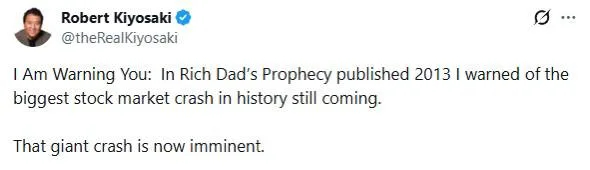
Robert Kiyosaki posted on February 17 that the "giant crash" he predicted in his 2013 Rich Dad's Prophecy is now imminent. He wrote he is "excited and can't wait" for the collapse, calling crashing assets "priceless assets going on sale." He added he is buying more Bitcoin as prices fall.
The logic echoes Buffett's "be greedy when others are fearful." It's not wrong in principle. Extreme readings below 10 have historically preceded 100%+ rallies.
But Kiyosaki issues crash warnings frequently. His framing doesn't provide timing. Fear can stay extreme for months. Using hedging strategies during periods like this protects downside while keeping exposure open.

Record-low fear is context, not a buy signal. Confirmation matters more than sentiment alone. Watch for:
Sentiment recovery : Index climbing back above 20 alongside price stabilization often marks the worst passing.
Volatility cooling : Shrinking liquidation sizes allow buyers to re-enter with confidence.
Exchange outflows : Sustained cold storage moves signal accumulation, not just repositioning.
ETF flow reversal :When redemptions slow, institutional demand may be returning.
The index hit 6 during Terra/Luna in 2022. Recovery took months, not days. History favors patient positioning over headline-driven reactions.
A score of 5 is deep "Extreme Fear." It signals most participants are selling or avoiding risk. Historically, extreme lows have preceded recoveries, but timing varies. It's context for traders, not a guaranteed buy signal.
The slide traces back to "10/10" on October 10, 2025, when over $19 billion in positions were liquidated. Bitcoin fell 52% from its all-time high. Forced selling, thin liquidity, and macro uncertainty pushed sentiment to its worst recorded level.
Extreme fear has preceded rallies historically. But fear can persist for months. Look for confirmation,stabilizing price, slowing liquidations, improving exchange outflows. Risk controls matter more than reacting to the index number alone.
Share it with your community