All information on this site is provided by Mubite for educational purposes only, specifically related to financial market trading. It is not intended as an investment recommendation, business advice, investment opportunity analysis, or any form of general guidance on trading investment instruments. Trading in financial markets involves significant risk, and you should not invest more than you can afford to lose. Mubite does not offer any investment services as defined under the Capital Market Undertakings Act No. 256/2004 Coll. The content on this site is not directed toward residents in any country or jurisdiction where such information or use would violate local laws or regulations. Mubite is not a brokerage and does not accept deposits.
Mubite s.r.o., Skolska 660/3, ICO: 23221551 Prague 1, 110 00, Czech Republic | Copyright Ⓒ 2025 Mubite. All Rights Reserved.

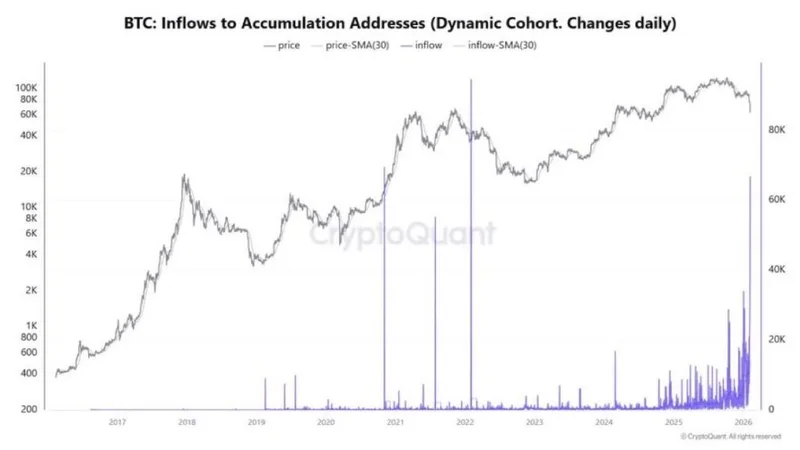
Bitcoin whales moved $4.7 billion into cold storage while retail panic-sold the dip. The divergence is creating the classic "strong hands vs weak hands" setup traders watch for turning points. Whale accumulation can reduce sell pressure, but traders need confirmation.
Whales are wallets holding between 1,000 and 10,000 BTC. These include institutions, corporate treasuries, and high-net-worth holders.
Recent data shows aggressive accumulation. These wallets added 53,000 BTC in one week during February's selloff. That's the fastest rate in over a decade.
The timing was deliberate. They bought while Bitcoin dropped from $80,000 to briefly touch $60,000. These weren't panic buys. They stepped in when forced sellers were getting liquidated.
Cold storage signals long-term holding. When whales move coins off exchanges, they remove supply from the market. This isn't speculative trading. It's conviction positioning.

Retail sold into the dip. Smaller wallets showed sustained outflows while whales accumulated. The 0.1 to 10 BTC cohort dumped 84,000 Bitcoin during the late 2024 rally.
This isn't surprising. Retail reacts to volatility and headlines. A 20% drop triggers fear. The instinct is to cut losses and preserve capital.
Whales operate differently. They have longer time horizons and deeper pockets. They absorb supply during panic while building positions at suppressed prices. This divergence has preceded market bottoms in 2017 and 2021.
Retail selling provides the liquidity whales need. Large positions get built when weaker hands capitulate.
For traders, the lesson is clear. Trading habits for beginners matter more during volatility. Don't let emotion drive decisions.
The $4.7 billion cold storage move happened on February 6. The coins moved into accumulator addresses that don't show regular spending patterns. This removes coins from exchange supply and signals long-term holding intent.
But single-day flows don't make trends. Traders should watch for sustained exchange outflows over weeks, repeated accumulation, and stabilization in selling pressure.
Different whales have different motivations. Strategy's buys are mechanical. SAFU's accumulation follows mandates. Both appear as demand, but durability varies.
ETFs saw continued redemptions during the same period. The split between spot buying and ETF outflows defines this drawdown. Some traders use crypto hedging during mixed signals.

Whale buying creates a floor, but floors need testing. Bitcoin touched $60,000 before bouncing to $68,000. That support needs to hold.
The next few weeks will show if this is a trend or a one-week event. Here's what matters:
Here's what traders should monitor:
Exchange balance trends: Are outflows continuing or reversing? Sustained cold storage moves over multiple weeks confirm conviction, not just tactical repositioning.
Large transfer follow-through: Is whale accumulation spreading across cohorts? Watch for 100-1,000 BTC wallets joining the accumulation pattern.
Key price levels: Can BTC hold $65,000-$68,000 support? A break below reopens downside toward $60,000. Above $75,000 shifts momentum.
ETF flow reversal: When do institutional redemptions stop? Net positive flows would validate the on-chain accumulation narrative.
Retail capitulation signals: Extreme fear often marks bottoms. Watch if small holders stop selling or start re-accumulating.
Whale accumulation is supportive. It removes supply and signals confidence. But confirmation comes when on-chain signals align with price action. Watch for sustained accumulation plus stabilization in selling. Understanding what makes crypto move helps explain this dynamic.
For now, the whales are building. Whether the floor holds depends on what happens next.
Bitcoin whales are large holders who control significant amounts of BTC. The most-watched category holds between 1,000 and 10,000 Bitcoin. These typically include institutions, corporate treasuries, and high-net-worth individuals.
Whale accumulation removes supply from circulation when coins move to cold storage. It signals long-term holding conviction from sophisticated capital. Historically, sustained whale buying during corrections has preceded market bottoms and eventual rallies.
Look for sustained exchange outflows over weeks, not days. Watch for accumulation across multiple whale cohorts. Check if price stabilizes while accumulation continues. Single-day flows can reflect internal wallet management rather than fresh buying conviction.
Share it with your community