All information on this site is provided by Mubite for educational purposes only, specifically related to financial market trading. It is not intended as an investment recommendation, business advice, investment opportunity analysis, or any form of general guidance on trading investment instruments. Trading in financial markets involves significant risk, and you should not invest more than you can afford to lose. Mubite does not offer any investment services as defined under the Capital Market Undertakings Act No. 256/2004 Coll. The content on this site is not directed toward residents in any country or jurisdiction where such information or use would violate local laws or regulations. Mubite is not a brokerage and does not accept deposits.
Mubite s.r.o., Skolska 660/3, ICO: 23221551 Prague 1, 110 00, Czech Republic | Copyright Ⓒ 2025 Mubite. All Rights Reserved.

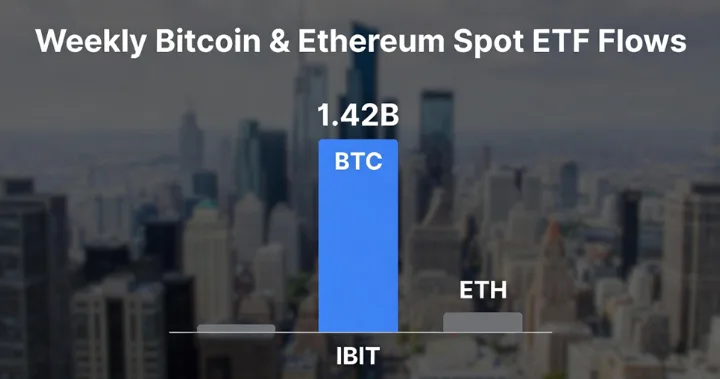
Bitcoin is having a rush moment again. Spot ETFs just pulled in 1.42 billion dollars in their strongest week since October, and BlackRock’s iShares fund is leading the charge. Traders now have to decide whether this is the start of a trend or just another short‑lived liquidity burst.
Bitcoin spot ETFs just logged their best weekly tally in more than three months. The move comes after a quieter stretch and instantly put bitcoin price action back on every serious trader’s screen.
Most of the spotlight sits on BTC because these are pure bitcoin inflows, not broad crypto bets. After weeks of mixed flows, this kind of size looks like a real rush back into regulated exposure rather than casual dip‑buying.
Spot ETF inflows matter because they typically require issuers to buy BTC to back shares, increasing spot demand when flows are positive. That flow-to-demand mechanic is one of the clearest examples of what makes crypto move when institutions step in.
In this latest burst, the BlackRock bitcoin ETF – the iShares IBIT fund – did most of the heavy lifting, attracting around one billion dollars alone. For traders, BlackRock’s dominance is a clear signal that large institutions prefer deep‑liquidity, brand‑name vehicles when they come back into BTC.
This leadership from BlackRock iShares suggests that big allocators are no longer ignoring bitcoin; they are scaling in through the safest, most familiar channel they know. That is exactly why “blackrock bitcoin etf” keeps showing up in trader dashboards and macro rundowns.

The bullish read is simple: sustained ETF inflows often act as a tailwind for BTC, especially when they come after a pullback. With 1.42 billion dollars entering in a single week and bitcoin price already near recent highs, the path of least resistance can remain up if flows continue.
But a hot week does not guarantee follow‑through. History shows that when inflows fade, bitcoin can give back gains quickly, even after impressive ETF numbers. Sentiment can flip in days if macro headlines change, or if whales use strength to distribute into the bid.
Bullish scenario: multiple weeks of steady bitcoin inflows, price holding higher lows, shallow pullbacks on the BTC chart.
Bearish scenario: flows drop back to flat or negative, while bitcoin price stalls or rejects at resistance, hinting at a liquidity‑driven spike, not a true trend.
For traders, confirmation means: not just one monster week, but a visible streak of net inflows plus constructive price structure, not just wicks and exhaustion candles. If you want a simple checklist for that kind of confirmation, use prop trading indicators that track structure, momentum, and follow-through – not hype.
A few simple checkpoints can keep this move in perspective.
Weekly flow streak: Do spot ETFs keep stacking inflows over the next two to four weeks, or was this a one‑off pop?
Price behavior: Does bitcoin price hold key levels after flows slow, or does BTC instantly unwind when demand cools?
Volatility profile: When institutional demand returns, bitcoin often sees sharper moves, tighter order books, and bigger reaction to macro headlines.
Watching bitcoin inflows, price structure, and implied volatility together will say more than any single headline – and it’s exactly how a rules-first crypto trading firm approaches BTC when volatility returns.
ETF-driven rallies can move fast – and that’s where traders get punished by the same mistakes: chasing candles, oversizing, and reacting to headlines. A better approach is mechanical: define invalidation, size for volatility, and only add exposure on confirmation (close + structure, not wicks). That’s crypto prop trading risk management in practice – the boring edge that keeps traders alive when bitcoin heats up.
Prop-style rulesets can help enforce that discipline, which is why a crypto prop firm like Mubite focuses on drawdown limits and position sizing to keep traders consistent when BTC heats up.
Bitcoin just recorded a 1.42 billion dollar ETF inflow week, with BlackRock’s iShares IBIT driving much of the demand. The big question now is whether this is the start of a durable bitcoin rush.
For traders, the playbook is clear: watch persistence of inflows, respect key price levels, and pair conviction with risk management. Exploring crypto prop trading with a firm like Mubite is one way to turn this new ETF phase into structured opportunity rather than emotional guessing.
It is real in size, but only sustained inflows over several weeks plus supportive price action will confirm whether it is a lasting trend.
Prop trading in crypto means trading digital assets using a firm’s capital under predefined risk and payout rules, instead of only personal funds.
ETF inflows represent regulated investors buying exposure, which forces issuers to acquire real BTC and can tighten available supply when demand stays strong.
Share it with your community