All information on this site is provided by Mubite for educational purposes only, specifically related to financial market trading. It is not intended as an investment recommendation, business advice, investment opportunity analysis, or any form of general guidance on trading investment instruments. Trading in financial markets involves significant risk, and you should not invest more than you can afford to lose. Mubite does not offer any investment services as defined under the Capital Market Undertakings Act No. 256/2004 Coll. The content on this site is not directed toward residents in any country or jurisdiction where such information or use would violate local laws or regulations. Mubite is not a brokerage and does not accept deposits.
Mubite s.r.o., Školská 660/3, Nové Město, ICO: 23221551 Praha 1, 110 00, Czech Republic | Copyright Ⓒ 2026 Mubite. All Rights Reserved.
If you’re searching for the best crypto prop trading firm in 2026, you’re not just picking a brand—you’re picking a rule set that will either fit your strategy or quietly break it. Most traders fail crypto funded accounts for one of two reasons: drawdown mechanics they didn’t understand (daily reset + equity rules) or payout friction (timing, restrictions, “consistency” limits).
This guide is built for traders who actually trade crypto volatility. We compare crypto prop firms that offer funded models and highlight:
what top crypto prop trading firms have in common (so you don’t overpay for marketing),
where Mubite's rules stand out and why(numbers + rule clarity),
and where other prop firm crypto trading options are genuinely good
Mubite is one of the firms reviewed on this page. Our firm card is held to the same criteria as every other entry — rules clarity, drawdown mechanics, and payout structure.
| Firm | Rule | Crypto Native | Payout Friction | Verdict |
|---|---|---|---|---|
| Mubite | 5/5 | 5/5 | 5/5 | Best for rule-based crypto day traders |
| HyroTrader | 4/5 | 5/5 | 4/5 | Best for patient crypto derivatives traders |
| FTMO | 5/5 | 3/5 | 4/5 | Best for multi-asset traders |
| BrightFunded | 4/5 | 3/5 | 3/5 | Best for traditional two-phase evaluation |
| FundedNext | 3/5 | 3/5 | 3/5 | Best for high split seekers |
| Funded Prime | 4/5 | 3/5 | 4/5 | Best for fastest path to funding |
| The Funded Trader | 3/5 | 3/5 | 3/5 | Best for program variety |
To rank crypto prop trading firms, we score them using criteria that directly impact real crypto prop trading results.
Daily drawdown calculation and reset time. Max drawdown type: balance vs equity and whether unrealized PnL can breach you.
Minimum trading days and what counts as a “trading day.”
Example: Mubite requires 4 days and defines it using a closed PnL threshold.
BrightFunded requires 5 days per phase and defines trading-day qualification differently.
How soon you can request a payout, how often after that, and whether there are restrictions that force “smooth equity curves.”
Does the firm behave like a crypto trading firm (24/7 market assumptions, crypto-first tooling), or like an FX prop model with crypto added?
More firms tightened monitoring and “consistency” controls, which matters more in crypto than FX because volatility creates naturally lumpy PnL.
Rule transparency is now a ranking factor for users, not just Google: the firms that clearly publish daily drawdown logic and trading-day definitions are easier to trust and easier to trade.
Rule clarity and crypto-native fit are why Mubite ranks first in this guide, those are the criteria, that decide real outcomes.
Most traders fail a crypto prop firm challenge for reasons that have nothing to do with strategy quality. They fail because they misunderstand how the rules behave in real crypto volatility.
If you’re evaluating crypto prop trading firms, these are the mechanics that actually decide whether you keep or lose your funded account.
The headline number (usually 4–5%) is only half the story. What matters is:
Is the daily drawdown calculated from balance or equity?
Does it reset at a fixed time (for example, midnight UTC)?
Can unrealized losses breach you?
In crypto markets, volatility doesn’t respect calendar days. If your prop firm crypto trading model resets daily loss at midnight UTC, you must know exactly where your balance stood at that moment. A strong trend reversal at 23:59 vs 00:01 can change whether you’re safe or in breach.
Professional traders treat the daily limit as a soft ceiling and risk well below it. If the firm allows 5%, you plan around 2–3%, that´s the risk rule. That buffer is what keeps you alive during high-volatility candles.
The maximum loss rule is the true survival test in crypto funded accounts. There are generally two practical realities:
Static max drawdown: fixed percentage from the starting balance.
Equity-based or dynamic behavior: your drawdown reference point changes based on balance peaks.
In crypto, this distinction matters more than in slower markets. A sharp wick can temporarily push equity down before price recovers. If unrealized equity counts toward breach, your risk management must adapt.
When comparing crypto prop trading firms, don’t just read “10% max loss.” Read how it’s measured.
Crypto exchanges often use mark price (a fair-value mechanism) rather than last traded price to calculate liquidation thresholds. If your crypto trading prop firm mirrors exchange logic, your position can hit risk limits even if the visible chart hasn’t fully moved there yet.
For traders used to spot-only charts, this can be a shock. For derivatives traders, it’s normal.
The key is awareness: understand what price model your crypto trading firm uses for drawdown calculation, and test it with small sizing before scaling.
The best prop firm crypto trading experience isn’t just about passing—it’s about actually withdrawing. Key things to look for:
When is the first payout allowed?
How frequently can you withdraw after that?
Are there “consistency” or single-day profit concentration rules?
How long does processing typically take?
Are there any payout processing fees?
Some firms market high profit splits but attach strict timing or performance distribution requirements. Others emphasize flexibility and faster request cycles. If you plan to compound aggressively, payout cadence becomes part of your strategy.
When choosing among crypto prop firms, don’t get distracted by headline profit splits. Focus on:
How daily drawdown behaves in 24/7 crypto markets
Whether max loss is static or equity-sensitive
How pricing (mark vs last) can impact breaches
How realistic the payout process is
If your strategy fits those mechanics, the firm becomes an amplifier. If it doesn’t, even the best crypto prop trading firm on paper will feel impossible to pass.
These crypto prop trading firms are the most relevant picks for 2026. Each mini-review includes quick numbers plus the practical “why it matters” so you can match the rules to your trading style.
We built Mubite because most prop models weren't designed for how crypto actually moves. The rules here are written for traders who size consistently and treat risk as a process — not a one-big-day gamble.
Profit targets: 10% (Phase 1) + 5% (Phase 2)
Daily drawdown: 5% (reset at midnight UTC)
Max drawdown: 8–10% (by program)
Minimum trading days: 4
Leverage: Up to 1:100
Best for: Traders who want a crypto-native crypto prop firm with clear rules and predictable risk boundaries
Built around one principle: rules you can actually plan around. The daily reset is fixed, the drawdown math is straightforward, and the minimum days requirement won't trap you if you trade with discipline.
Ready to trade with clear rules and no guesswork? Start Your Free Trial →

FTMO is strong if you’re not purely a crypto trader—if your core strategy is FX/indices and you treat crypto as an additional market. Their main advantage is operational maturity and very clear evaluation structure, but it’s typically not a “crypto-first” experience compared to dedicated crypto prop firms.
Profit targets: 10% (Challenge) + 5% (Verification)
Daily loss limit: 5%
Max loss: 10%
Minimum trading days: 4
Best for: Multi-asset traders who want prop structure first and crypto second
This is a good pick if you want predictable prop rules and don’t need deep crypto market breadth. It’s also a solid benchmark firm for comparing evaluation mechanics.

FundedNext is popular because it offers multiple program structures and attractive reward share messaging. If you like traditional “challenge shopping” and want options, it’s a common choice—but as with many large prop ecosystems, it can feel more like a generalized prop model than a crypto-native crypto trading prop firm.
Profit targets (Stellar 2-Step): 8% + 5%
Daily loss: 5%
Max loss: 10%
Minimum trading days: Often 5 (varies by model)
Profit split: Commonly starts at 80% with scaling paths
Best for: Traders who want program variety and strong reward-share positioning
Best used by traders who already know which model fits their strategy and don’t mind reading the fine print across plan types.

BrightFunded is a clean, rules-first evaluation model with a very “classic” two-phase structure. It’s not necessarily the fastest path to funding due to minimum days, but it’s easy to understand and suits traders who prefer clear objectives and consistent parameters.
Profit targets: 8% (Challenge) + 5% (Verification)
Daily loss: 5% (from initial balance)
Max loss: 10%
Minimum trading days: 5 per phase
Best for: Traders who want a traditional evaluation model with clear milestones
The main tradeoff is speed: you’re often committing to more trading days even if you hit the target early, which can matter in choppy crypto conditions.

Funded Prime is attractive on paper for traders who prioritize quicker completion, because minimum trading days can be lower than many competitors. Their rules documentation is also fairly direct, which helps if you build a mechanical plan around daily risk.
Profit target (1-phase): 10% (varies by plan)
Daily drawdown: 5% (based on prior-day equity snapshot)
Max drawdown: 10% (fixed from initial balance)
Minimum trading days: 3
Best for: Traders who want speed to funding and clearly explained drawdown formulas
This can fit disciplined day traders who can generate steady PnL without depending on a single high-volatility breakout session.

The Funded Trader earns a spot because of program variety: different models, different risk mechanics, and multiple ways to qualify. The upside is choice. The downside is that two traders can have completely different experiences depending on the program they picked.
Profit target: Commonly 10% (program-dependent)
Daily drawdown: Can be equity-based in some programs
Max drawdown: Often relative/static depending on program
Minimum trading days: Often 5 (varies)
Best for: Traders who want options and are comfortable tailoring their approach to specific rules
TFT is best for traders who actually read program docs and choose a model aligned to their style (scalp vs swing, low-frequency vs high-frequency).

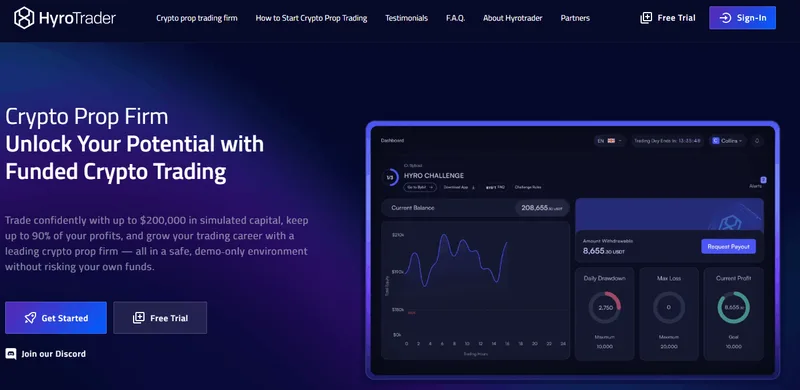
HyroTrader is one of the more clearly crypto-native picks in the list, typically framed around crypto derivatives/perpetual markets. It appeals to traders who want a crypto-only environment and prefer not being forced by strict time limits if market conditions are slow.
Daily drawdown: Often 5%
Max drawdown: Often 10%
Profit split: Commonly positioned around 70%–90% depending on structure
Time pressure: Frequently marketed as no strict time limit
Best for: Crypto derivatives traders who want crypto-only context and flexibility
HyroTrader is usually a better fit for patient, process-driven traders than for “pass it fast” challenge hunters.
Choosing a crypto trading prop firm is less about “who has the biggest profit split” and more about whether the rules match how you trade. The best crypto prop firms make it easy to plan risk. The worst ones make you feel safe right up until a single volatility spike or payout rule wipes out weeks of work.
Use this as your decision filter for prop firm crypto trading:
Drawdown math (daily + max): Is it measured on balance or equity, and when does it reset? If the reset is fixed (example: midnight UTC), you can build a routine around it.
Trading-day rules: How many days are required, and what counts as a “trading day”? Some firms require more minimum days per phase than you expect.
Time pressure: If you’re a swing trader, “no time limit” or longer windows can matter more than a slightly better split.
Payout friction: When is the first payout allowed, how often after that, and are there restrictions that punish “lumpy” crypto PnL (consistency rules / daily profit caps)? (We’ll detail this firm-by-firm.)
Market model: Does the firm behave like a crypto-first venue (perps/mark price logic), or like a general prop model that happens to list crypto? This affects how your positions behave during wicks and volatility.
You don’t need to avoid every strict firm, but these patterns are common on lower-quality crypto prop trading firms:
Rules that are hard to locate or keep changing without clear documentation. If you can’t verify the drawdown calculation quickly, expect surprises later.
Payout terms that look generous but are gated by extra conditions (profit concentration limits, minimum “profitable days,” or “consistency” filters that effectively cap your strategy).
Vague language around pricing model (mark price vs last price) or vague breach logic (“we may close positions if…”). In crypto, that vagueness is expensive.
If you want the fastest practical shortcut: pick a crypto prop firm with clearly published drawdown mechanics and trading-day definitions, then choose the plan that matches your trading tempo (scalp/day/swing). That alone eliminates most of the “I didn’t know the rules worked like that” failures.
With crypto funded accounts, you typically pass an evaluation (one-step or two-step) by hitting a profit target while respecting daily and maximum drawdown limits. After you pass, you trade a funded account and withdraw profit splits based on the firm’s payout schedule and rules.
Some are, some aren’t. Legit crypto prop trading firms publish clear rules, define drawdown math, explain payout timing, and provide verifiable support channels. A major warning sign is when drawdown calculation or payout eligibility isn’t clearly documented.
It depends. Some firms allow algorithmic trading with restrictions; others limit bots or ban certain forms of copy trading. The important step is not assuming—check the firm’s “prohibited activity” or “trading rules” section before you trade a funded account.
Share it with your community