All information on this site is provided by Mubite for educational purposes only, specifically related to financial market trading. It is not intended as an investment recommendation, business advice, investment opportunity analysis, or any form of general guidance on trading investment instruments. Trading in financial markets involves significant risk, and you should not invest more than you can afford to lose. Mubite does not offer any investment services as defined under the Capital Market Undertakings Act No. 256/2004 Coll. The content on this site is not directed toward residents in any country or jurisdiction where such information or use would violate local laws or regulations. Mubite is not a brokerage and does not accept deposits.
Mubite s.r.o., Skolska 660/3, ICO: 23221551 Prague 1, 110 00, Czech Republic | Copyright Ⓒ 2025 Mubite. All Rights Reserved.

Navigating the crypto correction with a buyer’s mindset
As you might have noticed, things have slightly escalated in the past few weeks and crypto market has undergone a relatively vicious downturn, which has sent Bitcoin spiralling down by roughly ~30% from its peak at the time of writing. That puts us past the technical bear-market threshold of 20%.
However, given that cryptocurrencies are a far more volatile asset class, such downturn is not as vicious as might seem at first glance, and through glass-half-full lens, could be thought of more as a mid-cycle downturn; helping to erase the highly leveraged positions that everyone, despite cautious warnings, keeps accumulating.
So, before everyone reaches for the pitchforks and start forecasting a 70-80% collapse, let’s do the useful thing: unpack what caused the recent drawdown, how traders should approach it, and why, if you keep a disciplined, buyer’s-mindset, this could be one of those not-so-frequent buying opportunities.
Before we dig deeper into the individual factors, let’s first run through the timeline of events that have taken place in the past several weeks to frame things into perspective:
October 1 (Government shutdown) – The US government shuts down for the second-longest stretch in history, draining liquidity and as such creating a risk-off environment
October 6 (Bitcoin peaks) – BTC hits a record high around $126k
October 10 (Flash crash) – A wave of liquidations wipes out over $19bn in leveraged long positions
November 4 (Bear market) – BTC slips below the psychologically important level of $100k, more than 20% from the top, thus entering technical bear market territory
November 18 (Death Cross) – Bitcoin plunges below $90k, forming a so-called ‘Death Cross’ (50-day simple moving average crossing below 200-day simple moving average)
So, what sparked the negative spiral that dragged BTC to the current ~$87k? Well, this wasn’t a single event, but rather a perfect storm of negative catalysts:
The Federal Reserve dashed the hopes of a certain December interest rate cut - Markets had been pricing in an almost guaranteed cut, but after several media comments from the central bank officials, this probability has turned into nothing more than a coin flip.
The government shutdown created a liquidity vacuum. Crypto is heavily correlated with fiscal liquidity, and this was one of the driest periods in years.
Overall sentiment in broader markets turned sour. High valuation in the AI sector, and warnings from heavyweight investors like Ray Dalio and Michael Burry (think Big Short) spooked equity investors. A risk-off shift in stock almost always bleeds to crypto.
Institutional investors hit the brakes. As money started flowing out of risk assets, ETF inflows, which had been supporting this bull market, flipped to some of the biggest outflows on record.
Put all this together and you get a sharp purge of risk appetite. Importantly though, this was not a structural crisis that would shake the faith in cryptocurrency markets, but rather a crisis of leverage.
Cryptocurrency investors just can’t help themselves (understandably so) and the overextended leveraged positions were sitting like dry tinder next to a series of negative headlines and evaporating liquidity.
The result? Flash crash on October 10th, over $1bn of liquidations on November 4th, another $1.1bn on the 14th, and another billion on the 18th. These are not small amounts – these are market-moving numbers. And in a market as volatile as crypto, clearing this amount of leverage almost guarantees severe downside.
This is, of course, the question everyone wants answered, and one that even we cannot claim to solve with certainty. What we can do is assess the situation and give you a grounded, calculated read on where things stand.
Yes, cryptocurrencies have technically entered a bear market, but as mentioned before, with assets as volatile as crypto, these levels are more arbitrary than practical. So, where does this leave us?
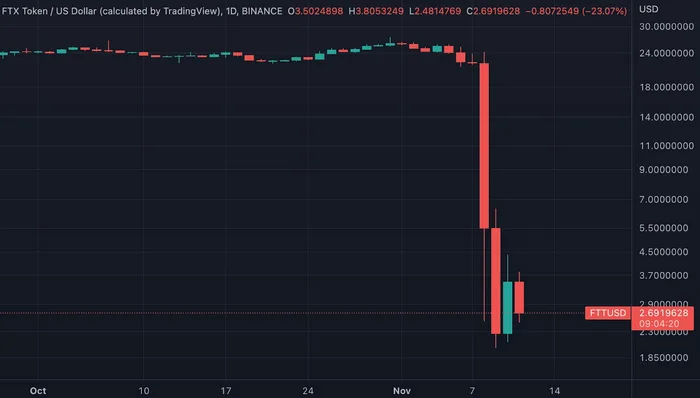
Market structure seems to remain intact, for now. We do not yet have contagion-level events that would spur further sell-offs such as the demise of FTX in 2022 or the ICO mania of rather worthless tokens in 2017. These are the kind of events that tend to spread across the ecosystem, cascade into bankruptcies and trigger the 70-80% bear markets that we have gotten used to.

For now, all we have seen is forced deleveraging - the market flushing out excess risk and clearing a massive pile of overextended positions, which, frankly speaking, provides us with a cleaner base to build upon once broader conditions improve.
From a technical perspective, BTC is currently revisiting multi-month support levels, and holding these will be key. In the short-term, the magnitude of the drawdown should form at least a tactical bottom and potentially also the foundation for a rebound if macro sentiment cooperates.
And yes, as already mentioned, the BTC chart painted the ominous Death Cross, but looking back just recently, this has been the fourth Cross of the cycle. The previous three? All have so far marked only late-stage corrections rather than cycle tops.

On-chain data is also not screaming ‘top’ yet. The market value to realized value (MVRV), a favourite measure of cycle positioning, has been so far stable and consistent with a mid-cycle accumulation phase. Some of the long-term holders have been cashing out, but most seem to still hold unshaken. Overall, the signals are mixed but certainly not indicative of a euphoric market peak.
Trading when markets are in a correction tends to be a much different experience compared to an unabated bull market. After all, fear environment is displayed in the markets much differently than a greed environment. We are obviously no experts, we leave that up to our professional Mubite traders, but there are a few traditional observations that most market participants can agree on.
Dial down use of leverage
In a correction, prices can drop violently within minutes. High leverage turns those moves into instant liquidation events. Therefore, for more longer-oriented traders, sizing down is simply survival. On the other hand, for short-term traders this could also mean amplified returns, hence we do not want to be too rigid about our recommendations.
Mean reversion plays (“catching the falling knife”)
This approach gets a bad name because, frankly, the metaphor is accurate - but it’s also one of the most popular strategies in heavy sell-offs. When a token falls far beyond reason, the bounce can be equally irrational. One could say the price, as of this writing, could be an aspiring falling knife, given the magnitude of the fall as well as the RSI level, which is deep into what’s considered oversold territory.
Laddering into shorts on weakness
On the other hand, one can scale short positions into the downturn, gradually scaling new entries into the weakness as the price unravels. This would have been very profitable in the past month as the price kept breaking down through multiple levels after just short consolidations with no meaningful signs of a bottom.
Option plays
Lastly, for the savvier traders, these volatility-abundant environments are great for devising derivative strategies, especially with options. The most intuitive play that easily comes to mind are a straddle or a strangle – buying both a call and a put, essentially betting on a big move in either direction; something that tends to happen quite frequently in volatile environments like these.
So, as said before, we are no experts – we leave that up to you. But regardless of the direction, large, volatile movements always present a great opportunity for traders. So, do not get discouraged by the overall trend, but rather do what you do best, which is creating opportunities where others see pain.
Cautious optimism
Naturally, we are not out of the woods yet. BTC is sitting right on the most recent local bottom, and we still haven’t seen the kind of sharp relief rally that usually confirms a shift in momentum. But looking at the situation objectively doesn’t paint a hopeless picture, quite the opposite.
The structure of the market is still intact, there have not been any systematic failures, and all the selling so far has only been mechanical, clearing the leverage and the froth out of the system. At the same time, the wider market, especially equities riding on the back of the AI boom, have gotten a little over enthusiastic, and the correction was overdue to drain out the excesses.
But so far, there are no clear signs of systemic issues that would throw us into a prolonged bear market. And most importantly, nothing about the fundamental story of crypto has changed and the long-term thesis remains exactly where it was before the drawdown. Cautious optimism is the name of the game
From a trader’s perspective, nothing has changed, except the strategy. Whether the markets go up, down or sideways, proprietary traders always know how to find profitable opportunities. That’s the entire point of what we do at Mubite: provide the capital and tools so the best traders can perform regardless of direction.
Corrections are uncomfortable, but they are also clarifying. They force out all the excesses, reset positions and set the stage for the next move. So, keep your eyes open, your risk tight and the capital ready – cautious optimism is where we are right now.