All information on this site is provided by Mubite for educational purposes only, specifically related to financial market trading. It is not intended as an investment recommendation, business advice, investment opportunity analysis, or any form of general guidance on trading investment instruments. Trading in financial markets involves significant risk, and you should not invest more than you can afford to lose. Mubite does not offer any investment services as defined under the Capital Market Undertakings Act No. 256/2004 Coll. The content on this site is not directed toward residents in any country or jurisdiction where such information or use would violate local laws or regulations. Mubite is not a brokerage and does not accept deposits.
Mubite s.r.o., Školská 660/3, Nové Město, ICO: 23221551 Praha 1, 110 00, Czech Republic | Copyright Ⓒ 2026 Mubite. All Rights Reserved.
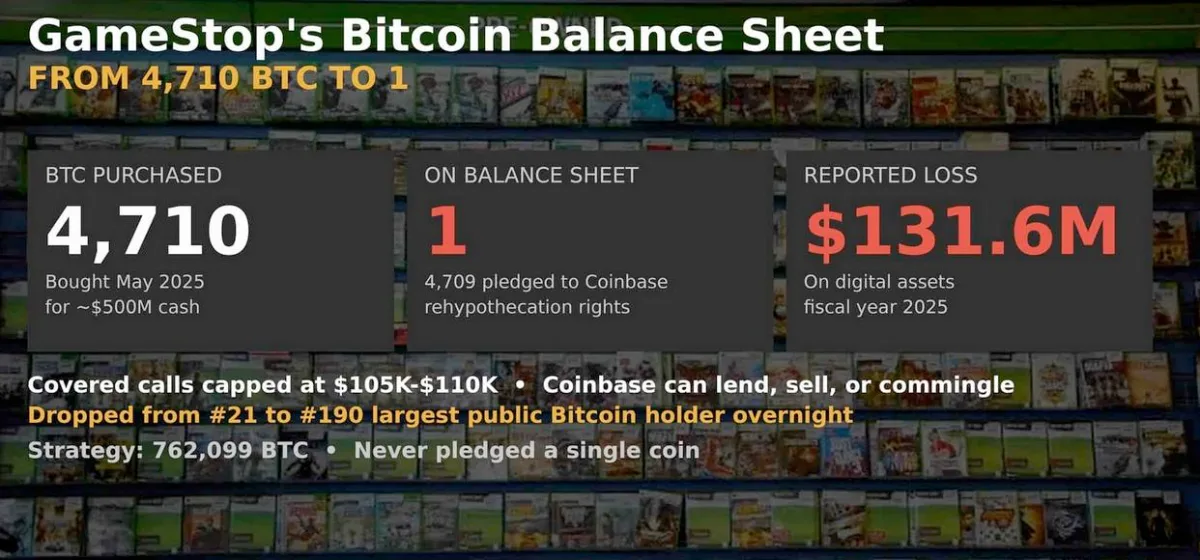
GameStop did not sell its Bitcoin. That is what the company's fiscal 2025 annual report, filed with the SEC on March 25, 2026, confirms. The video game retailer pledged 4,709 of its 4,710 BTC as collateral with Coinbase Credit for a covered-call options strategy. It did not exit the position. Yet for two months, on-chain analysts and traders widely believed it had.

The speculation started in January 2026. Blockchain analytics firm CryptoQuant spotted that GameStop had transferred its entire 4,710 BTC stash to Coinbase Prime. Large transfers to Coinbase often signal intent to sell. GameStop said nothing. CEO Ryan Cohen told CNBC the company was targeting a transformational acquisition that was "way more compelling than Bitcoin." Markets assumed the worst.
The 10-K filing cleared it up. Here is what GameStop actually did with its bitcoin treasury:
Pledged 4,709 BTC as collateral with Coinbase Credit in Q4 fiscal 2025
Sold short-dated covered call options with strike prices between $105,000 and $110,000
Earned option premiums as income while retaining economic exposure to BTC price
Recorded a $368.3 million digital assets receivable and a $59.7 million unrealized loss as of January 31, 2026
Because Coinbase Credit retained rehypothecation rights over the pledged BTC, GameStop was required under U.S. GAAP to derecognize the coins from its balance sheet.
The GameStop BTC speculation ran for two months without correction. That is not unusual. Bitcoin market sentiment is highly sensitive to corporate treasury moves because of how concentrated large holdings are.
Traders watch corporate BTC positions closely for several reasons. A large seller entering the market can shift the supply-demand balance quickly. GameStop held approximately 4,710 BTC, worth around $420 million at the time of the transfer. That is a meaningful position. Any credible signal of a sale creates positioning pressure even before a single coin moves on a public exchange.
Greg Magadini, director of derivatives at Amberdata, described the broader risk clearly. The bearish scenario for Bitcoin centers on corporate buyers from 2024 and 2025 turning into net sellers. If that wave reverses, falling BTC price forces additional selling and a downward spiral begins. GameStop's ambiguous signals fit directly into that fear.
The episode is a clean example of what makes crypto move: narrative pressure from large holders shapes short-term sentiment even when the underlying facts have not changed.
GameStop's approach sits in the middle of a widening spectrum of corporate bitcoin strategies. Not every company with a bitcoin treasury is using it the same way.
Core Scientific sold $175 million worth of Bitcoin in early March 2026 to accelerate its pivot toward AI data center infrastructure. That decision was strategic and deliberate. GameStop's covered-call structure sits between these two poles: it retained economic exposure while generating income. Strategy Inc. sits at the other end, treating every dip as a buying opportunity. For traders holding positions through corporate announcement cycles, understanding drawdown is essential. Rumor-driven drops can be as steep as fundamental ones.
| Company | Bitcoin Strategy |
|---|---|
| Strategy Inc. (MSTR) | Aggressive accumulation, long-term hold |
| GameStop (GME) | Hold with covered-call income strategy |
| Core Scientific | Selling BTC to fund AI infrastructure pivot |
The GameStop situation has been resolved for now. But the dynamics it exposed are ongoing. Several signals are worth tracking in the coming weeks.
Watch GameStop's covered-call expiry outcome. The contracts were set to expire on March 27, 2026. If BTC stayed below the $105,000 to $110,000 strike range, the options expired unexercised and GameStop retained its right to reclaim the coins. If BTC broke above that range, GameStop's upside was capped. The outcome determines whether the covered-call strategy is repeated or abandoned.
Fast moves triggered by narrative shifts require a clear exit plan. Knowing where your stop loss sits before entering a trade around corporate Bitcoin news is not optional.
No. GameStop pledged 4,709 of its 4,710 BTC as collateral with Coinbase Credit as part of a covered-call options strategy. The company did not sell the coins. It now records a $368.3 million digital assets receivable on its balance sheet rather than directly held BTC.
A covered-call strategy involves pledging an asset as collateral and selling call options on it. The seller earns option premiums as income. In return, the upside is capped at the strike price. GameStop sold short-dated calls with strike prices between $105,000 and $110,000.
Corporate bitcoin holdings affect BTC price primarily through sentiment. Large on-chain transfers signal potential selling even when no sale has occurred. Companies like Strategy Inc. accumulating aggressively can support price floors, while companies selling like Core Scientific add near-term supply pressure.
Share it with your community