All information on this site is provided by Mubite for educational purposes only, specifically related to financial market trading. It is not intended as an investment recommendation, business advice, investment opportunity analysis, or any form of general guidance on trading investment instruments. Trading in financial markets involves significant risk, and you should not invest more than you can afford to lose. Mubite does not offer any investment services as defined under the Capital Market Undertakings Act No. 256/2004 Coll. The content on this site is not directed toward residents in any country or jurisdiction where such information or use would violate local laws or regulations. Mubite is not a brokerage and does not accept deposits.
Mubite s.r.o., Skolska 660/3, ICO: 23221551 Prague 1, 110 00, Czech Republic | Copyright Ⓒ 2025 Mubite. All Rights Reserved.

Updated February 5, 2026 - Crypto loans without collateral sounds like free liquidity. In practice, the phrase is used for two very different products, and confusing them is where traders get hurt.
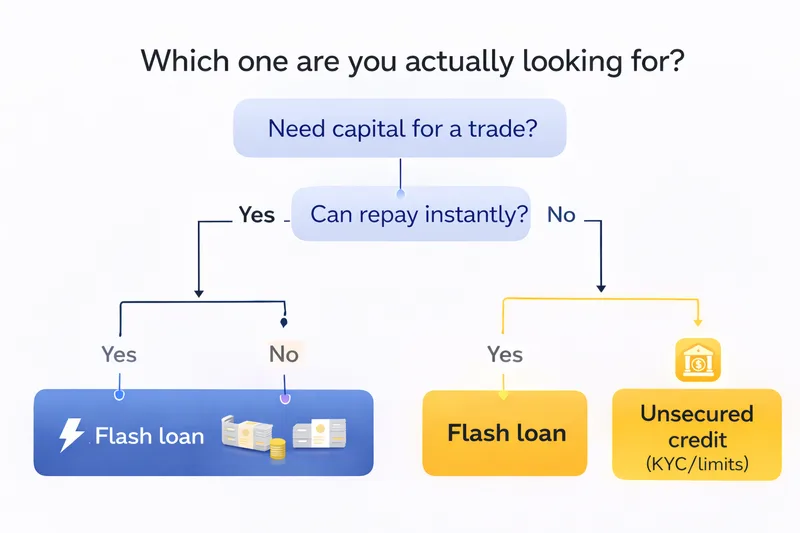
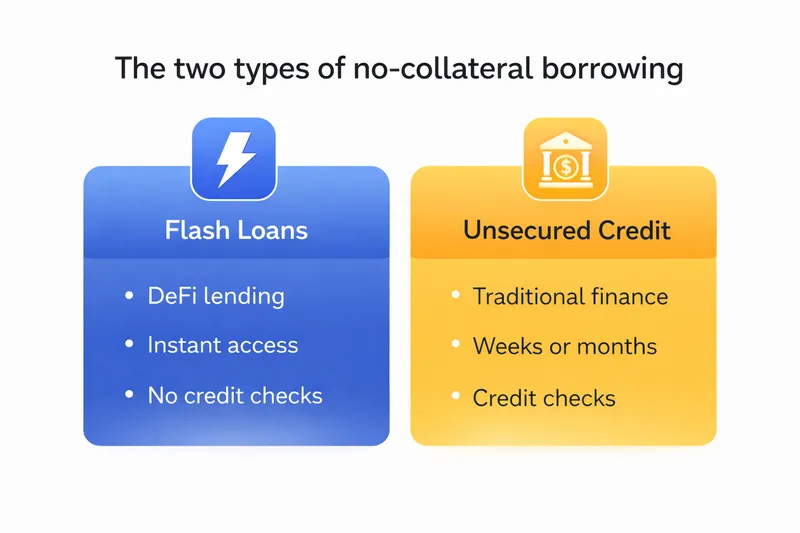
One meaning is flash loans in DeFi, where you borrow and repay inside a single blockchain transaction. The other meaning is unsecured (credit-style) crypto lending, where you repay over weeks or months but approval depends on identity, history, and underwriting. If you are a trader, the right question is not only “Can I borrow?” but “Will this structure help me without pushing me into reckless sizing and bad decisions?”
If you’re considering borrowing to trade bigger, read this first: risk management in crypto prop trading. A funding source doesn’t fix risk. It amplifies whatever risk habits you already have.

Yes, sometimes — but it depends on what “without collateral” means in that context.
Flash loans can be truly no-collateral, but they must be repaid instantly. Credit-style unsecured loans can exist, but they usually involve KYC, strict limits, and higher costs because the lender has fewer protections. In both cases, the risk doesn’t disappear — it changes shape.
Here’s the simplest way to avoid misunderstanding: many offers that say “no collateral” are not claiming “no risk.” They’re claiming “no collateral deposit.” That’s a big difference.
In traditional lending, collateral is a safety net. In crypto, collateral is also a volatility buffer. Since prices can move hard and fast, collateral is the simplest way to manage default risk without expensive enforcement.
When a platform advertises “no collateral,” one of three things is usually true:
it’s a flash loan (the enforcement is technical: repay in the same transaction)
it’s credit-style (the enforcement is identity, limits, and repayment tracking)
it’s marketing language for a product that still has strong constraints, fees, or hidden risk
That’s why you should treat the phrase as a category label, not a guarantee.
Most crypto loans are still overcollateralized. You lock BTC or ETH and borrow stablecoins. That structure exists because crypto is volatile and lenders need a simple mechanism: if the borrower fails, collateral can be liquidated.
No-collateral borrowing replaces liquidation with other enforcement. In flash loans, enforcement is technical: repayment must happen inside the transaction or the transaction fails. In unsecured credit-style lending, enforcement is social and legal: identity, repayment history, and access.

No-collateral crypto loans aren’t one product — they’re a label people use for two completely different mechanisms. It’s easy to assume you’ve found “free liquidity,” when in reality you’re either looking at an advanced, atomic transaction (flash loans) or an approval-based loan that still comes with strict limits, higher rates, and real consequences for missed repayments.
So before you decide whether this is useful for you as a trader, it helps to understand which category you’re actually dealing with — because the risks, costs, and “who this is for” are completely different.
Flash loans in DeFi (true no-collateral, but instant)
A flash loan is borrowed and repaid in a single transaction. If the sequence of actions can’t repay the lender, the chain reverts everything as if it never happened. That “all-or-nothing” property is what makes flash loans possible without collateral.
For traders, the key takeaway is this: flash loans are not “borrow money to trade.” They are a tool for executing a bundled set of actions that ends with repayment. That’s why flash loans are common in arbitrage and position management workflows, but rare as a retail funding method.
A non-technical mental model is helpful here. Imagine a flash loan as a “one-click bundle” that borrows capital, executes an action, and repays immediately. If any step fails — price moved too far, liquidity wasn’t there, fees were too high — the whole thing cancels. You may still lose transaction fees, and in some cases you can lose more if the strategy interacts with complex components.
This is also where execution costs become decisive. If you don’t understand how fills and fees affect outcomes, you will misjudge whether an “edge” is real. Two pages that help traders build that foundation are what slippage is in crypto and maker vs taker fees.
Unsecured or reputation-based loans (weeks to months)
Credit-style “unsecured” loans are a different category. Here, you’re approved for a limit and you repay over time. These models are rarer in crypto because enforcement is harder and volatility makes underwriting tricky, so approval usually depends on a combination of identity verification, history, and risk limits.
Some systems use on-chain behavior signals. Others rely heavily on KYC and compliance. Either way, unsecured crypto loans tend to work like this: the lender limits the amount, prices the risk higher, and tracks repayment to decide whether you qualify again.
If you’re expecting “instant, large loans with no questions,” you’re likely looking at marketing — or at a product that will be expensive, restrictive, or risky in ways that aren’t obvious on the landing page.
Trust is the central challenge. Without collateral, lenders need another way to measure risk. Some platforms analyze on-chain activity. A wallet that has been active for years and shows consistent behavior looks far more trustworthy than one created last week.
Others use credit scoring tools that bridge digital identity with real-world data. Borrowers may provide KYC verification, income records, or business documents. This gives lenders confidence that they are dealing with a reliable counterparty.
Institutional lenders like Maple Finance and TrueFi already use reputation-based systems for vetted businesses and professional funded traders. For retail borrowers, it can be as simple as linking your exchange account and showing you have traded responsibly. The stronger your track record, the more likely you are to be approved.
People borrow without collateral for one reason: opportunity.
A trader might use a short-term loan to seize a setup they strongly believe in without selling current holdings. If the trade works, the loan is repaid and profits remain.
DeFi users may use unsecured loans to join staking pools or yield-farming opportunities that require fast liquidity. Approval often takes hours rather than the days or weeks needed for bank financing.
Not every trader needs a no-collateral loan. If your goal is simply more exposure to the market, consider safer alternatives:
Collateralized loans – Borrow stablecoins while keeping Bitcoin or ETH locked as security.
Margin trading – Use exchange-provided leverage with defined liquidation rules.
Prop firm accounts – Trade with firm-funded capital once you pass an evaluation.
None of these are free, but each offers a predictable framework for risk. The best option depends on your skill set, time horizon, and tolerance for volatility.
For traders seeking capital without debt, explore our overview of funded crypto trading options to see how prop firms like Mubite provide structured access to trading funds.
Without collateral, lenders need signals of reliability. The typical signals are not mysterious. They are the same ideas as credit, expressed through crypto-native data.
Longer history, consistent behavior, and verified identity reduce risk. A new wallet, a new account, or inconsistent activity makes underwriting harder. Some platforms may ask for documentation or restrict geographic access. Others may offer smaller limits until a repayment record is established.
In practice, unsecured borrowing isn’t “trust me.” It’s “prove it.”
Most people understand default risk. The bigger issue is that unsecured borrowing introduces risks that traders often ignore.
Default consequences can be more persistent than liquidation. If you default, it may not be “lose collateral and move on.” It can mean loss of access, blacklisting, repayment history that follows your identity, and potential legal enforcement in KYC-based models.
Platform risk matters too. In crypto, platforms can fail quickly when too many counterparties break at once. In DeFi, the smart contract is the counterparty. In CeFi, the platform is the counterparty. Either way, you’re taking counterparty risk.
But the most common failure is psychological. Borrowed money feels like “extra,” which leads to oversized positions, revenge trading, and stacking leverage on top of debt. If you plan to trade borrowed capital at all, you need a hedge and an exit plan, not hope. A useful companion read here is what crypto hedging is.
Unsecured credit is usually more expensive than collateralized borrowing because the lender has less protection. Repayment schedules vary, but the one constant is that transparency matters more than the headline rate.
Before borrowing, you should be able to answer: What is the total cost? What happens if repayment is late? Are there penalties, service fees, early repayment conditions, or variable rates? If those answers are unclear, the product is not ready for you.
Flash loans often look cheap on paper, but the true cost shows up as failed transactions, fees, and execution risk. That’s why traders should treat them as advanced tools, not casual funding methods.
This is the part most competitors skip, but it’s the part traders actually need.
If your goal is to increase exposure, borrowing is only rational when the plan is already defined. A trader should know the maximum loss, the stop condition, the daily loss cap, and the repayment plan before the first order is placed.
A simple test is: if this trade loses, can I still repay without gambling? If the answer is no, borrowing is not the solution — your sizing is.
To build a disciplined framework before adding capital, review prop firm rules explained. Even if you’re not in a challenge, those constraints are an excellent survival model.
You don’t need a complicated framework to avoid most bad outcomes. You need to verify the basics quickly and walk away when something feels hidden.
Look for clear ownership, jurisdiction, and terms. Make sure total cost is transparent and you can read a repayment schedule like a normal financial product. In DeFi, look for audits and established protocol history. In CeFi, look for clear operational and custody practices.
If you cannot verify leadership, terms, and real-world feedback, don’t borrow there.
If your real goal is “more exposure,” debt is not always the cleanest route. Collateralized loans can be simpler (with liquidation risk managed properly). Exchange leverage can be predictable (if position sizing is disciplined). And for traders looking for capital without debt, funded models can be cleaner because there is no repayment obligation — only rules and risk limits.
If you want to understand that path, start with Mubite, and choose making money over crypto loans.
“No collateral” doesn’t mean “no risk.” It means risk shifts from liquidation to platform reliability, execution quality, repayment discipline, and psychology. Borrow only when you have a defined purpose, a repayment plan that doesn’t rely on one big win, and sizing rules you can follow under stress.
Some are. Flash loans are legitimate DeFi mechanics. Credit-style unsecured lending exists too, but typically requires verification and comes with higher costs.
Usually no. They are technical, and mistakes can still cost fees or create unexpected outcomes.
Because volatility makes collateral the simplest way to manage default risk without expensive enforcement.
Sometimes, but typically via approval-based models rather than instant borrowing. Be cautious with vague “no collateral” promises.
Share it with your community