All information on this site is provided by Mubite for educational purposes only, specifically related to financial market trading. It is not intended as an investment recommendation, business advice, investment opportunity analysis, or any form of general guidance on trading investment instruments. Trading in financial markets involves significant risk, and you should not invest more than you can afford to lose. Mubite does not offer any investment services as defined under the Capital Market Undertakings Act No. 256/2004 Coll. The content on this site is not directed toward residents in any country or jurisdiction where such information or use would violate local laws or regulations. Mubite is not a brokerage and does not accept deposits.
Mubite s.r.o., Skolska 660/3, ICO: 23221551 Prague 1, 110 00, Czech Republic | Copyright Ⓒ 2025 Mubite. All Rights Reserved.

Core Scientific sold $175 million worth of Bitcoin in January to fund its AI infrastructure expansion. Meanwhile, Strategy purchased over $200 million in Bitcoin last week despite market volatility. The divergence reveals how corporate Bitcoin strategies are maturing beyond simple accumulation or rejection. Companies now treat the asset as a capital allocation decision tied to specific business models rather than ideological commitment.
Core Scientific, according to the records, sold 1,900 Bitcoin in January for $175 million at an average price of $92,100 per coin, 35% higher than Bitcoin's current $67,000 level.
The sale wasn't bearish. CEO Adam Sullivan described mining as "essentially in runoff," maintained primarily to meet power requirements while sites convert to AI colocation. Core Scientific now holds under 1,000 Bitcoin, down from 2,537 at year-end 2025.
The shift reflects broader trends. MARA Holdings, Riot Platforms, Cipher Digital, and Bitfarms are all pivoting toward AI. Understanding what makes crypto move requires recognizing miner business models are evolving beyond Bitcoin production.
Core Scientific secured over $10 billion in AI contracts with $4 billion in potential financing. By 2028, every megawatt goes toward AI workloads rather than Bitcoin mining. The company missed Q4 expectations with $79.8 million revenue versus $122.08 million consensus. Its $530 million liquidity funds infrastructure buildouts, not Bitcoin accumulation.

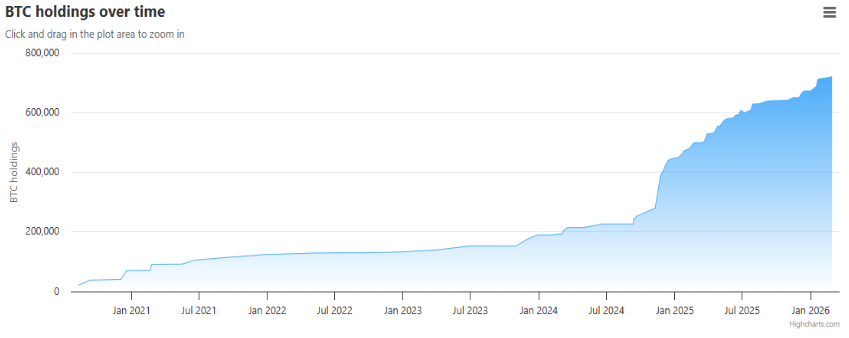
Strategy disclosed the purchase in a recent update, continuing its ongoing accumulation program. They purchased 3,015 Bitcoin for $204.1 million at $67,700 per coin. The company now holds 720,737 Bitcoin acquired for $54.77 billion at an average cost basis of $75,985. With Bitcoin at $67,000, Strategy carries unrealized losses but continues conviction-based buying.
Strategy funded this through $229.9 million in common stock sales and $7.1 million in preferred shares. The company controls 3.4% of Bitcoin's eventual 21 million supply. This marks its 101st purchase since 2020.
Strategy's "42/42" plan targets $84 billion in equity offerings through 2027 to fund acquisitions. Proper risk management in volatile markets looks different when your business model explicitly embraces Bitcoin volatility.
Strategy reported a $12.4 billion Q4 2025 loss from unrealized crypto losses yet continues accumulating. The company treats Bitcoin as a primary reserve asset on an "indefinite horizon."
The divergence illuminates how Bitcoin functions within different business models rather than serving as a universal treasury asset.
Core Scientific: Revenue-driven pivot prioritizing AI infrastructure over Bitcoin exposure. Needs immediate capital for data centers generating contracted revenue. Bitcoin holdings were unproductive capital—profitable to sell at $92,100. Hybrid AI-mining model focuses on megawatt monetization. Liquidity drives decisions.
Strategy: Pure Bitcoin treasury thesis providing leveraged Bitcoin exposure through equity markets. Exists to accumulate regardless of price through continuous offerings. Monitoring crypto derivatives positioning matters less than long-term conviction. Tolerates substantial unrealized losses without selling pressure.
Neither approach is superior. They reflect different priorities and business fundamentals.
Miner selling adds supply but reflects operational necessity. Core Scientific's sale at $92,100 made strategic sense given capital needs. Trading discipline during volatility requires adapting to circumstances.
Strategy's accumulation offsets narrative impact. The net effect remains neutral unless trends accelerate. If miners monetize holdings, supply pressure builds. If corporations adopt treasury models, demand absorption intensifies.
Bitcoin is becoming a capital allocation decision rather than ideology. Core Scientific and Strategy represent opposite poles, yet both make sense given their business models. The divergence strengthens Bitcoin's institutional case by demonstrating flexibility.
Will more miners pivot to AI and sell Bitcoin opportunistically? Or will Strategy's accumulation attract imitators? Both trends will likely continue, creating natural supply-demand dynamics. Corporate strategies have moved beyond "buy and hold" versus "avoid entirely" into sophisticated frameworks weighing opportunity costs and strategic positioning.
Core Scientific sold 1,900 Bitcoin ($175 million) in January to fund its AI infrastructure expansion and data center buildouts. The company is pivoting away from Bitcoin mining toward AI colocation services, with CEO Adam Sullivan describing mining as "essentially in runoff." The sale occurred at $92,100 per Bitcoin, 35% above current prices, demonstrating opportunistic timing to raise liquidity for contracted AI projects worth over $10 billion.
Strategy holds 720,737 Bitcoin acquired for approximately $54.77 billion, representing an average cost basis of roughly $75,985 per Bitcoin. The company purchased 3,015 Bitcoin in late February for $204.1 million at an average price of $67,700 per coin. Strategy controls over 3.4% of Bitcoin's eventual 21 million supply, making it the world's largest publicly traded corporate Bitcoin holder.
Miners aren't abandoning Bitcoin but rather diversifying business models. Core Scientific, MARA Holdings, Riot Platforms, Cipher Digital, and Bitfarms are all pivoting toward AI infrastructure and high-performance computing colocation. They're selling Bitcoin to fund these transitions, viewing data center revenue as more reliable than mining-dependent income. This represents business model evolution, not loss of faith in Bitcoin's long-term value.
Share it with your community