
All information on this site is provided by Mubite for educational purposes only, specifically related to financial market trading. It is not intended as an investment recommendation, business advice, investment opportunity analysis, or any form of general guidance on trading investment instruments. Trading in financial markets involves significant risk, and you should not invest more than you can afford to lose. Mubite does not offer any investment services as defined under the Capital Market Undertakings Act No. 256/2004 Coll. The content on this site is not directed toward residents in any country or jurisdiction where such information or use would violate local laws or regulations. Mubite is not a brokerage and does not accept deposits.
Mubite s.r.o., Školská 660/3, Nové Město, ICO: 23221551 Praha 1, 110 00, Czech Republic | Copyright Ⓒ 2026 Mubite. All Rights Reserved.
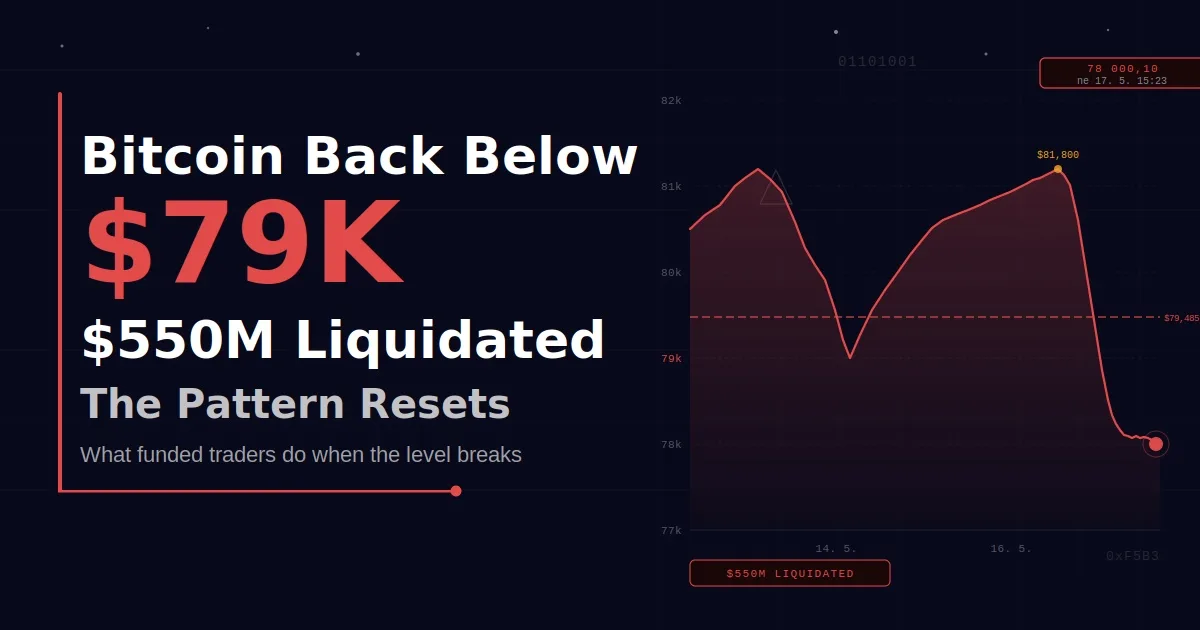
On May 1 we flagged $79,485 as the level that historically determines Bitcoin's May direction. BTC broke above it on May 5 and we covered the relief. On May 14 longs got wiped for $230 million.
Now, one day later, Bitcoin has dropped to $78,600 with $550 million liquidated in 24 hours and the macro picture that just turned significantly more hostile. The pattern we have been tracking across six weeks of connected coverage has reset, and the implication for funded traders is specific.
This was not a single catalyst event. From what we have tracked across this series, the most dangerous moves for funded traders are precisely this kind, multiple independent pressures arriving in the same session without a clear single cause to fade.
The 10-year US Treasury yield rose to 4.58%, the highest level in a year. Oil topped $100 a barrel on West Texas Intermediate futures. The Nasdaq 100 opened down 1.7% and the S&P 500 fell 1.2%. Gold dropped 2.5%. Bitcoin fell as much as 3.4% to around $78,600, its lowest in two weeks. Every risk asset sold simultaneously, which means this was not a crypto-specific move, it was a macro repricing.
US 10-year Treasury yields pushed past 4.5% as macro assets priced out any likelihood of liquidity easing through 2026. The highly leveraged digital asset market experienced an abrupt repricing as a result.
Back-to-back upside inflation surprises and renewed geopolitical tension over Taiwan hit risk sentiment simultaneously, cracking Bitcoin's $80,000 floor and sending traders watching $78,000 as the next key support level.
127,628 traders were liquidated in the past 24 hours for $440 million according to CoinGlass data. Investing.com and CryptoTimes put the total closer to $550 to $573 million including cascading positions across the session. BTC-specific liquidations reached $194.76 million, led by Binance at $35.12 million, with the overwhelming majority hitting long positions.
This is the third major liquidation event we have documented in ten days. What we observe in comparing all three is a pattern that matters for position sizing decisions going forward.
May 9: $356M liquidated, 91% shorts. Short side was overcrowded after 30 days of negative funding.
May 14: $230M liquidated, 90% longs. Bullish positioning that built after the squeeze was caught by the reversal.
May 15: $550M liquidated, predominantly longs again. The long side did not flush out in a single day, it took two sessions.
That sequencing tells funded traders something important. When a crowded side begins to liquidate, a single 24-hour session rarely clears the overhang completely. The second day is often worse, not better, because stop losses from traders who survived day one get triggered as price continues lower.
We are now back where we started on May 1. BTC is trading near $78,000, below the $79,485 threshold that the May historical pattern depends on. Bitcoin losing $79K support on a daily close points toward $74,000 to $75,000 as the next key level, according to Standard Chartered and Citi analysis tied directly to the CLARITY Act legislative outcome.
The irony of this week is not lost on us. The CLARITY Act passed its Senate committee vote 15-9 on May 14 — the most significant US crypto regulatory development in two years. Bitcoin briefly reclaimed $82,000 on the news. Less than 24 hours later it was trading at $78,600 on macro fears that had nothing to do with crypto regulation.
That disconnect between regulatory progress and price action is itself a funded trader signal: sentiment is fragile enough right now that positive catalysts are being faded within the same session they arrive.
The answer is not to pick a direction. From what we have observed across three liquidation events in ten days, the traders who preserved their accounts through this volatility shared one characteristic: they were sized for the environment rather than the conviction.
A few principles that apply directly after a $550M liquidation event on a funded account:
Do not assume the flush is complete after one day. The May 14 data showed $230M in long liquidations. May 15 added another $550M. Open interest has dropped but has not reset to a neutral baseline yet.
Check funding rates before sizing any position in either direction. After two consecutive long liquidation sessions, funding will likely be moving toward neutral or negative, which changes the risk profile of both longs and shorts.
The drawdown buffer you had at the start of the week may have narrowed. Recalculate your actual available buffer before the next entry rather than relying on the number you started Monday with.
The $79,485 level now acts as overhead resistance rather than support. A clean reclaim on daily close is the signal to reassess bullish positioning. A continued failure below it keeps the bearish pattern from May 1 alive.
Slippage in this environment is elevated. Bitcoin witnessed a low of $77,630 and a high of $79,516 within 24 hours, an $1,886 range in a single session. Slippage on stops during that range is not the same as slippage in a $200 daily range environment.
The risk management principles that protect a funded account have not changed. The volatility environment in which you apply them has changed significantly in the last ten days. That distinction is what separates traders who are still in their challenges at the end of May from those who are not.
Share it with your community