All information on this site is provided by Mubite for educational purposes only, specifically related to financial market trading. It is not intended as an investment recommendation, business advice, investment opportunity analysis, or any form of general guidance on trading investment instruments. Trading in financial markets involves significant risk, and you should not invest more than you can afford to lose. Mubite does not offer any investment services as defined under the Capital Market Undertakings Act No. 256/2004 Coll. The content on this site is not directed toward residents in any country or jurisdiction where such information or use would violate local laws or regulations. Mubite is not a brokerage and does not accept deposits.
Mubite s.r.o., Skolska 660/3, ICO: 23221551 Prague 1, 110 00, Czech Republic | Copyright Ⓒ 2025 Mubite. All Rights Reserved.

Bitcoin gave back most of its rebound from last week's crypto crash. It drifted back toward the $65,000 area after failing to hold above $70,000.
Bitcoin is a digital asset. It trades like a high-volatility risk market. That means it moves with equities when macro sentiment flips fast. For context on how crypto assets work, see these crypto basics.
Bitcoin’s earlier recovery did not stick. It rolled over as broader risk appetite weakened. The coin fell back toward the $65,000 level, erasing nearly all gains above $70,000.
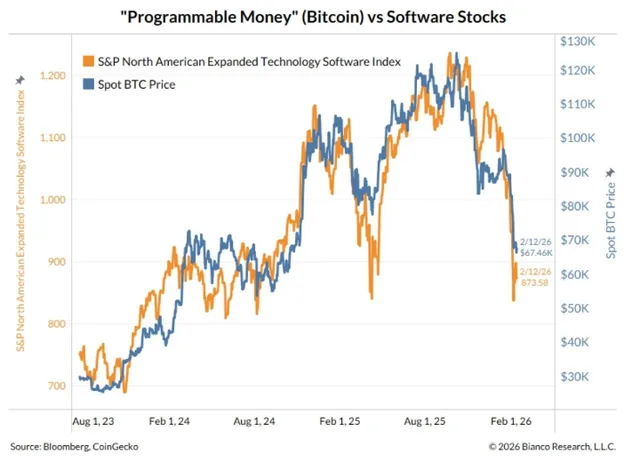
Macro strategist Jim Bianco of Bianco Research drew the line clearly. He called out the link between Bitcoin and software stocks in a widely shared post. “Software stocks are struggling again today,” Bianco wrote. “Don’t forget there’s another type of software ‘programmable money,’ crypto. Bitcoin and the software index. They are the same thing.”
Bitcoin was down around 2% in 24 hours. Ether and Solana tracked the move even lower.
Key data point: Bitcoin’s 30-day correlation with the iShares Expanded Tech-Software ETF (IGV) hit 0.73, according to ByteTree Research. That is stronger than its correlation with the Nasdaq-100.

The iShares Expanded Tech-Software Sector ETF (IGV) dropped hard. It fell 3% in a single session, revisiting panic lows from the week prior. The ETF is now down over 21% year to date.
The reason is straightforward. Markets are repricing “growth” risk. AI tools are seen as a threat to traditional software revenue models. Investors are selling the sector. Bitcoin often trades in that same bucket during macro stress.
As Jack Mallers, CEO of Strike, noted: markets treat Bitcoin like a software stock right now. The reason is simple. The same short-term, risk-seeking traders hold both.
Goldman Sachs analyst Matthew Martino also weighed in. He said the software selloff “reflects a rapid shift in investor sentiment rather than a sudden deterioration in fundamentals.” That pattern applies to Bitcoin too.
If you are trading these swings, the edge is almost always process. That is where protecting capital in volatile news cycles becomes the real differentiator.
Volatility like this is not new. Bitcoin has moved with equities before. It did so in March 2020 and again in late 2022. Each time, the traders who survived were not the ones who predicted the move. They were the ones who managed it. The AI selloff is a reminder that crypto does not exist in a vacuum. Macro events shape the price. Regulatory news shapes the price. Sentiment shapes the price. Understanding these forces is part of the job.
No single session decides the trend. But this setup gives traders clear “next signals.” The key is staying disciplined and not letting headlines drive your decisions. Learning to avoid headline-driven mistakes is critical in an environment like this.
Core takeaway: if correlation stays tight, macro tape-reading matters more than crypto narratives. Watch the software sector as a leading indicator for Bitcoin’s next move.
Bitcoin now has a 0.73 correlation with the iShares Software ETF (IGV). The same risk-seeking traders hold both assets. When macro sentiment turns negative, they sell both. Bitcoin no longer acts as a hedge in these conditions.
The $64,400–$65,000 zone is the main support area analysts are watching. A hold here could set up a relief rally toward $75,000. A break lower puts fresh weekly lows in play.
It means macro factors are driving Bitcoin more than crypto-specific news. Traders need to watch Nasdaq, the software sector, and Fed signals just as closely as on-chain data.
Share it with your community