All information on this site is provided by Mubite for educational purposes only, specifically related to financial market trading. It is not intended as an investment recommendation, business advice, investment opportunity analysis, or any form of general guidance on trading investment instruments. Trading in financial markets involves significant risk, and you should not invest more than you can afford to lose. Mubite does not offer any investment services as defined under the Capital Market Undertakings Act No. 256/2004 Coll. The content on this site is not directed toward residents in any country or jurisdiction where such information or use would violate local laws or regulations. Mubite is not a brokerage and does not accept deposits.
Mubite s.r.o., Skolska 660/3, ICO: 23221551 Prague 1, 110 00, Czech Republic | Copyright Ⓒ 2025 Mubite. All Rights Reserved.

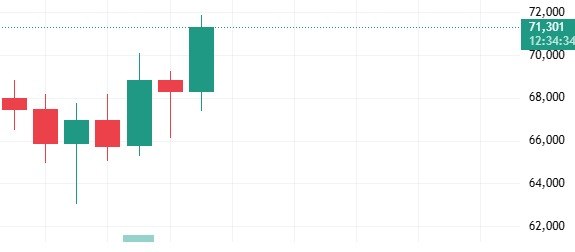
Bitcoin climbs back toward $70,000 as spot ETFs saw $1.45 billion in inflows over five trading days. Institutional demand appears to be stabilizing the market after weeks of volatility driven by geopolitical tensions and macro uncertainty. The rebound raises a critical question: Are ETF flows powerful enough to sustain Bitcoin's recovery, or does this represent temporary positioning before the next leg down?
Institutional flows increasingly shape Bitcoin price movements. Understanding what makes crypto move requires recognizing that ETF capital deployment now drives price action as much as on-chain metrics or derivatives positioning.
Spot Bitcoin ETFs pulled in $1.45 billion across five consecutive sessions ending March 3, marking the strongest sustained buying since early February. Bloomberg ETF analyst Eric Balchunas noted that "just about all of the original ten spot ETFs" participated, indicating breadth rather than concentration.
BlackRock's IBIT led flows, with strong participation from Fidelity's FBTC, Grayscale's GBTC, and ARK 21Shares' ARKB. Broad participation suggests diversified demand that tends to persist rather than concentrated flows that reverse quickly.
ETF inflows absorb sell pressure. When authorized participants create shares, they must purchase underlying Bitcoin, removing supply from exchanges. Monitoring crypto derivatives helps identify whether ETF buying aligns with futures sentiment.
Market maker Enflux noted Bitcoin's rebound reflected short-covering, but sustained ETF inflows suggest fundamental support. Glassnode reported RSI climbed to 41 from 36, though below neutral 50. Spot volume increased to $9.6 billion from $6.6 billion.

ETFs make Bitcoin accessible to traditional portfolios that cannot hold the asset directly due to custody requirements or regulatory constraints. Several key institutions now have clear pathways to Bitcoin exposure:
Pension funds with fiduciary custody requirements
Registered investment advisors needing regulated vehicles
Wealth management platforms avoiding operational complexity
Insurance companies restricted to approved securities
This accessibility transforms Bitcoin from a niche speculation into a legitimate portfolio allocation option for trillions in institutional capital.
Institutional flows move slower but larger than retail. Institutions deploy capital through deliberate processes involving committees and risk frameworks, creating steadier demand. Proper risk management means understanding institutional buying operates on different timeframes.
Sustained inflows stabilize volatility by creating baseline demand that counters selling pressure. ETF accumulation absorbs supply without triggering cascading liquidations. While $1.45 billion over five days sounds significant, it represents a tiny fraction of global institutional assets—if adoption continues expanding, structural demand could dwarf current levels.
Several factors will determine whether Bitcoin sustains the recovery or reverses:
Several factors will determine whether Bitcoin sustains the recovery or reverses. Monitor these key signals
These metrics provide early warning signals for directional changes. Slippage in fast markets can impact execution during volatile breakout attempts, so positioning ahead of major moves matters more than reacting during them.
ETF inflows stabilized Bitcoin after volatile correction. The $1.45 billion represents meaningful demand countering selling pressure. Institutional participation continues growing as traditional finance embraces Bitcoin through ETF structures.
However, the Bitcoin versus gold debate remains unresolved. Dalio's comment came as Bitcoin outperformed during the crisis, highlighting narrative gaps. The next key test is whether Bitcoin reclaims $70,000 sustainably with volume confirmation.
Spot Bitcoin ETFs pulled in approximately $1.45 billion in net inflows over five consecutive trading days ending March 3, 2026. Bloomberg ETF analyst Eric Balchunas noted that almost all of the original ten spot ETFs participated, indicating broad-based demand rather than concentration in a single fund. BlackRock's IBIT led flows, with strong participation from Fidelity's FBTC, Grayscale's GBTC, and ARK 21Shares' ARKB.
Ray Dalio stated "there is only one gold" on the All-In Podcast, arguing Bitcoin lacks central bank backing, offers no privacy, and faces quantum computing threats. However, on the day he made those comments, gold fell 3% while Bitcoin declined just 0.7%. Bitcoin outperformed gold during the U.S.-Iran conflict despite Dalio's skepticism, though he maintains 1% of his portfolio in Bitcoin for diversification.
Bitcoin must decisively break and hold above $70,000 with sustained volume to confirm the recovery. This psychological resistance level previously acted as support before flipping. Glassnode data shows Bitcoin's RSI at 41 (below neutral 50), spot volume improving to $9.6 billion, and derivatives markets still showing seller dominance. A clean break above $70,000 would shift momentum constructively and validate ETF-driven demand.
Share it with your community