
All information on this site is provided by Mubite for educational purposes only, specifically related to financial market trading. It is not intended as an investment recommendation, business advice, investment opportunity analysis, or any form of general guidance on trading investment instruments. Trading in financial markets involves significant risk, and you should not invest more than you can afford to lose. Mubite does not offer any investment services as defined under the Capital Market Undertakings Act No. 256/2004 Coll. The content on this site is not directed toward residents in any country or jurisdiction where such information or use would violate local laws or regulations. Mubite is not a brokerage and does not accept deposits.
Mubite s.r.o., Školská 660/3, Nové Město, ICO: 23221551 Praha 1, 110 00, Czech Republic | Copyright Ⓒ 2026 Mubite. All Rights Reserved.
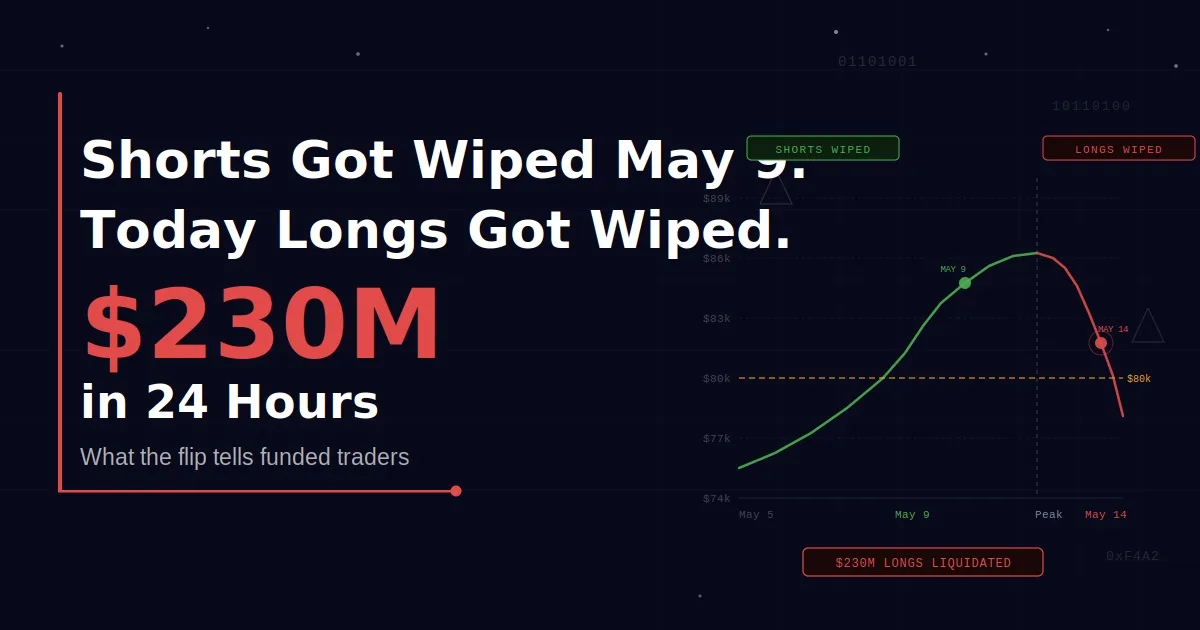
On May 9 we wrote about the trader who lost $1.94 million on a single BTC short after 11 winning trades, and what a crowded short position looks like before it snaps. Today the market handed us the mirror image. $230 million in crypto futures were liquidated in 24 hours, and this time 90% of the losses hit the long side.
Same mechanics, opposite direction, same lesson for funded traders who are not paying attention to which side is now overcrowded.
The data is precise enough that the pattern is impossible to miss. This was not a broad deleveraging event. It was a directional wipeout concentrated on bullish positioning across the three largest derivatives markets simultaneously.
When we see 90% long liquidation ratios across three unrelated assets in the same 24-hour window, the cause is not asset-specific. It is structural. The long side was overcrowded and a sustained sell-side move triggered cascading margin calls that amplified the initial decline well beyond what the underlying price action would have produced on its own.
| Asset | Total liquidated | Long position share |
|---|---|---|
| Bitcoin (BTC) | $106.93 million | 90.94% |
| Ethereum (ETH) | $95.14 million | 89.54% |
| Solana (SOL) | $27.78 million | 93.11% |
| Total | $230 million | ~91% average |
In the short squeeze article we published on May 9, we explained how 30 days of negative funding rates created a structurally overcrowded short position. When BTC broke $80,000, that crowding produced a violent, amplified move against the shorts.
From what we observe in how these cycles run, the reversal tends to follow a predictable pattern. The short squeeze drives price higher. Retail and leveraged traders see the move and open long positions chasing the momentum. Funding rates flip positive as the long side dominates. Positive funding means longs pay to stay in the trade, eroding margin over time. And then a correction hits an already over-leveraged long side with the same amplified mechanics that hit the shorts three weeks earlier.
The funding rate data following the May 5 breakout above $80,000 showed exactly this dynamic building. Funding turned positive on perpetuals across BTC, ETH, and SOL as bullish positioning dominated. Today's data is the reset.
The same principles that protected funded accounts on the short side apply here in reverse. The mechanics of a liquidation cascade do not care which direction the market is moving. A 91% long liquidation ratio means the forced selling from those closures added additional downward pressure, pulling more accounts through their maintenance margin thresholds in a feedback loop.
A few things funded traders should assess after today's event:
Check whether funding rates have reset toward neutral or turned negative following today's long wipeout. A rapid funding reset is often where the next directional opportunity forms, but it also signals the overcrowding is flushing out rather than reversing immediately.
Reassess any open long positions against current drawdown buffers. If a position survived today's move but is sitting closer to its liquidation price than before, the buffer has narrowed. That is not a neutral observation on a funded account.
Understand that slippage during a liquidation cascade on the long side is worse than in normal conditions. If a stop was set but filled at a worse price today, that is not an anomaly. That is the expected behaviour of a market absorbing $230 million in forced selling simultaneously.
The market has now produced a short squeeze and a long squeeze within a two-week window. That pattern – violent moves in both directions in rapid succession, is what a market in the process of finding a new equilibrium looks like after a significant structural shift. For funded traders, the risk management response is not to pick a direction. It is to size for the volatility rather than the conviction.
Share it with your community