All information on this site is provided by Mubite for educational purposes only, specifically related to financial market trading. It is not intended as an investment recommendation, business advice, investment opportunity analysis, or any form of general guidance on trading investment instruments. Trading in financial markets involves significant risk, and you should not invest more than you can afford to lose. Mubite does not offer any investment services as defined under the Capital Market Undertakings Act No. 256/2004 Coll. The content on this site is not directed toward residents in any country or jurisdiction where such information or use would violate local laws or regulations. Mubite is not a brokerage and does not accept deposits.
Mubite s.r.o., Školská 660/3, Nové Město, ICO: 23221551 Praha 1, 110 00, Czech Republic | Copyright Ⓒ 2026 Mubite. All Rights Reserved.
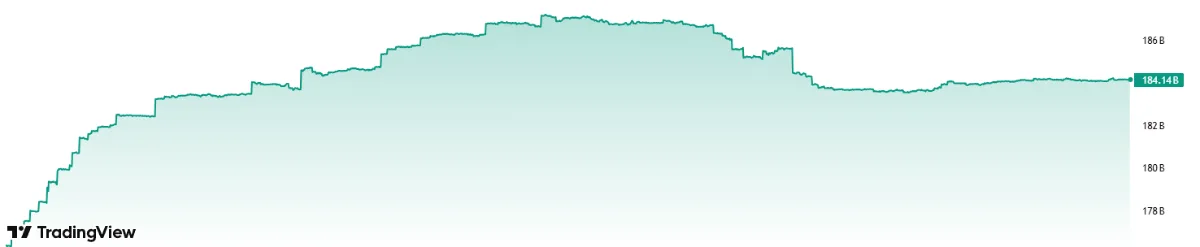
Stablecoins kept growing in Q1 even as the broader crypto market lost ground. Total supply reached a record $315 billion, but the quarterly increase was only about $8 billion, making it the slowest pace of growth since Q4 2023.
That is what makes the data interesting. This was not a clean risk-on expansion. It looked more like capital staying inside crypto while shifting toward safer, more liquid assets.
The wider crypto market cap fell about 21% in Q1, while stablecoin supply still grew by roughly 2.6%. That gap suggests traders were moving toward liquidity rather than chasing upside.
In simple terms, money did not fully leave crypto. A meaningful part of it moved into stable assets instead, which is also why concepts like crypto hedging stay relevant when sentiment turns more defensive.
One of the clearest shifts in Q1 came from the two biggest stablecoins. USDC grew by about $2 billion, while USDT declined by roughly $3 billion, showing that traders were not only moving into stablecoins, but also becoming more selective about which ones they used.
That made Q1 less about broad expansion and more about internal rotation. Stablecoin demand stayed strong, but the market’s preferences changed.
Total stablecoin supply: $315 billion
Quarterly increase: about $8 billion
USDC change: + $2 billion
USDT change: - $3 billion

Stablecoins accounted for about 75% of total crypto trading volume in Q1, up from the previous record of 72% in Q3 2022. That tells you how central dollar-backed assets have become when traders want flexibility without leaving the market.
It also means execution matters more when so much flow runs through stablecoin pairs. In fast markets, traders still have to think about slippage in crypto, especially when liquidity looks deep on paper but price moves quickly.
Another notable trend was the rise of yield-bearing stablecoins. That category grew by about 22%, or roughly $4.3 billion, during the quarter.
That suggests part of the market wanted both safety and return. In a weaker quarter, that combination became more attractive than taking direct exposure to more volatile crypto assets.
This is not a straightforward bullish signal. Rising stablecoin supply can be constructive because it shows capital is still active on-chain, but the Q1 data points more to caution than to a full risk-on shift.
For traders, the message is simple: liquidity stayed in crypto, but conviction weakened. In that kind of market, risk management often matters more than trying to predict the next breakout.
Stablecoin supply hit a record: $315 billion
Growth was the weakest since: Q4 2023
Stablecoins made up: 75% of crypto trading volume
Broader crypto market cap: down 21% in Q1
Stablecoin supply hit a record in Q1, but the bigger message was not pure growth. With the broader crypto market falling, USDC gaining share, and stablecoins taking a record portion of trading volume, the quarter looked more like a move into liquidity than a broad return to risk.
That is still an important signal. Capital has not disappeared from crypto, but for now it is sitting in safer instruments and waiting for clearer direction.
Because it shows capital is still active inside crypto even when traders are reducing exposure to riskier assets.
Not on its own. In Q1 2026, stablecoins grew while the broader crypto market fell, which points more to defensive positioning than a full recovery.
Share it with your community