All information on this site is provided by Mubite for educational purposes only, specifically related to financial market trading. It is not intended as an investment recommendation, business advice, investment opportunity analysis, or any form of general guidance on trading investment instruments. Trading in financial markets involves significant risk, and you should not invest more than you can afford to lose. Mubite does not offer any investment services as defined under the Capital Market Undertakings Act No. 256/2004 Coll. The content on this site is not directed toward residents in any country or jurisdiction where such information or use would violate local laws or regulations. Mubite is not a brokerage and does not accept deposits.
Mubite s.r.o., Školská 660/3, Nové Město, ICO: 23221551 Praha 1, 110 00, Czech Republic | Copyright Ⓒ 2026 Mubite. All Rights Reserved.
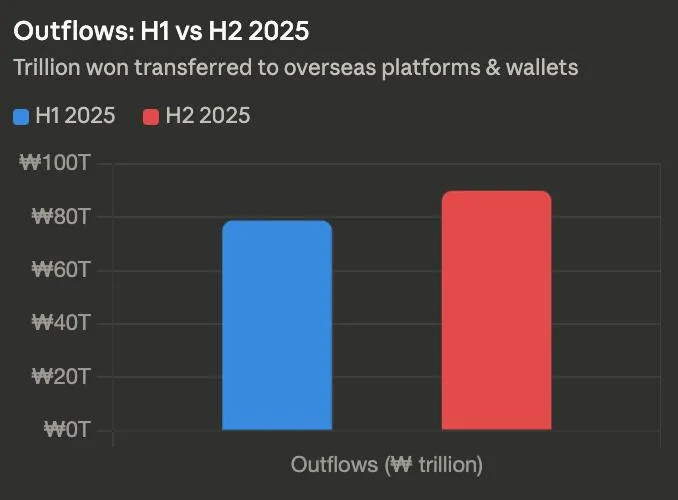
South Korea recorded approximately $60 billion in crypto outflows from domestic exchanges in the second half of 2025. Exchange operating profits dropped 38% to $253 million. Stablecoin balances on the country's five largest platforms fell 55% since July 2025. And capital is moving into stocks.
This is one of the clearest examples of crypto market outflows driven by equity competition that any major market has produced in recent years. Is this a local story or a signal for global crypto market sentiment?

South Korea's Financial Services Commission published its H2 2025 crypto market report on March 25, 2026. The numbers paint a detailed picture of a market under structural pressure.
Here is a summary of the key data points from the FSC report:
Despite these outflows, the number of active accounts grew 3% to 11.1 million and deposits jumped 31% to $5.4 billion. That is the unusual part of this story. More people opened accounts and deposited more money. But profits for exchanges fell sharply because the capital was not staying and trading actively on domestic platforms.
| Metric | Figure (H2 2025) |
|---|---|
| Crypto outflows to overseas | $60 billion, up 14% from H1 |
| Exchange operating profits | Down 38% to $253 million |
| Daily trading volume | Down 15% to $3.6 billion |
The South Korea crypto outflow story has two distinct phases. The first started in November 2025 when traders chased AI-linked chipmakers as altcoin momentum faded. The second phase hit in March 2026 when the Korean won broke past 1,500 per dollar, a 16-year low.
The currency move turned stablecoin outflows into a straightforward trade. Traders holding USDT at a favorable USD/KRW exchange rate had a direct incentive to sell, convert to won and redeploy into local assets. Brokerage data confirms this happened. Investor deposits available for stock purchases fell from roughly 131 trillion won in early March to around 112 trillion won after the currency move. Capital went directly from stablecoins into equities.
South Korea is one of the world's most active retail crypto markets. What happens there tends to reflect broader shifts in crypto market sentiment before they show up in global data. The current picture is cautious.
Several factors are shaping sentiment right now. These are the main forces behind the current risk-off positioning in South Korean crypto markets:
Declining retail participation: daily trading volumes on Korean exchanges dropped 15% while the number of accounts grew, a sign that existing users are less active
Stablecoin outflows: a 55% drop in stablecoin balances signals traders are not just reducing risk but actively exiting the ecosystem
FX-driven behavior: the won's weakness created a specific currency arbitrage that pulled capital out of crypto, not a broad rejection of digital assets
Policy competition: tax incentives for domestic equity investment are directly competing with crypto for the same retail capital
The important nuance here is that the latest stablecoin outflows were currency-driven, not sentiment-driven.
Managing positions during capital rotation cycles requires treating each drawdown on its own terms. A clear approach to drawdown helps traders separate noise from structural trend shifts.
The South Korea crypto situation signals capital rotation from crypto to equities. Key indicators will show if this deepens or reverses. Watch the Korean won vs. dollar: 1,500 triggered stablecoin outflows; stabilization could halt exits.
Watch stablecoin balances on Korean exchanges: Deposits stabilizing per brokerage data; rebuild signals returning buying power.
Watch the KOSPI: Semiconductor rally fading could rotate capital back to crypto.
Watch spot Bitcoin ETF regulatory news: Approval timeline post-U.S. moves could flip sentiment.
In fast-moving rotation environments, having a clear stop loss framework protects positions when sentiment shifts faster than fundamentals.
South Korea's $60 billion in crypto outflows shows how quickly capital rotates between asset classes when conditions change. Crypto market sentiment in one of the world's most active retail markets has turned cautious. But this rotation was partly currency-driven and partly policy-driven. It is not a permanent verdict on crypto.
The next phase depends on three things: whether the won stabilizes, whether Korean equity strength continues and whether crypto can offer a compelling enough reason to bring retail capital back. All three are still in play.
South Korea's Financial Services Commission reported that roughly $60 billion in crypto assets left domestic exchanges for overseas platforms and private wallets in H2 2025. The outflows were driven by a combination of factors: capital rotating into equities, the Korean won hitting a 16-year low against the dollar, and government policies offering tax incentives for domestic stock investment.
Stablecoin outflows from exchanges reduce the pool of capital available to buy crypto assets. When stablecoin balances fall sharply, it often signals that traders are exiting the ecosystem rather than simply waiting on the sidelines.
South Korea is one of the most active retail crypto markets globally, so its trends are worth watching. However, the current crypto market outflows there have specific local drivers: a weak won, equity-friendly tax policy and a semiconductor-led KOSPI rally.
Share it with your community