All information on this site is provided by Mubite for educational purposes only, specifically related to financial market trading. It is not intended as an investment recommendation, business advice, investment opportunity analysis, or any form of general guidance on trading investment instruments. Trading in financial markets involves significant risk, and you should not invest more than you can afford to lose. Mubite does not offer any investment services as defined under the Capital Market Undertakings Act No. 256/2004 Coll. The content on this site is not directed toward residents in any country or jurisdiction where such information or use would violate local laws or regulations. Mubite is not a brokerage and does not accept deposits.
Mubite s.r.o., Školská 660/3, Nové Město, ICO: 23221551 Praha 1, 110 00, Czech Republic | Copyright Ⓒ 2026 Mubite. All Rights Reserved.
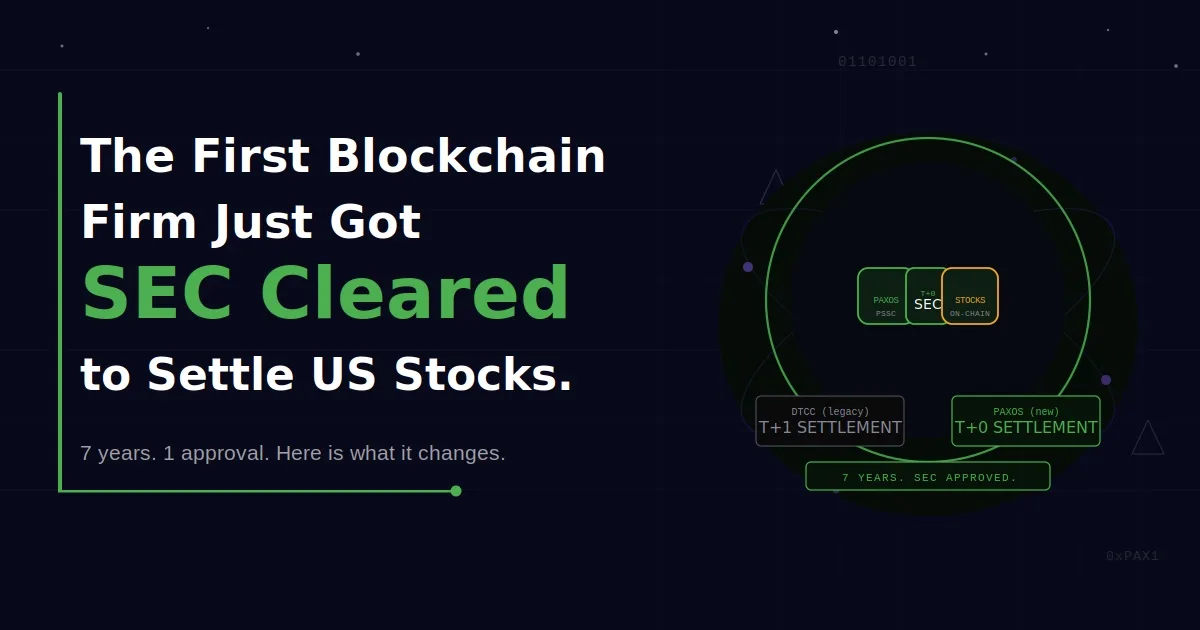
On May 28, the SEC granted Paxos Securities Settlement Company full registration as a clearing agency and central securities depository for US equities, the first blockchain-native firm to hold this designation in US history.
The practical meaning: Paxos can now settle US stock trades on blockchain rails on the same day they execute, bypassing the legacy infrastructure that has processed virtually every US securities transaction for decades. For crypto traders, the significance is not about stocks. It is about what happens to volatility, liquidity, and asset class boundaries when traditional and digital markets start running on the same settlement layer.
The Depository Trust and Clearing Corporation has processed the majority of US securities settlements since the 1970s. Every stock trade you have ever seen execute in milliseconds took one full business day to actually settle, cash and legal ownership changing hands, because of the DTCC's centralised clearing infrastructure. That T+1 standard was itself an improvement from T+2 only two years ago.
Paxos spent seven years building a blockchain-native alternative. The regulatory journey in brief:
2019: SEC issued a no-action letter allowing Paxos to pilot blockchain settlement
2020: Live pilot launched with Bank of America, Credit Suisse, Societe Generale, and Instinet
December 2025: Paxos Trust Company converted to a national trust charter under the OCC
May 28, 2026: Full SEC clearing agency registration granted under Section 17A
The approval positions Paxos alongside the DTCC as one of a tiny group of firms authorised to run post-trade infrastructure for US capital markets. Partners already confirmed on the Paxos platform include PayPal, Mastercard, and Interactive Brokers.
From the analysis we have built across this series since April, the Paxos approval is the infrastructure milestone that the equity perps and tokenised stock products we have been documenting were always building toward.
Ostium launched equity perpetuals on Nasdaq data. Coinbase listed stock perps. ICE and OKX brought oil perpetuals to crypto rails. All of those products require price discovery on traditional assets. What they have not had until now is a regulated settlement layer that can handle the actual transfer of ownership in real time when a tokenised stock position is closed.
Paxos changes that. When T+0 settlement on blockchain is operational at scale, the friction between holding a crypto-native equity perp and holding the underlying stock approaches zero. Capital that currently sits separated between brokerage accounts and crypto exchanges can move between them in the same session. That structural change in capital mobility has direct implications for funding rates on equity perps and for liquidation mechanics on crypto-native instruments that track traditional asset prices.
Visa's stablecoin settlement pilot reached a $7 billion annualized run rate in April 2026, growing 50% quarter-over-quarter. Approximately 90% of open order book volume on Binance's peer-to-peer platform is now stablecoin-denominated. The plumbing for a unified TradFi and crypto settlement layer is being built simultaneously from multiple directions. Paxos is the piece that connects the regulated equity market into that infrastructure.
The Paxos approval is a structural development that will matter significantly over the next two to three years. It does not change the assets available to trade today or the risk parameters of existing positions.
Bitcoin is trading at approximately $62,000. The macro environment, elevated yields, geopolitical pressure, sustained ETF outflows, has not changed because Paxos received a clearing agency registration. The tokenisation narrative is a long-term tailwind for crypto market depth and liquidity. It is not a short-term price catalyst and treating it as one is how traders get caught chasing structural stories in the wrong timeframe.
Know your position. Know your drawdown buffer. The infrastructure is being built. Trade the market you are in while it gets there.
Share it with your community