All information on this site is provided by Mubite for educational purposes only, specifically related to financial market trading. It is not intended as an investment recommendation, business advice, investment opportunity analysis, or any form of general guidance on trading investment instruments. Trading in financial markets involves significant risk, and you should not invest more than you can afford to lose. Mubite does not offer any investment services as defined under the Capital Market Undertakings Act No. 256/2004 Coll. The content on this site is not directed toward residents in any country or jurisdiction where such information or use would violate local laws or regulations. Mubite is not a brokerage and does not accept deposits.
Mubite s.r.o., Skolska 660/3, ICO: 23221551 Prague 1, 110 00, Czech Republic | Copyright Ⓒ 2025 Mubite. All Rights Reserved.

In a seven-day leaderboard that rewarded speed, discipline, and composure under pressure, Mannie, a crypto trader from Nigeria, finished second with $62,000 in profit on a $100,000 crypto prop firm account. The result drew attention not because of extreme leverage or constant trading, but because of how controlled the execution remained throughout the competition.
While other accounts surged and collapsed just as quickly, Mannie’s approach to crypto prop trading followed a different rhythm. Fewer trades. Clear structure. Defined risk.
Mannie, whose real name is Emmanuel, began trading roughly two years ago, but he is quick to clarify that trading only became serious earlier this year. Before that, it was exploratory. Casual. The shift came when he decided to fully commit, treating trading not as a side activity but as a skill to be developed with structure and discipline.
He describes that period as one where he “stayed really committed,” focusing heavily on market structure and risk management. His education came less from theory and more from repetition. Practice. Watching price. Making mistakes and correcting them. That process laid the foundation for what would later become a funded trading account environment rather than retail trading.
Crypto was always his entry point. He never migrated from other markets. As he puts it, it was always “Bitcoin, altcoins, meme coins.” The appeal was not hype, but volatility and access. Crypto markets trade every day, at any time, and that constant movement creates opportunity, especially for traders preparing to operate inside a crypto funded account rather than trading personal capital
Mannie discovered Mubite organically through Crypto Twitter. At the time, he had limited exposure to prop firms, especially crypto-focused ones. What caught his attention was simply the opportunity to trade firm capital in markets he already understood.
After joining, what stood out was usability. He describes the platform as “really seamless” and emphasizes that it allowed him to focus on trading rather than navigating restrictions. He contrasts this with stories he had heard from other traders about firms with heavy limitations that restrict how strategies can be executed.
For him, the experience felt flexible without being careless, which allowed him to trade naturally within his framework.
Mannie’s approach to the market is deliberate and methodical. He does not enter trades based on forecasts or opinions. Instead, he waits for the market to show its hand, a mindset that translates well to competitive environments like a crypto prop firm competition or on a crypto trading leaderboard.
He often explains that trading, in his view, “is not about prediction, it’s about reacting.” Price, he believes, always reacts from somewhere. Support. Resistance. Supply. Demand. The role of the trader is to identify those zones and wait for confirmation.
If a setup does not align with his directional bias and structure, he does nothing. That rule alone eliminates a large percentage of trades and helps him avoid overtrading, something that becomes especially important when performance is publicly visible, as it is in a prop firm trader story or a funded trader interview like this one.
Many of Mannie’s strongest trades came from volatile small-cap pairs, but he is careful to explain that volatility alone is not enough. What matters is whether price respects structure.
Before committing capital, he watches how price behaves around his levels. If price reacts cleanly, the setup becomes tradable. If it ignores those zones, he walks away. He notes that many low-cap coins fail this test entirely, which is why he filters aggressively.
This is why his PnL distribution came from a handful of decisive moves rather than dozens of marginal trades.
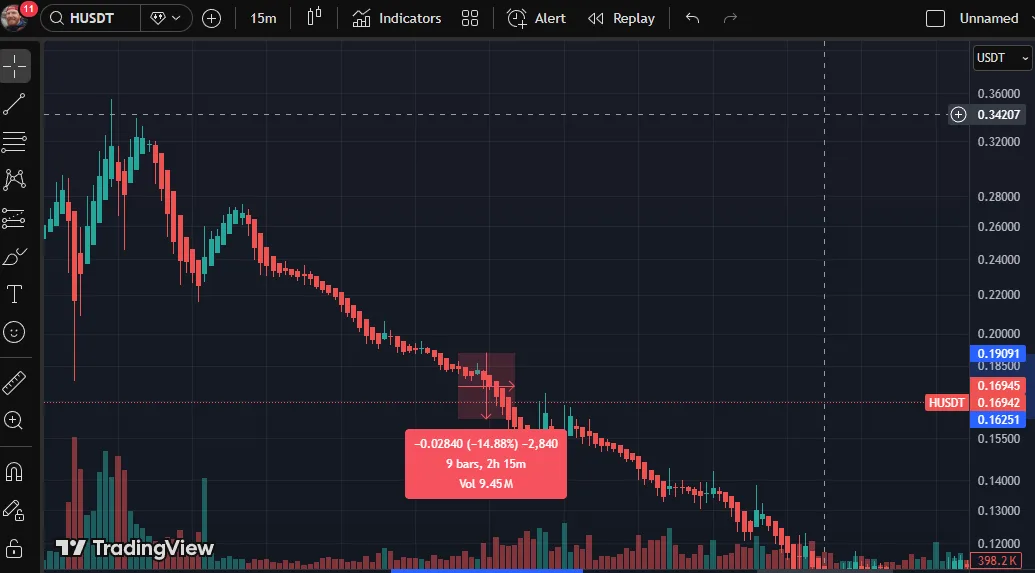
The most defining trade of Mannie’s run was HUSDT, which produced over $14,000 in profit. Importantly, this was not an early, aggressive entry. It came later in the challenge, when protecting capital was just as important as growing it.
He was acutely aware of daily drawdown limits and adjusted leverage accordingly, keeping it intentionally low despite the potential upside. Low-cap volatility, he explains, can be unforgiving. Stops can be hit even when the idea is correct, simply because of how violently price moves.
What allowed him to hold the trade was not confidence in profit, but acceptance of loss.
“I was okay with losing at my stop loss, knowing this is where I’m comfortable being taken out.”
That acceptance removed hesitation. Once in the trade, there was no second-guessing.

Leverage appears throughout Mannie’s trade history, but it was never applied blindly. On volatile small caps, leverage was reduced. On cleaner instruments like Bitcoin, it was increased.
He explains that Bitcoin’s dominance makes it structurally different. When BTC trends, it often dictates the direction of the broader market, which allows for tighter invalidation and clearer entries. His BTC/USDT trade at 25x leverage followed the same structural logic and resulted in a clean profit of nearly $2,400.
In his case, leverage was not a shortcut. It was a variable adjusted to match the behavior of the instrument.
Mannie is candid about his development. He sees himself primarily as a technical trader. Market structure, key levels, and execution form the foundation of his approach.
Psychology still matters, especially in volatile conditions, but he believes it cannot replace technical skill. Without understanding structure, confidence becomes meaningless. The HUSDT trade tested him psychologically, but it also reinforced the importance of predefined risk.
Volatility did not disappear. His reaction to it changed.
During the leaderboard, Mannie observed many traders aggressively pushing their accounts. Some scaled rapidly, reaching extreme percentages early in the competition.
From his perspective, many of those traders were gambling. They chased leaderboard position instead of respecting risk. He admits there were moments when he questioned whether patience would be enough, especially when others appeared to be far ahead.
What kept him grounded was execution. He focused on taking trades that aligned with his framework and ignored what others were doing. By the end of the competition, that restraint proved decisive.
Mannie also adjusted his trading during the challenge itself. Rather than focusing on lower-timeframe scalping, he paid closer attention to the daily chart and intraday reactions.
His goal was not to hold trades indefinitely, but to identify where price was likely to react during the day and take profit accordingly. Psychological levels and structural zones guided exits just as much as entries.
This adaptability is often overlooked, but it plays a significant role in successful prop trading.
When asked what advice he would give other traders, Mannie does not overcomplicate it. He emphasizes execution over outcome, patience over urgency.
Many traders, especially in challenges, rush the process because they are focused on payouts. His view is that consistency comes from waiting. If the setup is not there, the correct decision is to do nothing.
For traders looking to take the next step, understanding how funded accounts actually work is essential. We break this down in our guide on becoming a funded crypto trader.
Mannie’s second-place finish was not built on constant action or excessive risk. It was built on structure, restraint, and a clear understanding of where he was willing to be wrong.
Seven days.
$62,000 in profit.
A performance defined by discipline rather than aggression.
In a competitive environment where many traders overextend, his run stands as a reminder that execution still matters more than speed.
Profitable Funded Crypto Trading - Compare top instant funding options and learn how skilled traders pass evaluations and scale with firm capital.
Risk Management for Crypto Prop Traders - Explore how top funded traders manage risk, size positions, and avoid the mistakes that kill most accounts early.