All information on this site is provided by Mubite for educational purposes only, specifically related to financial market trading. It is not intended as an investment recommendation, business advice, investment opportunity analysis, or any form of general guidance on trading investment instruments. Trading in financial markets involves significant risk, and you should not invest more than you can afford to lose. Mubite does not offer any investment services as defined under the Capital Market Undertakings Act No. 256/2004 Coll. The content on this site is not directed toward residents in any country or jurisdiction where such information or use would violate local laws or regulations. Mubite is not a brokerage and does not accept deposits.
Mubite s.r.o., Varšavská 488/23, ICO: 23221551 Prague 2, 120 00, Czech Republic | Copyright Ⓒ 2025 Mubite. All Rights Reserved.
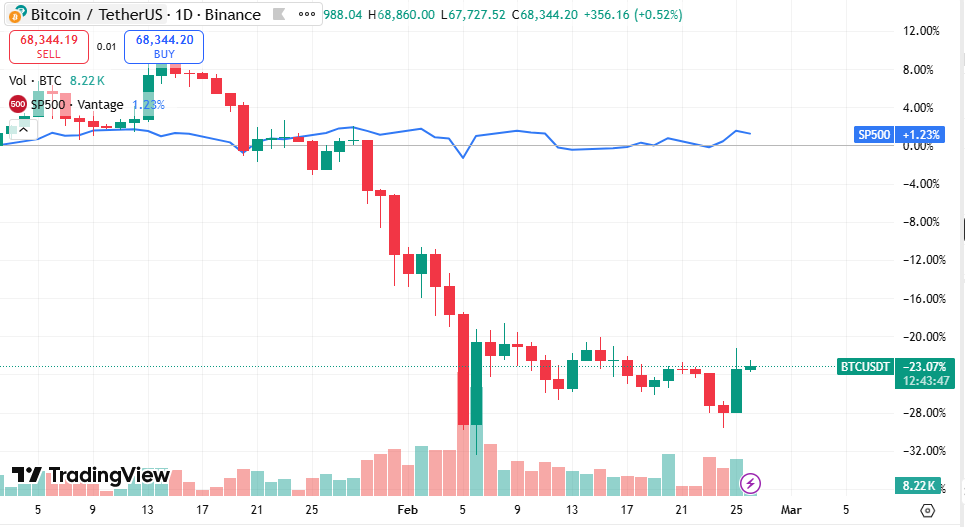
Bitcoin climbed toward $70,000 as U.S. equities advanced on Tuesday, delivering an 8% surge that snapped multiple weeks of downside pressure. The rally arrived alongside gains in major tech stocks, with Nvidia up 6% and the broader Nasdaq recovering from recent AI-driven selloffs. Is this a relief rally that fades at resistance, or the start of sustained recovery?
The rebound reflects three converging forces that temporarily aligned to push Bitcoin price higher.
Equity market stabilization provided the primary catalyst. After sharp drawdowns in AI-exposed tech stocks triggered rotation out of risk assets, investors returned to growth-oriented positions as fears about AI disruption to legacy software models eased. Bitcoin followed equities higher, demonstrating the 75% correlation that now defines its price behavior according to institutional positioning data.
Short squeeze dynamics amplified the move. When Bitcoin briefly touched $60,000 during the prior session's decline, liquidations created thin order books and overcrowded short positioning. The reversal back above $70,000 forced shorts to cover, accelerating the rally's momentum.
Technical breakout confirmation added fuel. Bitcoin reclaimed short-term resistance around $68,000 with volume, triggering algorithmic buying from momentum systems. Monitoring crypto derivatives positioning helps identify when these setups develop before they resolve violently.
However, context matters. The 8% surge recovers only a fraction of the 45% drawdown from Bitcoin's $126,000 all-time high. Price remains well below recent consolidation zones between $80,000 and $90,000 that defined late 2025 and early 2026 trading. This makes the rally impressive on a daily basis but unresolved on longer timeframes.
Bitcoin's movement alongside U.S. equities has become undeniable. BTC-to-S&P 500 correlation sits at 60.5% over 30 days, with Nasdaq correlation running even tighter. Understanding what makes crypto move requires recognizing institutional algorithms treat Bitcoin as high-beta risk, not independent value.
When equities stabilize, crypto follows with amplified moves. But correlation cuts both ways. If risk deteriorates, Bitcoin underperforms as capital exits. The 0.75 equity correlation is up from just 0.15 in 2021.
This challenges Bitcoin as "digital gold." Gold hedges portfolios because it doesn't correlate with stocks. Bitcoin's rising correlation undermines the diversification thesis institutions once found compelling.

Bitcoin now faces its most important test: can it reclaim and hold $70,000 as support rather than resistance?
Immediate resistance sits at $70,000. Price briefly touched this during Tuesday's rally but hasn't confirmed with sustained volume. A decisive close above opens $75,000-$80,000.
Support rests at $68,000, the breakout level. Holding suggests the move has legs. Failure indicates false breakout, likely retesting $65,000.
RSI shows neutral to slightly overbought after the 8% move. Volume was decent but not exceptional. Slippage in fast markets impacts execution during volatile moves.
Two scenarios frame the reasonable range from current levels.
Bullish case: Break and hold above $70,000 with volume. Equities stabilize. Macro sentiment improves. Target: $75,000-$80,000 over 2-4 weeks.
Confirmation: Volume expansion, funding rates normalizing, ETF inflows reversing.
Cautious case: Failure at $70,000 triggers profit-taking. Liquidity stays thin. Pullback toward $65,000, potentially retesting $60,000-$62,000. Using hedging strategies protects capital if this scenario develops.
Invalidation: Break below $65,000, continued ETF outflows, equity weakness.
The key is positioning for uncertainty rather than betting on certainty. Proper risk management means sizing for both scenarios and adjusting as new information emerges.
The rebound is meaningful but not yet decisive. Bitcoin's 8% surge represents a relief rally until proven otherwise. The $70,000 level remains the key psychological barrier that separates hope from conviction.
Traders should focus on follow-through, not headlines. Watch for sustained closes above $70,000, improving volume profiles, and whether equity market strength persists beyond a single session. The correlation that drove Bitcoin higher can reverse just as quickly if risk sentiment shifts.
Three main factors drove the rally: U.S. equity market stabilization after tech stock selloffs, short squeeze dynamics as overcrowded positions unwound above $68,000, and technical breakout confirmation that triggered algorithmic buying. The move followed Bitcoin's correlation with stocks, which currently sits at 60-75%.
It's too early to confirm a trend reversal. Bitcoin needs to decisively break and hold above $70,000 with sustained volume to validate bullish continuation. Until then, this appears to be a relief bounce that recovers only a fraction of the 45% drawdown from all-time highs. Watch for follow-through above $70,000 or failure leading to retests of $65,000 support.
Resistance sits at $70,000 psychological level; a clean break opens $75,000-$80,000. Support rests at $68,000 breakout level, with critical support at $65,000. A break below $65,000 would invalidate the bullish setup and likely trigger retests of $60,000-$62,000 lows established during recent weakness.
Share it with your community