All information on this site is provided by Mubite for educational purposes only, specifically related to financial market trading. It is not intended as an investment recommendation, business advice, investment opportunity analysis, or any form of general guidance on trading investment instruments. Trading in financial markets involves significant risk, and you should not invest more than you can afford to lose. Mubite does not offer any investment services as defined under the Capital Market Undertakings Act No. 256/2004 Coll. The content on this site is not directed toward residents in any country or jurisdiction where such information or use would violate local laws or regulations. Mubite is not a brokerage and does not accept deposits.
Mubite s.r.o., Skolska 660/3, ICO: 23221551 Prague 1, 110 00, Czech Republic | Copyright Ⓒ 2025 Mubite. All Rights Reserved.

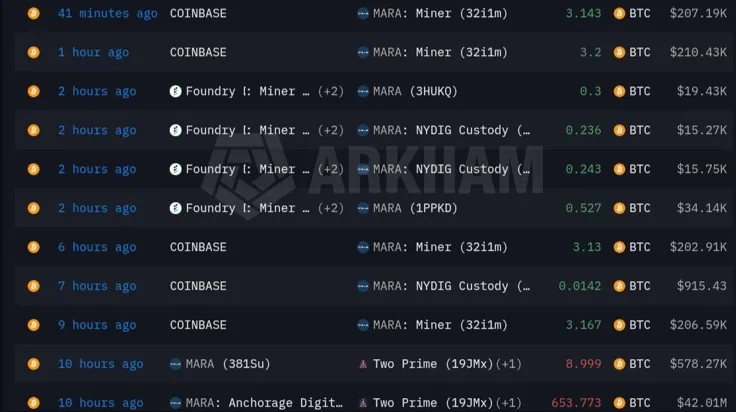
Bitcoin miner MARA Holdings moved roughly 1,317 BTC, worth about $87M, on-chain during a broader market selloff.
The transfer occurred as Bitcoin volatility spiked, with BTC sliding sharply over a 24-hour window. Treasury moves from miners often draw attention during drawdowns, as they can hint at liquidity management under stress rather than outright selling.
This article explains what MARA moved and why miners transfer BTC during volatility.

On-chain data shows MARA executed several BTC outflows over a short timeframe.
The total transfer amounted to 1,317 BTC, or roughly $87.4M, within about 13 hours. The activity stood out because it coincided with a sharp BTC price decline.
Publicly listed miners hold large treasuries. Even routine operational transfers can therefore move meaningful size on-chain. That makes these events closely watched during periods of market stress.
At the start of 2026, MARA held roughly 26,800 BTC. This transfer represented around 5% of its total holdings, making it notable but not exhaustive.
Large BTC transfers often spark fears of miner selling. In practice, movement does not equal liquidation.
Common reasons for miner transfers include:
● Custody reshuffles or security upgrades.
● Posting BTC as collateral for loans or crypto derivatives, including futures and perpetuals.
● Internal treasury operations or liquidity preparation.
● Risk controls during volatile market conditions.
Actual selling pressure usually requires follow-through. Traders look for repeated transfers, exchange inflows, or a sustained decline in miner reserves. A single event, even a large one, is often part of standard risk management in volatile markets.
Bitcoin miners operate capital-intensive businesses. Energy costs, debt obligations, and hardware spending do not pause during drawdowns.
When Bitcoin volatility increases, miners may move BTC to:
● Secure short-term liquidity.
● Post collateral to manage margin exposure.
● Prepare for operational expenses.
● Rebalance treasury risk.
These actions are often defensive rather than directional. For traders, the key is distinguishing operational moves from sustained selling behavior. That requires watching reserve trends over time, not reacting to a single headline.
Recent corporate commentary highlights how Bitcoin drawdowns now affect public-company narratives.
During its latest earnings call, Strategy reported a weaker quarter tied partly to BTC price declines. The company acknowledged that Bitcoin volatility directly impacts reported results, even as it continues to frame BTC as a long-term strategic asset.
This matters because miners and corporate holders increasingly operate under the same scrutiny as traditional public firms. Treasury decisions, stress testing, and liquidity planning are now part of earnings discussions, not fringe topics.
Strategy’s CEO also addressed a worst-case scenario that caught market attention.
He stated that BTC would need to fall to roughly $8,000 and remain there for several years to threaten the company’s debt assumptions. This was not a price forecast.
Instead, it was a stress-test framework, designed to show survivability under extreme conditions. Public companies routinely model severe downside scenarios to satisfy creditors and investors.
In simple terms, the comment reflects how corporate Bitcoin holders think about drawdowns, not where they expect price to go.
MARA’s transfer is best viewed as a data point, not proof of dumping.
Traders should focus on:
● Whether miner BTC continues flowing to exchanges.
● Changes in aggregate miner reserves.
● Broader risk sentiment across crypto markets.
Bitcoin miner holdings are increasingly managed with the same tools used in traditional finance. Hedging, collateralization, and liquidity planning are now standard practice.
For active traders, pairing on-chain signals with disciplined risk rules in volatile markets remains essential.
MARA’s $87 million BTC transfer occurred during a sharp market drawdown, making it stand out. However, on-chain movement alone does not confirm selling.
Miner treasury activity often reflects liquidity management during volatility. At the same time, corporate stress-test language from firms like Strategy shows how Bitcoin drawdowns are now openly discussed at the boardroom level.
For traders, the message is clear. Watch trends, not headlines. In a market defined by Bitcoin volatility, context matters more than any single transaction. Hedging needs to be also taken into consideration to protect downside risk.
No. Bitcoin transfers often relate to custody, collateral, or internal operations. Analysts look for exchange inflows and reserve declines to confirm selling pressure.
Miners move BTC to manage liquidity, post collateral, rebalance risk, or cover operational costs during volatile periods.
Sustained miner outflows can signal financial stress. They should be evaluated alongside earnings, debt levels, and operating costs.
Share it with your community