All information on this site is provided by Mubite for educational purposes only, specifically related to financial market trading. It is not intended as an investment recommendation, business advice, investment opportunity analysis, or any form of general guidance on trading investment instruments. Trading in financial markets involves significant risk, and you should not invest more than you can afford to lose. Mubite does not offer any investment services as defined under the Capital Market Undertakings Act No. 256/2004 Coll. The content on this site is not directed toward residents in any country or jurisdiction where such information or use would violate local laws or regulations. Mubite is not a brokerage and does not accept deposits.
Mubite s.r.o., Školská 660/3, Nové Město, ICO: 23221551 Praha 1, 110 00, Czech Republic | Copyright Ⓒ 2026 Mubite. All Rights Reserved.
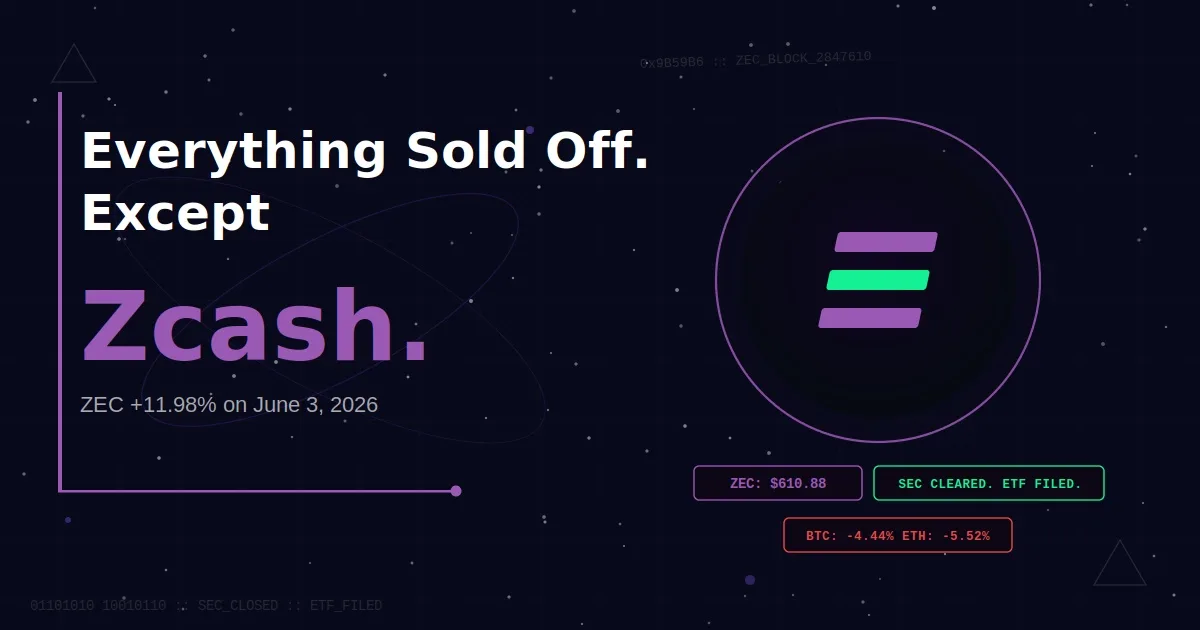
On June 3, BTC fell 4.44% to $66,958, ETH dropped 5.52% to $1,871, total crypto liquidations exceeded $1 billion, and the Fear and Greed Index collapsed to 12, deep in extreme fear territory. Zcash went up 11.98% to $610.88. One asset moving against the entire market on a session this broad is not noise. It is a signal worth understanding, and the explanation behind the ZEC price move is more layered than a single headline can carry.
A privacy coin outperforming in a risk-off session is structurally unusual. When macro fear drives broad market selling, high-beta assets including crypto typically move together to the downside. Correlation across the market rises as institutional risk managers reduce exposure across all volatile assets simultaneously.
ZEC breaking that correlation today is not coincidence. From the data we have analysed across the Zcash narrative over the past six months, this move is the product of four separate catalysts converging, each one independently bullish, all arriving within the same 30-day window.
Each catalyst is distinct and the combination of all four in a short window is what separates today's ZEC move from a simple short squeeze:
SEC investigation closed without action. In January 2026, the SEC ended its two-year investigation into the Zcash Foundation with no enforcement action. That closure removed the single largest regulatory overhang that had suppressed institutional participation since 2024. For any asset carrying a live SEC investigation, the resolution is a structural unlock, the XRP trajectory we documented last week is the clearest comparable.
Emergency protocol upgrade on June 2. The Zcash development team executed an emergency upgrade patching a vulnerability discovered in the Orchard shielded pool. No evidence of exploitation was found before the patch was deployed. The speed of the response and the clean outcome are a credibility signal, the team found a critical issue and fixed it in hours.
Grayscale spot Zcash ETF filing. Grayscale filed an amended S-3 registration statement for the Grayscale Zcash Trust ETF, targeting a listing on NYSE Arca. The filing names the trust's purpose as holding ZEC directly. Grayscale's ETF pipeline has historically functioned as an institutional optionality signal – DCG, Grayscale's parent, has been accumulating ZEC alongside the filing process.
Multicoin Capital institutional position disclosed. Multicoin's Tushar Jain publicly disclosed a significant ZEC position built since February 2026, describing Zcash as "a return to the cypherpunk ideals crypto was founded on." Cypherpunk Technologies separately acquired over $90 million worth of ZEC. The Winklevoss twins and Barry Silbert have also made disclosed positions. Robinhood listed ZEC. THORChain integrated it. The institutional access infrastructure that was absent during the 2023 to 2024 delisting cycle has been rebuilt.
The most significant of the four catalysts is the SEC investigation closure. From what we have observed across the regulatory series we have tracked since April, the pattern is consistent: once a major regulatory overhang is removed, institutional product development accelerates and price follows within 12 to 18 months.
Zcash is a privacy-preserving alternative to Bitcoin, created in 2016 using zero-knowledge proof cryptography. Its selective privacy features, shielded and transparent transaction pools, have historically been treated by regulators as a compliance risk. The SEC's decision to close the Zcash Foundation investigation without action is the clearest signal yet that privacy technology, implemented with the right governance structure, is not inherently incompatible with US regulatory expectations.
The Wall Street Journal published a feature this month reframing privacy as a feature rather than a flaw. That editorial shift in a mainstream financial publication is a leading indicator of institutional acceptance, not a trailing one.
ZEC is up more than 1,200% from its 2024 lows when regulatory pressure and delistings were compressing both price and liquidity. The current ZEC price of $610.88 sits well below the theoretical upside of a fully institutionally adopted privacy coin with a Grayscale ETF, a clean SEC record, and accumulation from top-tier funds, but historical comparisons with XRP and the distance between "regulatory cleared" and "fully repriced" suggest the market has not finished adjusting.
What the four catalysts collectively signal for Zcash price prediction in 2026 is that the structural preconditions for a larger repricing are in place. ETF approval pending, institutional positions building, regulatory narrative shifting. The timing of when those preconditions translate into sustained price movement depends on macro conditions that are currently working against every risk asset, including ZEC.
Understanding how funding rates on ZEC perpetuals behave after a multi-catalyst single-session move is relevant for any trader sizing a position after today. Sharp single-session moves on thin liquidity often produce elevated funding and rapid mean reversion within 24 to 72 hours.
Zcash news today is genuinely positive on the fundamentals. Four real catalysts, institutional participation building, regulatory clarity improving. None of that changes what today's 12% move means in a risk management context.
A 12% single-session gain in a broad market selloff is a high-volatility event regardless of the underlying thesis. Assets that move this fast against the market direction can reverse just as quickly when the catalyst narrative fades and correlation reasserts itself. Understanding your liquidation price before entering any leveraged ZEC position is not optional knowledge — it is the baseline.
The four catalysts are real. The macro environment is hostile. Size for the environment you are trading in, not just the story you believe in.
Share it with your community