All information on this site is provided by Mubite for educational purposes only, specifically related to financial market trading. It is not intended as an investment recommendation, business advice, investment opportunity analysis, or any form of general guidance on trading investment instruments. Trading in financial markets involves significant risk, and you should not invest more than you can afford to lose. Mubite does not offer any investment services as defined under the Capital Market Undertakings Act No. 256/2004 Coll. The content on this site is not directed toward residents in any country or jurisdiction where such information or use would violate local laws or regulations. Mubite is not a brokerage and does not accept deposits.
Mubite s.r.o., Školská 660/3, Nové Město, ICO: 23221551 Praha 1, 110 00, Czech Republic | Copyright Ⓒ 2026 Mubite. All Rights Reserved.
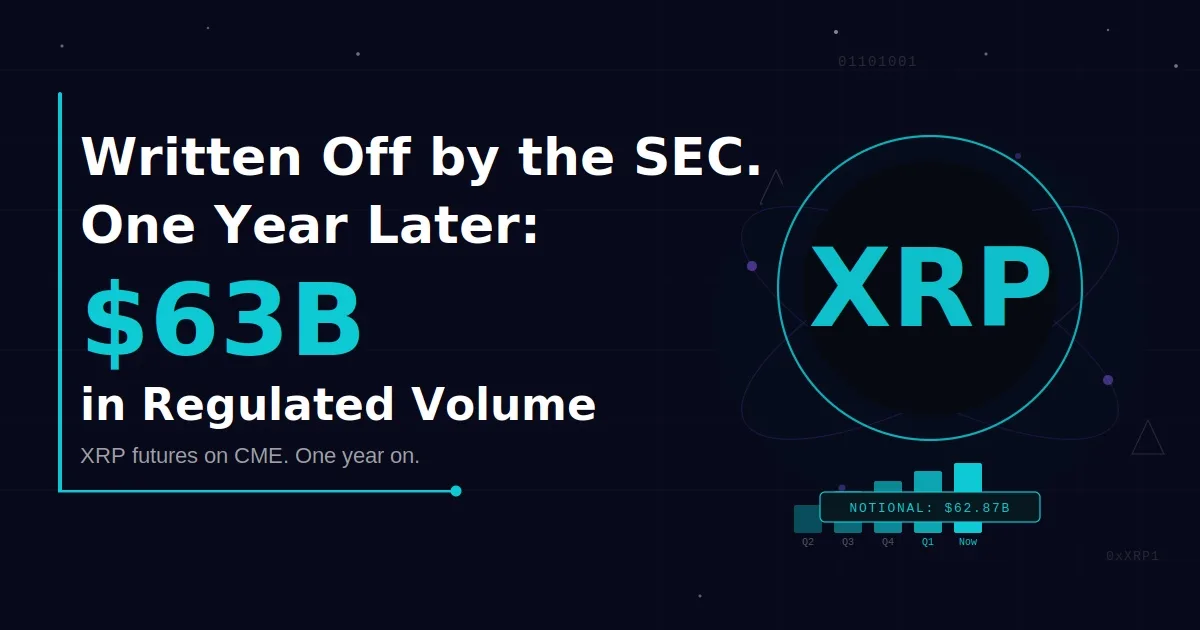
A year ago XRP was finishing a four-year SEC lawsuit that had effectively frozen institutional participation in the asset. On May 19, 2025, CME listed XRP futures. As of May 15, 2026, those contracts have generated $62.87 billion in notional trading volume, 1.32 million contracts, 28.6 billion XRP tokens, $238 million in average daily volume. The number tells a story beyond XRP specifically. It tells us how fast regulated capital moves once the ceiling is removed.
Notional volume represents the total value of the underlying XRP controlled by each contract, not the cash that changed hands. From the data we have analysed, the $238 million average daily volume is the more meaningful signal. Daily averages smooth out the outlier sessions. A consistent $238 million per day over twelve months means funds and structured product desks are using XRP futures as a regular portfolio tool.
The counterintuitive detail worth reading twice: XRP current price sits at approximately $1.37 a 40% decline from the all-time high of $3.65 reached in July 2025. Institutional derivatives activity and the price of XRP moved in completely opposite directions. Futures volume grows while price falls because hedgers are managing existing exposure, not adding directional bets.
Bitcoin took roughly 18 months from ETF approval to consistent daily CME volume above $10 billion. XRP took 12 months from CME launch to $238 million average daily volume, from a lower base, with an asset classified as a potential security for four years prior.
The assets to watch now are the ones sitting in the same pre-legitimacy position XRP occupied in 2024:
Solana, Cardano, and Avalanche are all absent from CME's current futures suite
All three have had regulatory cases pending or recently resolved with the SEC
The CLARITY Act formally classifies digital commodities under CFTC jurisdiction, removing remaining ambiguity for institutional desks cautious about altcoin exposure
Standard Chartered analysts estimate the Act could unlock $4 to $8 billion in additional XRP ETF inflows alone
XRP/USD is currently trading around $1.37 after touching $1.20 during the macro-driven sell-off in mid-May. XRP price in USD has been range-bound between $1.20 and $2.20 for most of 2026, well below the $3.65 peak but significantly above sub-$0.50 levels from the lawsuit years.
What the CME volume data tells us about XRP price prediction in 2026 is structural rather than directional:
Consistent institutional hedging at $238M daily creates a floor, capitulation moves get absorbed faster than in assets with no regulated derivatives market
The funding rate environment on XRP perpetuals has remained broadly negative since early April, mirroring the BTC pattern before the May 5 short squeeze, signalling a crowded short position building
How liquidation mechanics behave differently on an asset with deep institutional futures participation versus a retail-driven altcoin is one of the most underappreciated dynamics in derivatives right now
The signal across XRP's $63 billion CME milestone and the institutional product launches we have documented since April is consistent. The infrastructure for institutional crypto participation is arriving in parallel from multiple directions at once, and the assets that get their regulatory frameworks right first capture the liquidity that follows.
XRP's one-year trajectory is the most concrete proof point we have for how fast that capital moves. The question is which assets are next, and how long after the regulatory gate opens before the $238 million per day starts showing up in their order books.
The $63 billion in CME volume tells you institutional infrastructure is real. It does not tell you where XRP price goes next week. Regulated derivatives markets reduce certain risks, extreme liquidity gaps, settlement failures, counterparty exposure. They do not reduce directional risk, volatility risk, or the risk of being wrong about the trade.
XRP/USD has moved between $1.20 and $3.65 in the past twelve months. That is a 200% range on a single asset. Anyone trading that range with leverage needs to know their liquidation price before the position is open, not after it moves against them. Funding rate costs on multi-day holds in volatile conditions can quietly erode a position even when price stays flat, understanding how funding rates work is not optional knowledge for anyone trading XRP perpetuals.
Institutional legitimacy is a structural tailwind. It is not a trade thesis and it is not a safety net. Size accordingly.
Share it with your community