All information on this site is provided by Mubite for educational purposes only, specifically related to financial market trading. It is not intended as an investment recommendation, business advice, investment opportunity analysis, or any form of general guidance on trading investment instruments. Trading in financial markets involves significant risk, and you should not invest more than you can afford to lose. Mubite does not offer any investment services as defined under the Capital Market Undertakings Act No. 256/2004 Coll. The content on this site is not directed toward residents in any country or jurisdiction where such information or use would violate local laws or regulations. Mubite is not a brokerage and does not accept deposits.
Mubite s.r.o., Školská 660/3, Nové Město, ICO: 23221551 Praha 1, 110 00, Czech Republic | Copyright Ⓒ 2026 Mubite. All Rights Reserved.
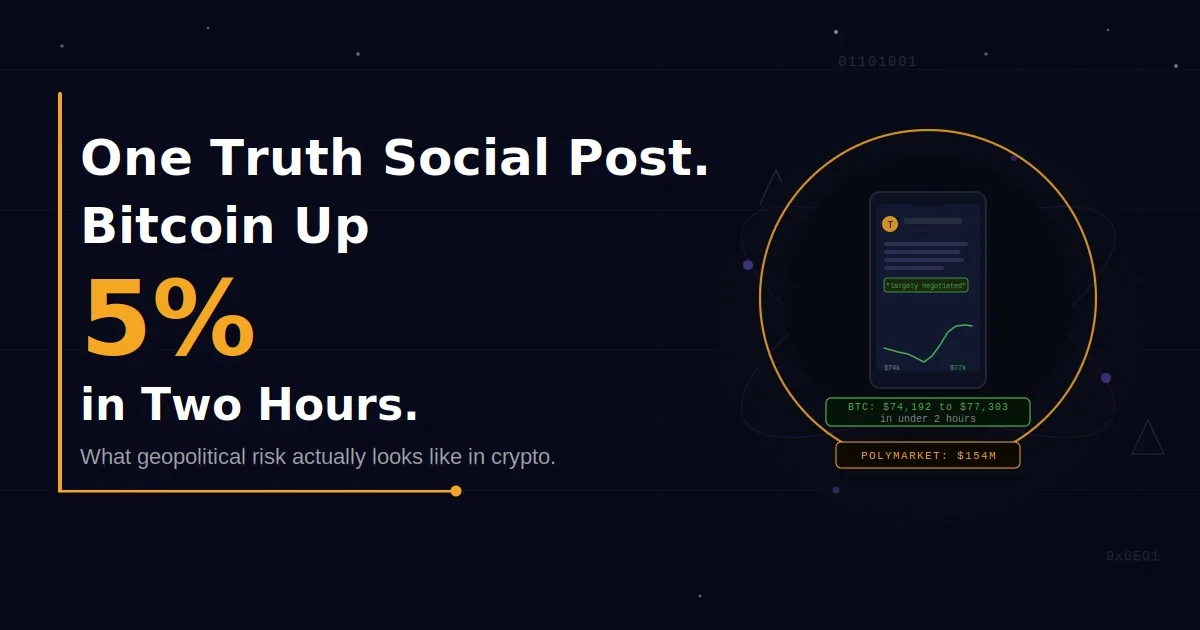
On Saturday May 23 at 8:52 PM ET, President Trump posted on Truth Social that a peace agreement had been "largely negotiated" between the United States, Iran, Saudi Arabia, the UAE, Qatar, Pakistan, Turkey, Egypt, Jordan, and Bahrain and that the Strait of Hormuz would be reopened under the deal.
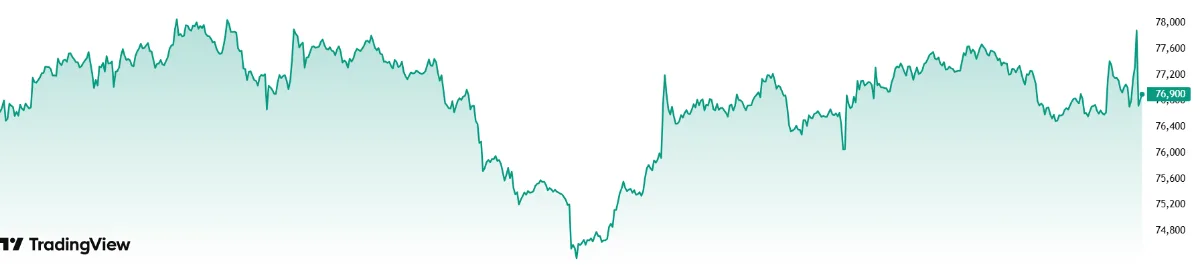
Crypto markets had just finished a week of sustained selling. Bitcoin had fallen to a one-month low of $74,192. Within hours of the post, BTC spiked to an intraday high of $77,303 and total crypto market capitalisation recovered approximately $75 billion.

The US-Iran conflict has become one of the most consistent macro drivers for Bitcoin this year, and understanding why matters more than the specific move from this weekend.
The mechanism is oil. When conflict threatens the Strait of Hormuz, the passage through which roughly 20% of global oil flows, crude prices spike, inflation expectations rise, interest rate cut odds fall, and risk assets including crypto sell off. When the conflict appears to de-escalate, oil falls, inflation pressure eases, and the same capital flows back into high-beta assets.
From the data we have tracked across this series, 2026 has seen this pattern play out multiple times:
April 7: Trump issued a two-day ultimatum to Iran. BTC was at $68,000 and fell sharply on escalation fear.
May 18: Trump posted "TIME IS OF THE ESSENCE" on Truth Social warning Iran its "clock is ticking." BTC slipped below $76,700 and $660 million in positions were liquidated.
May 23: Trump posted the peace deal announcement. BTC rebounded from $74,192 to $77,303 within hours.
The asset that is most sensitive to oil price expectations in the crypto market is not a commodity token. It is Bitcoin. That relationship has tightened considerably in 2026 as institutional holders with macro frameworks have become the dominant force in the BTC ETF market.
The Truth Social post sent Polymarket volumes on US-Iran peace deals past $154 million, the largest prediction market on a geopolitical outcome since the 2024 election. The December 31, 2026 contract for a permanent US-Iran peace deal was trading at 91% odds within hours of the post.
Trump described his position as a "solid 50/50" between accepting a diplomatic agreement and resuming escalated military action. His framing was specific: accept a deal strong enough to be worth accepting, or resume military strikes. Emergency talks with Vice President Vance, Defense Secretary Hegseth, and General Caine were convened on May 23 as the announcement circulated.
The unresolved details are significant. A proposed 60-day ceasefire extension is on the table. The Strait of Hormuz reopening, sanctions relief, Iran's nuclear program, and enforcement guarantees all remain subject to finalization. What moved markets was not the resolution of any of those issues. It was the signal that a resolution framework exists.
The most important analytical point from Saturday's move is not the magnitude. BTC moving from $74k to $77k in two hours is notable but not exceptional in a market that has seen $550 million in single-day liquidations this month.
The important point is the instrument that caused it. A social media post on a platform used almost exclusively by one political figure, describing a deal that was explicitly unfinished, moved a $1.4 trillion asset class by 5% in real time. No verified diplomatic document. No UN confirmation. No official Iranian statement.
That tells us something specific about where crypto sits in the macro hierarchy in 2026. It is priced as a high-beta risk asset that responds to geopolitical sentiment faster than almost any other liquid market, not because crypto has direct exposure to Iranian sanctions or Hormuz oil flows, but because the same institutional capital that holds BTC via ETFs makes macro allocation decisions across all risk assets simultaneously.
When ceasefire optimism rises, Bitcoin rallies. When escalation fears return, Bitcoin sells off. After an earlier ceasefire announcement, BTC jumped to $72,700, triggering nearly $600 million in liquidations on the short side. The pattern is repeatable and increasingly predictable in its direction if not its magnitude.
Understanding how funding rates spike during geopolitical relief rallies and how liquidation risk concentrates on the short side in those first minutes after a positive headline is the only reliable preparation for this kind of event. The catalyst will always be different. The mechanics are always the same.
The deal Trump described on Saturday is not signed. Key issues like sanctions, nuclear program, Hormuz enforcement, require formal negotiation. Trump gave himself until May 24 or 25 to decide between accepting a deal or resuming military pressure.
A full resolution including confirmed Hormuz reopening would remove the single largest macro overhang on crypto markets in 2026. Bullish projections from analysts have suggested BTC could move toward $90,000 in a genuine risk-on reset if the conflict resolves cleanly. A return to escalation from current levels would likely test the $74k support again and potentially extend toward the $68k to $70k range that held during April's uncertainty.
The market is treating the Truth Social post as a genuine de-escalation signal. Whether it becomes a genuine peace agreement is the question the next two weeks will answer.
Geopolitical events can move Bitcoin 5% in under two hours, in either direction. A deal that gets announced can get denied. A ceasefire that holds for weeks can collapse overnight. No analysis, no chart level, and no prediction market removes that uncertainty.
Never size a position based on a headline before the underlying facts are confirmed. Understand where yourliquidation price sits before the news hits, not after.
Share it with your community