All information on this site is provided by Mubite for educational purposes only, specifically related to financial market trading. It is not intended as an investment recommendation, business advice, investment opportunity analysis, or any form of general guidance on trading investment instruments. Trading in financial markets involves significant risk, and you should not invest more than you can afford to lose. Mubite does not offer any investment services as defined under the Capital Market Undertakings Act No. 256/2004 Coll. The content on this site is not directed toward residents in any country or jurisdiction where such information or use would violate local laws or regulations. Mubite is not a brokerage and does not accept deposits.
Mubite s.r.o., Školská 660/3, Nové Město, ICO: 23221551 Praha 1, 110 00, Czech Republic | Copyright Ⓒ 2026 Mubite. All Rights Reserved.
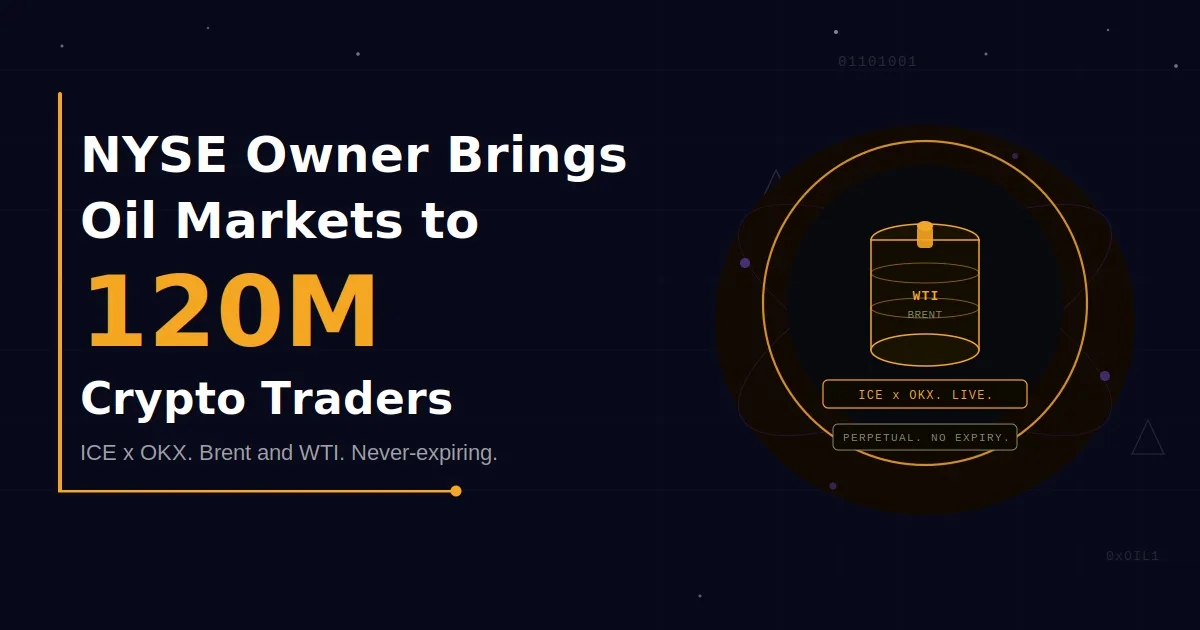
Intercontinental Exchange, the company that owns the New York Stock Exchange, announced today it is partnering with OKX to launch perpetual futures contracts on Brent crude and West Texas Intermediate oil benchmarks.
The contracts never expire, are cash-settled in crypto, and will be available to OKX's 120 million retail traders across all regions where OKX holds derivatives licences. This is not a crypto company trying to enter commodities. This is the world's most important energy benchmark provider entering crypto derivatives, and the direction of travel matters as much as the product itself.
ICE is not here by accident. Its futures prices underpin the global Brent crude benchmark that oil-producing nations, airlines, and refiners use to price contracts worth trillions of dollars annually.
The timing is specific. Hyperliquid's oil perpetual hit $1.7 billion in daily volume during the Iran war oil spike in March 2026. JPMorgan noted at the time that demand for 24/7 oil price access was driving volume away from traditional venues that close on weekends. ICE watched that accumulate on a decentralised exchange without its data or infrastructure, and responded by building the regulated, benchmark-anchored version.
These are not tokenised barrels of oil. No physical commodity changes hands. The contracts are perpetual futures that track ICE's existing Brent crude and WTI futures prices as the reference rate, the same price the physical market uses, not a crypto-native oracle.
Key mechanics:
No expiry date – no monthly roll cost, no need to close and reopen positions around settlement.
Cash-settled in crypto – accessible without a traditional brokerage relationship.
ICE benchmark reference rate – reduces the manipulation risk that has affected some on-chain commodity products.
Funding rates apply on the same 8-hour cycle as crypto perps – multi-day holds carry the same cost structure traders already know.
Hyperliquid built $1.6 billion in daily oil volume from a standing start, entirely decentralised, without traditional data. ICE watched and responded. The centralised, regulated version is now entering a market that decentralised infrastructure already proved exists.
The rest of the competitive picture moved this week too. Ostium launched equity perpetuals on Nasdaq data last week. CME goes 24/7 in seven days. Coinbase already offers WTI futures 24/7. The pattern is identical across all of them: traditional financial infrastructure entering crypto derivatives at the same time crypto platforms prove demand for traditional assets.
For traders choosing between OKX futures and Hyperliquid, the distinction is regulatory status and price quality. ICE's benchmark-anchored rate should produce tighter spreads during volatile oil sessions. How liquidation mechanics behave when oil moves 5 to 10% in a session, which is normal in energy markets, will be the real test.
The interface is identical to trading BTC perpetuals, same leverage controls, same margin modes, same liquidation structure. The underlying asset is different and its drivers are unfamiliar to most crypto-native traders.
Before sizing into crude oil perpetual futures, understand these differences from crypto:
Oil price moves are often geopolitical – the Iran conflict produced a 30% spike in a single session in March 2026.
Brent crude and WTI trade in a $2 to $5 spread from each other that widens during supply disruptions – know which benchmark you are trading.
Oil has strong seasonal and inventory cycle patterns that have no equivalent in crypto.
The 24/7 structure removes the weekend gap risk from CME – it does not remove fundamental oil volatility.
The arrival of ICE-benchmarked oil perpetuals on crypto infrastructure is genuinely new. It is also a product that combines two of the most volatile markets on earth, crude oil and crypto derivatives, in a single instrument. That combination deserves respect before it deserves a position.
Oil markets have produced 30% single-session moves in 2026. Crypto derivatives amplify those moves with leverage. A trader using 10x on a WTI futures crypto position during a geopolitical shock is not trading oil or crypto, they are trading both simultaneously, with the risk profile of each stacked on top of the other.
Size accordingly. Know your liquidation price before the position is open. Understand how funding rates compound on multi-day holds in a volatile commodity market. The infrastructure has arrived. The discipline to use it well is still entirely yours.
Share it with your community