All information on this site is provided by Mubite for educational purposes only, specifically related to financial market trading. It is not intended as an investment recommendation, business advice, investment opportunity analysis, or any form of general guidance on trading investment instruments. Trading in financial markets involves significant risk, and you should not invest more than you can afford to lose. Mubite does not offer any investment services as defined under the Capital Market Undertakings Act No. 256/2004 Coll. The content on this site is not directed toward residents in any country or jurisdiction where such information or use would violate local laws or regulations. Mubite is not a brokerage and does not accept deposits.
Mubite s.r.o., Školská 660/3, Nové Město, ICO: 23221551 Praha 1, 110 00, Czech Republic | Copyright Ⓒ 2026 Mubite. All Rights Reserved.
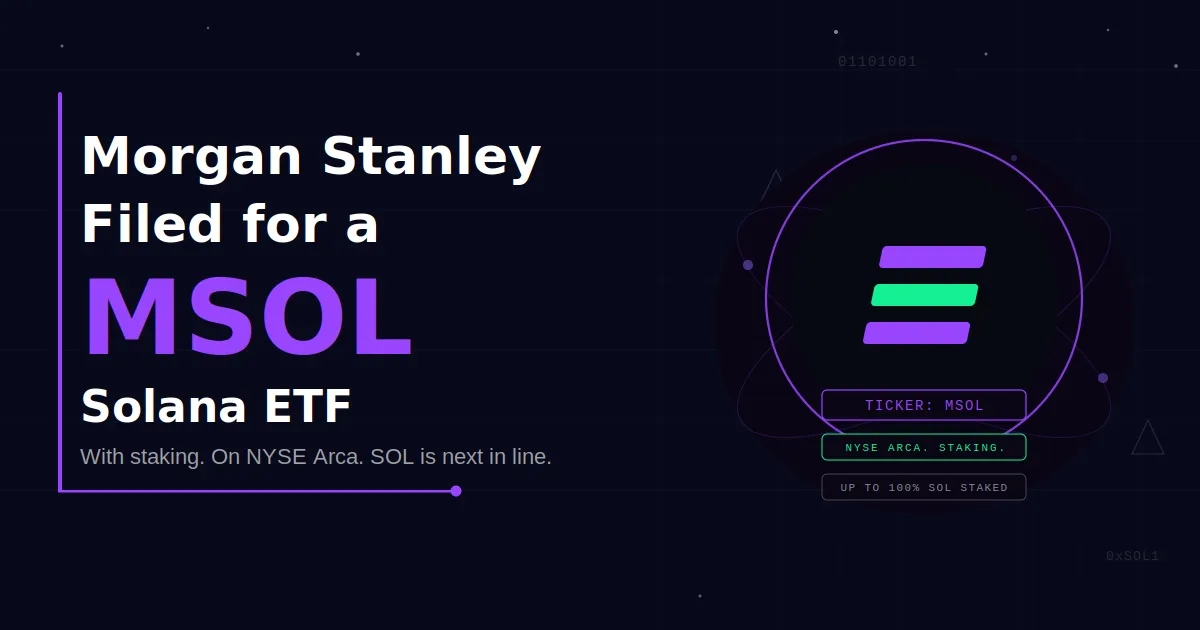
On May 20, Morgan Stanley submitted an amended registration statement for the Morgan Stanley Solana Trust, a proposed spot Solana ETF expected to trade on NYSE Arca under the ticker MSOL. The original January filing was a placeholder. This one is not. It names custodians, outlines staking mechanics, describes creation and redemption, and signals that one of the world's largest wealth managers is seriously building toward a live product. The institutional queue for Solana just moved meaningfully forward.
The amendment fills in the details January's skeleton filing left open. From the research we have analysed across the full document:
The trust holds SOL directly rather than through derivatives or synthetic exposure
BNY Mellon and Coinbase Custody are named as custodians
The fund may stake up to 100% of its SOL holdings through third-party providers
Solana staking rewards will be reflected in the fund's net asset value rather than distributed separately
Quarterly reward distributions are planned under current IRS guidance
No management fee has been set yet – Bloomberg ETF analyst James Seyffart flagged this as the filing's most notable gap
The staking component is what separates MSOL from every Bitcoin ETF currently trading. A spot Solana ETF that accrues staking rewards inside the product is a fundamentally different instrument from a passive price-tracking vehicle. It generates yield from the network itself, which changes the return profile and the competitive positioning against holding SOL directly.
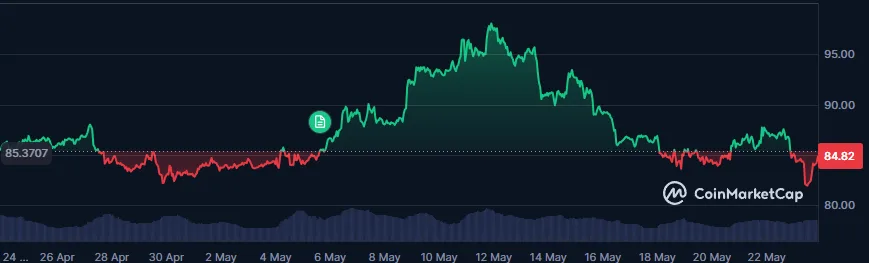
Spot Solana ETFs have already drawn more than $103 million in May inflows before MSOL is even approved. SOL price is currently trading near $84, down from its 2025 peak but well above the sub-$30 levels of the regulatory uncertainty period.

Morgan Stanley manages trillions in client assets across its wealth management arm. Approval of MSOL would open Solana exposure to retirement portfolios, corporate treasury allocations, and the 8.6 million E*Trade clients the bank is already rolling out direct crypto trading for via Zerohash. That is a different scale of potential inflow than anything currently priced into SOL.
Goldman Sachs exited its Solana and XRP ETF positions entirely this week despite rising institutional inflows. One major bank building, another exiting. Institutional consensus on SOL has not yet formed. MSOL approval would accelerate it in one direction.
This is genuinely new territory for US regulated investment products. When you hold SOL directly and stake it, you earn network rewards, currently around 6 to 7% annually, for helping validate transactions. MSOL proposes to pass those rewards through to shareholders inside the fund structure.
The product would offer:
Direct SOL exposure through a traditional brokerage account without wallets or private keys
Staking yield accruing inside the fund assessed on validator performance, uptime, and slashing history
Regulated custody via BNY Mellon and Coinbase Custody
Understanding liquidation mechanics and funding rates becomes particularly relevant here. Institutional holders earning staking yield inside an ETF structure have different holding incentives than traders accessing SOL through perpetual futures. That changes how funding rates on SOL perps behave as MSOL assets under management grow.
In the XRP article we published this week, we identified Solana as the asset most likely to follow XRP's CME trajectory, regulatory clarity arriving, institutional products following within 12 months, volume building regardless of spot price direction. The MSOL filing is the first concrete step in that sequence.
It is not approval. The SEC may request additional information or amendments. But each updated filing is generally seen as progress, and this amendment replaces placeholders with named custodians and detailed staking mechanics. That is substantive, not procedural.
The MSOL filing is a bullish structural development. It is not a trade signal. The distance between a filing and a live ETF with real inflows is measured in months and regulatory decisions.
SOL price went from $30 to $295 and back to $84 in under 18 months. Anyone accessing Solana through perpetual futures needs to understand how liquidation risk scales on an asset with this volatility profile. The institutional adoption narrative is a tailwind. It is not a floor. Position size should reflect the instrument you are using, not just the strength of the thesis.
Share it with your community