All information on this site is provided by Mubite for educational purposes only, specifically related to financial market trading. It is not intended as an investment recommendation, business advice, investment opportunity analysis, or any form of general guidance on trading investment instruments. Trading in financial markets involves significant risk, and you should not invest more than you can afford to lose. Mubite does not offer any investment services as defined under the Capital Market Undertakings Act No. 256/2004 Coll. The content on this site is not directed toward residents in any country or jurisdiction where such information or use would violate local laws or regulations. Mubite is not a brokerage and does not accept deposits.
Mubite s.r.o., Školská 660/3, Nové Město, ICO: 23221551 Praha 1, 110 00, Czech Republic | Copyright Ⓒ 2026 Mubite. All Rights Reserved.
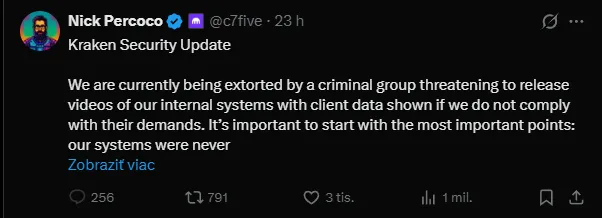
Kraken says it is being extorted by a criminal group after two insider-related incidents exposed limited user data tied to about 2,000 accounts. The exchange stressed that no client funds were at risk, its core systems were not breached, and it will not pay or negotiate. Chief Security Officer Nick Percoco said the company is already working with federal law enforcement across multiple jurisdictions.
That distinction matters. Kraken’s message is that this was not a classic exchange hack hitting wallets or trading infrastructure. Instead, the case involved improper access by support staff, which later turned into an extortion attempt once criminals obtained internal videos and limited client data.
For users, that does not make the situation harmless. Personal data exposure can still create phishing, impersonation, and social-engineering risks even when funds stay safe. That is one reason crypto exchange security is not only about storage and wallets, but also about how firms handle people, permissions, and internal controls.

Reports around the case say the affected information included support-system data rather than direct wallet credentials or trading access. Coverage tied to the incident says the exposed material involved customer details visible through internal tools, while Kraken maintained that the access was limited and read-only.
The key facts so far are straightforward:
around 2,000 accounts were affected
Kraken says no client funds were at risk
the exchange says there was no breach of core systems
Nick Percoco said Kraken will not pay the criminals
the company is working with federal law enforcement in multiple jurisdictions
This is also why user trust is part of the story. Even limited data exposure can become dangerous if criminals use it for targeted scams, fake support outreach, or identity-based attacks. In volatile situations like this, the wider lesson is still about risk management, especially for users who keep meaningful balances on centralized platforms.
The bigger issue is that insider risk is becoming harder to ignore across crypto. Kraken’s case follows a pattern the industry has already seen elsewhere, where criminals do not always attack code first. Sometimes they target employees, contractors, or support teams because people can be easier to exploit than infrastructure.
That makes this story bigger than one exchange. It shows how the threat model is shifting from pure “hack the system” attacks toward “access the people around the system” attacks. For traders, that is also why understanding crypto hedging and platform risk matters, because exchange-related incidents can quickly spill into broader market sentiment.
Percoco’s response was blunt: Kraken will not pay and will not negotiate. That matters because paying ransom in a case like this can encourage copycat attempts, especially when criminals believe limited user data is enough to pressure a major exchange into a settlement.
At the same time, refusing to pay does not end the risk immediately. The market will now watch whether any data is released, whether arrests follow, and whether Kraken’s internal controls are tightened further. For users, this is a reminder that exchange safety is not just about market liquidity or fees. It is also about process, controls, and the ability to contain damage when something goes wrong.
The practical takeaway is simple:
this looks like an insider data-access case, not a full exchange hack
users should stay alert for phishing or fake support messages
exchanges are now fighting people-layer attacks as much as technical ones
trust will depend on how clearly firms disclose incidents and respond to them
Kraken says its wallets, trading systems, and client funds were never at risk, and that is an important line. But the real pressure point now is trust. When insider-related access leads to stolen user data and extortion threats, the incident stops being only a technical story and becomes a credibility test for the exchange.
That is why this case matters. Kraken may have avoided a full-scale hack, but it is still dealing with the kind of security incident that can unsettle users across the industry. In crypto, protecting money is essential, but protecting trust is what keeps people on the platform.
Share it with your community