All information on this site is provided by Mubite for educational purposes only, specifically related to financial market trading. It is not intended as an investment recommendation, business advice, investment opportunity analysis, or any form of general guidance on trading investment instruments. Trading in financial markets involves significant risk, and you should not invest more than you can afford to lose. Mubite does not offer any investment services as defined under the Capital Market Undertakings Act No. 256/2004 Coll. The content on this site is not directed toward residents in any country or jurisdiction where such information or use would violate local laws or regulations. Mubite is not a brokerage and does not accept deposits.
Mubite s.r.o., Školská 660/3, Nové Město, ICO: 23221551 Praha 1, 110 00, Czech Republic | Copyright Ⓒ 2026 Mubite. All Rights Reserved.
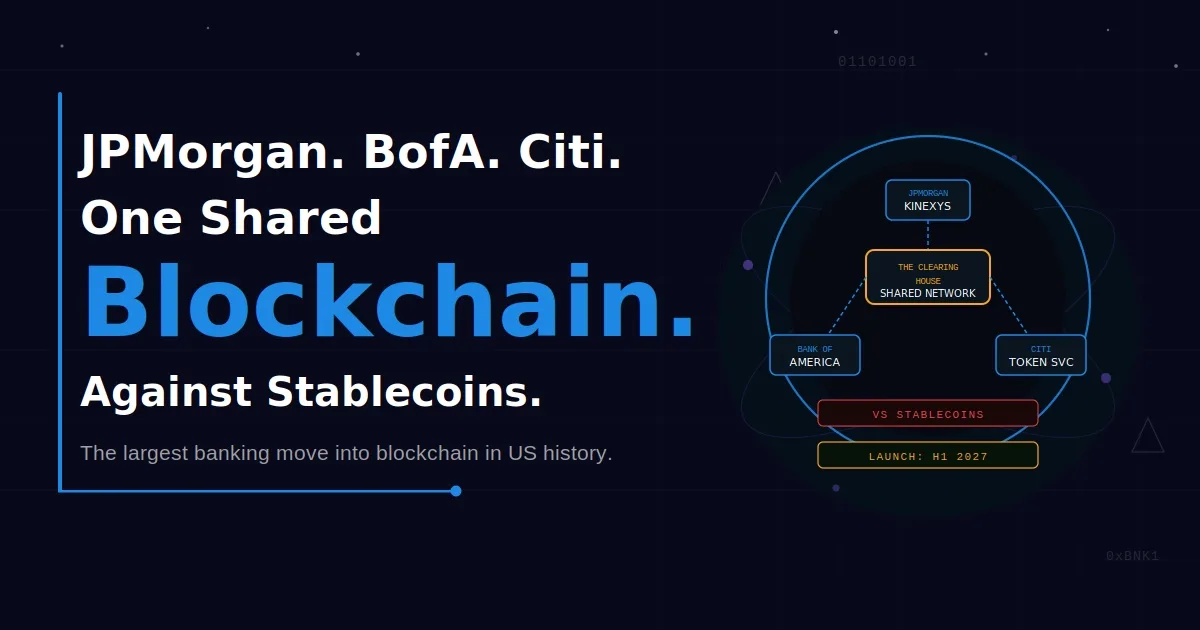
On June 5, the Wall Street Journal confirmed that JPMorgan, Citigroup, Bank of America, Wells Fargo, and other major US banks are building a shared tokenized deposit network through The Clearing House, with a launch targeted for the first half of 2027. The network will convert traditional bank deposits into blockchain tokens that move around the clock, while keeping every dollar inside the regulated banking system.
The Clearing House CEO David Watson called it "a big move for the banks" and said the industry faces "a radically different" future as money shifts on-chain. This is the largest coordinated banking move into blockchain infrastructure in US history, and it is a direct response to one specific threat: stablecoins.
The threat model is specific and worth understanding clearly. Stablecoins are dollar-pegged digital assets issued by crypto companies that live outside the traditional banking system. If customers adopt stablecoins at scale, banks could face a deposit flight to crypto wallets, and deposits are what banks rely on to extend credit in the economy.
The CLARITY Act stablecoin provisions advancing through the Senate have sharpened the urgency. If the legislation passes with yield-bearing stablecoin provisions intact, bank deposits become directly less competitive against stablecoin alternatives offering faster settlement, lower fees, and potentially interest. The tokenized deposit network is the banking industry's answer: match the speed and programmability of blockchain payments without letting deposits leave the regulated system.
Some banks are calling the network "the bridge," others call it "the chain." Both names signal the same intent, this infrastructure sits between traditional banking and the public blockchain rails that have been processing billions in stablecoin payments daily.
This is the distinction most coverage is missing. Tokenized deposits are not stablecoins. They are digital versions of regular bank deposits that stay on the bank's balance sheet and remain covered by existing rules, including FDIC insurance where applicable.
The practical differences matter:
Tokenized deposits carry the same credit risk, regulatory treatment, and accounting standards as the money in your bank account today
Stablecoins are liabilities of the issuer, not insured deposits, and exist outside the regulated banking system
The new network moves deposits on blockchain rails for speed, not to create a new digital asset class
The Clearing House expects large multinationals to embrace the network for programmable treasury options, real-time liquidity management, and cross-border payments
JPMorgan brings significant existing infrastructure to the network. Its Kinexys platform has processed institutional payments via JPM Coin since 2020. Earlier in 2026 it launched a deposit token on Coinbase's Base for institutional clients. Citi runs Token Services, enabling real-time digital transfers between New York, London, and Hong Kong. The new shared network extends that infrastructure across the entire US banking system.
From the analysis we have built since April, this announcement is the most significant single institutional development in the on-chain migration of traditional assets that we have documented.
The sequence we have covered: Ostium launched equity perpetuals on Nasdaq data. ICE brought oil perpetuals to crypto rails. Paxos received SEC approval to settle US stocks on blockchain. Mastercard widened stablecoin settlement to eight blockchains. Now the three largest US banks are building shared blockchain infrastructure to move the entire deposit base of the US banking system on-chain.
The direction has been consistent across every article. The scale of today's announcement is the step change. This is the largest coordinated banking move into blockchain technology in US history and a direct response to stablecoin issuers like Tether and Circle.
Understanding how funding rates on stablecoin-denominated perpetual markets will evolve as the boundary between bank deposits and blockchain tokens blurs is the derivatives question that flows directly from today's announcement. The bank also launched a tokenized deposit token on Base, Coinbase's public Layer 2 network, for institutional clients earlier in 2026, and approximately 90% of open order book volume on Binance's peer-to-peer platform is now stablecoin-denominated. The plumbing for a unified financial system is being assembled from both ends simultaneously.
The JPMorgan announcement is structurally significant. It is not a price catalyst for this week or this month. The network launches in mid-2027. The CLARITY Act it is partly responding to has not yet passed the full Senate. The regulatory framework that will govern tokenized deposits does not exist in final form.
Bitcoin is trading below $62,000 today. The macro environment of elevated yields, geopolitical pressure, and sustained ETF outflows has not changed because three banks announced a 2027 infrastructure project. The tokenisation wave is real and it is accelerating. The assets you are trading right now respond to today's liquidity conditions, not next year's infrastructure.
Know your liquidation price before any position. Build your view on where markets are heading over the next year. Trade the market you are in while it gets there.
Share it with your community